
From algorithms to relationships: Teaching marketing for an AI-powered future
Author: Faculty of Management
Posted on May 20, 2026
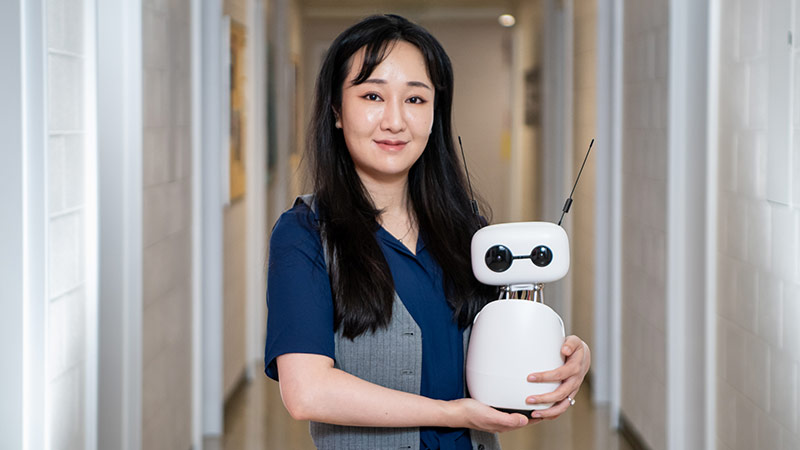
In a corner of the faculty of management, marketing students aren’t just studying consumers, they’re interacting with artificial intelligence in real time, testing how relationships between people and machines are formed.
At the centre of this work is Dr. Yunzhijun Yu, a marketing professor and founder of the Human-AI Collaboration (HAIC) Research Lab. Her research sits at the intersection of marketing, psychology, and AI, exploring a question that is becoming increasingly important: what happens when AI isn’t just a tool, but something people interact with, rely on, and even relate to?
Five years ago, AI in marketing largely operated in the background. “Think of Netflix recommendation engines, ad targeting, segmentation algorithms running quietly behind the consumer experience,” says Dr. Yu.
Today, that’s no longer the full picture.
Consumers now speak directly with AI assistants, build routines around them, and engage with them in ways that feel personal. According to Dr. Yu’s research, people don’t just use AI systems functionally, they can develop relational ties to them. That shift has major implications for marketers.
“Standard corporate practices like model updates or product changes can sometimes be perceived by consumers as disruptions to their established interactions and relationships, rather than improvements,” she explains.
This means the focus of marketing is changing. Rather than simply asking how AI can help brands reach consumers more efficiently, researchers and practitioners must now consider how AI itself becomes the primary touchpoint for brand and consumption experiences.
“That’s the kind of territory the HAIC Lab is working in,” she says.
The HAIC Lab provides a dedicated environment to explore how humans build trust with AI, collaborate through feedback loops, and adapt their behaviour over time.
One of its most eye-catching features is Reachy Mini, a small open-source robot developed by Pollen Robotics that embodies a key research theme: how physical presence changes human-AI interaction.
Reachy Mini gives us a tangible way to think about embodied AI. It’s an early step toward a broader research direction involving humanoid systems, where AI isn’t just a voice or interface, but something with a physical presence.
That physical dimension opens up new questions. Does a robot feel more trustworthy than a chatbot? Do people behave differently when AI occupies shared space? These are the kinds of questions the lab is beginning to explore.
What makes Dr. Yu’s work especially distinctive is how seamlessly it moves from lab to lecture hall.
Rather than relying on static case studies, her teaching draws directly from ongoing research. “Findings, methods, and ongoing questions show up in my marketing courses as live examples, which means students are engaging with AI-and-human-behaviour research as it’s happening rather than after it’s settled.”
In one recent course, Dr. Yu introduced a real-time AI virtual avatar built on the Tavus platform as a guest speaker. The avatar interacted directly with students, discussing AI’s role in consumer judgment and decision-making.
“This helped to give my students a direct, experiential encounter with the kind of AI interaction we study in the lab,” she says.
Experiences like this transform abstract concepts into something tangible. Students don’t just learn about AI, they engage with it, question it, and observe their own responses.
The HAIC Lab also opens doors for students to participate in research as it happens. Research assistants in the lab gain hands-on experience with a range of methods, including interviews, experimental design, large-scale text analysis, and human-AI interaction studies.
These skills are increasingly valuable in both academic and industry settings, where understanding consumer behaviour in AI-mediated environments is becoming essential.
As the lab expands into embodied AI with tools like virtual avatars, Reachy Mini, and potentially full-size humanoid robots, Dr. Yu sees even more opportunities for experiential learning.
“Embodied AI work (the kind of work that involves virtual avatars, Reachy Mini, and full-size humanoid robots in the potential future) in the lab will also create natural opportunities for demos and discussions that bring research into our students’ experience in a more exciting and experiential way.”.
At its core, the HAIC Lab is about understanding how technology is reshaping human behaviour and what that means for marketing.
As AI becomes more present, more interactive, and more human-like, the discipline itself is evolving and thanks to Dr. Yu’s work, students aren’t just observing that evolution, they’re part of it.
In the HAIC Lab, the future of marketing isn’t something to study from a distance. It’s something students can see, test, and experience for themselves.
Photo: UNB Marketing professor Dr. Yunzhijun Yu is leading research about how people interact with artificial intelligence in real time, testing how relationships between people and machines are formed.
Learn more about UNB’s faculty of management.