
Finagling the good, the bad and the courageous in academia
Author: Faculty of Management
Posted on May 19, 2026
Category: Faculty
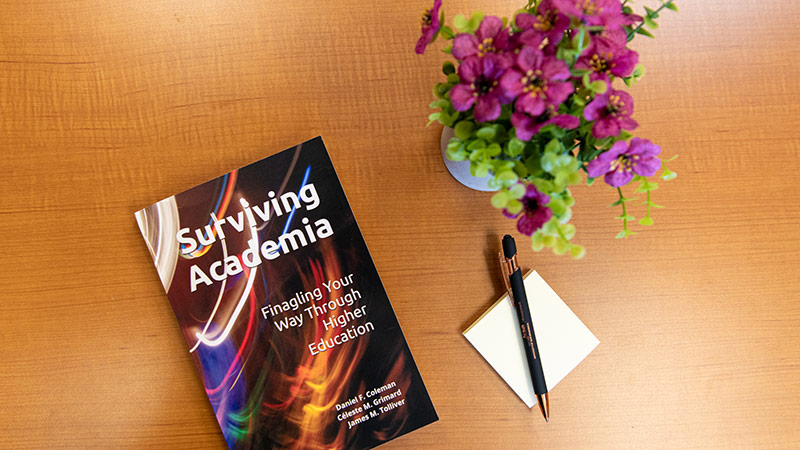
How do you not just survive academia, but actually embrace it full of its contradictions, challenges, and quiet rewards? That question sits at the heart of Surviving Academia: Finagling Your Way Through Higher Education (2025), a new book coauthored by three retired faculty members who collectively spent decades navigating university life.
The authors are Dan Coleman, former dean and longtime professor in UNB’s faculty of management; Jim Tolliver, also retired from UNB’s management faculty; and Celeste Grimard, who just retired from teaching business at Université du Québec à Montréal. Drawing on their careers, they created a collection of case studies that trace the full arc of an academic life, from early days as a PhD student to retirement.
At the centre of the book is a fictional protagonist with a telling name: Ian Finagle. Through Finagle’s experiences, readers encounter situations that will feel familiar to anyone working in higher education. The result is a narrative that feels cohesive, honest, and recognizable.
“Many business courses use the case method,” Coleman notes. “We wanted to apply that same approach to academia.” Instead of business dilemmas, the authors wrote cases about academic life itself, crafted for use in faculty development sessions and PhD student workshops. Over time, they produced more than twenty cases, most of which were presented at academic conferences. Eventually, the authors realized those cases naturally aligned to form a career-long storyline.
The book offers practical advice and cautionary tales for readers at different stages, whether they are just starting out, deciding how to balance teaching, research, and service, or trying to make sense of the subtle politics that shape academic institutions. Teaching notes accompany each case, reinforcing the book’s usefulness as a reflective and developmental tool.
The authors explain their choice of storytelling clearly in the introduction: stories, more than dry facts, help us understand how things really happen, why they turn out the way they do, and what we might expect when we step into similar roles ourselves. Through Ian Finagle’s journey, readers experience what the authors describe as “the good, the bad, and the quiet courage” that underpin academic life.
Importantly, Surviving Academia is not meant as a critique of the profession. Instead, it is an invitation to reflect, to learn from others’ experiences, and to think more intentionally about the kind of academic one wants to be: teacher, researcher, administrator, or some evolving combination of all three.
The book is available on Amazon; any profits will go to Chalice.ca, a Nova Scotia-based charity supporting Ukrainian families devastated by the war.
Media contact
Liz Lemon-Mitchell
Lizabeth.Lemonmitchell@unb.ca