Modern Methods of Construction in Canada
Author: OCRC
Posted on Apr 21, 2026
Category: Off-site Construction
Why the conversation about “building better” in Canada needs more clarity and less confusion
We keep talking about innovation in construction, but what does that actually mean? If you’ve been anywhere near the construction conversation in Canada lately, you’ve probably heard terms like:
- Modular
- Prefabrication
- Industrialized Construction
- MMC
They’re often used interchangeably, and sometimes incorrectly across the industry, which has become part of the problem when trying to innovate in this area. When an industry lacks a shared language and defined terminology, it struggles to scale change.
That’s exactly why the UNB Off-site Construction Research Centre (OCRC) developed the Canadian Modern Methods of Construction (MMC) Framework. The framework is an effort to bring clarity to a space that’s been fragmented and oftentimes, misunderstood, for too long.
What is MMC really about?
At its core, Modern Methods of Construction (MMC) is not a single technology or method. It’s a spectrum of innovative ways to build within the construction industry. According to the Canadian framework:
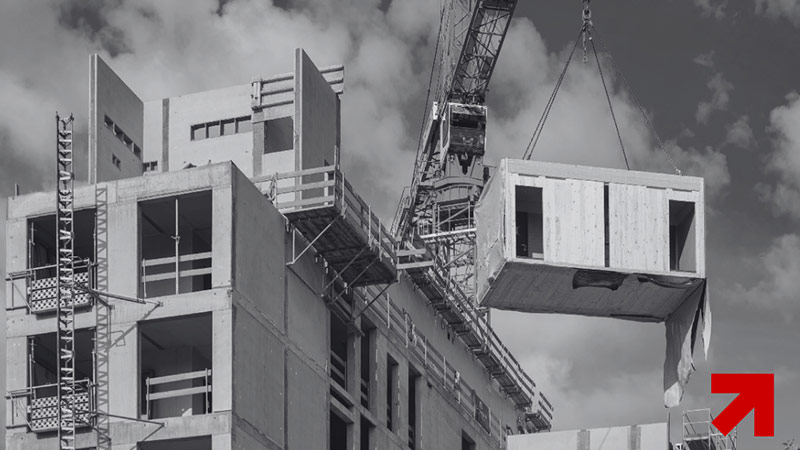
- It includes off-site construction (modular, panelized, prefab)
- It includes on-site innovation (better products, better processes)
- It includes emerging technologies like 3D printing
The goal this defined framework is simple: Improve productivity, quality, and efficiency across the entire construction lifecycle.
Why Canada needed this framework in the first place
Canada doesn’t have a shortage of innovation. But when it comes to innovative methods of construction, common barriers that were found within an national study executed by the OCRC was:
- Misaligned regulations and approval processes
- Inconsistent terminology
- Fragmented adoption
And those small issues create big consequences:
- Confusion in procurement
- Delays in approvals
- Hesitation in financing
- Difficulty scaling solutions
The reality is: You can’t scale what you can’t clearly define. By creating a shared language for the industry, and defining what innovation falls under the umbrella of Modern Methods of Construction, the standardization of terms has the potential to:
- Reduce risk for investors and insurers
- Clarify expectations in procurement and contracts
- Help policymakers design better regulations
- Enable better data collection and benchmarking
- Support workforce training and curriculum development
In short, it turns innovation from isolated efforts into a coordinated system.
Breaking it down: The 7 categories of MMC
Instead of vague definitions, the framework organizes MMC into seven clear categories:
-
- Volumetric (3D) modular construction: Entire building units manufactured in factories and assembled on-site.
- Panelized (2D) systems: Walls, floors, and roofs prefabricated and assembled on-site.
- Prefabricated components: Individual structural elements like piles, beams, or staircases.
- Non-structural assemblies: Pods, façades, MEP systems. Things that simplify installation.
- Additive manufacturing: 3D printing components or entire structures, on-site or off-site.
- Product-led site improvements: Innovative on-site material improvements such as pre-cut components, pre-made formwork, etc.
- Process-led site improvements: Digital tools, automation, robotics, and lean practices improving workflows on the project site.
Most projects today use a mix of these approaches, and this hybrid type of approach is expected to result in a real shift in productivity improvement. We’re moving away from one way of building, a hybrid, optimized system of building that leverages advanced methodologies and technologies.
Who benefits from this?
This framework isn’t just for researchers or policymakers. It impacts the entire value chain:
- Developers: clearer business cases, reduced risk
- Contractors: better planning and delivery models
- Manufacturers: stronger market alignment
- Architects & engineers: better integration with DfMA
- Governments: improved policy and regulatory clarity
- Financial institutions: clearer risk profiles
- Workforce & educators: aligned skills development
That’s what makes this different. It’s not about one group changing, it’s about everyone moving in the same direction.
The bigger picture: Why this matters now?
Canada is facing:
- A housing crisis
- Labour shortages
- Productivity stagnation
- Increasing sustainability pressures
MMC alone won’t solve all of this. But without it? We simply won’t build fast enough, or efficiently enough, to meet the expected demands. The framework is a foundational step, not the final solution. It creates the conditions for:
- Policy alignment
- Investment confidence
- Scalable innovation
This isn’t about building differently, it’s about thinking differently. The construction industry doesn’t lack ideas. It lacks:
- Alignment
- Clarity
- System-level coordination
The Canadian MMC Framework is a step toward fixing that. Not by introducing something entirely new, but by connecting what already exists into a system that can actually scale.
If there’s one thing to take away
Modern methods of construction isn’t a trend. It’s a transition, and the real opportunity isn’t just adopting new methods; it’s aligning the entire industry around them.