
UNB research centres and institutes: Leaders in innovation, partnership, and impact
Author: Jeremy Elder-Jubelin
Posted on Oct 8, 2026
Category: UNB Fredericton , Research , UNB Saint John
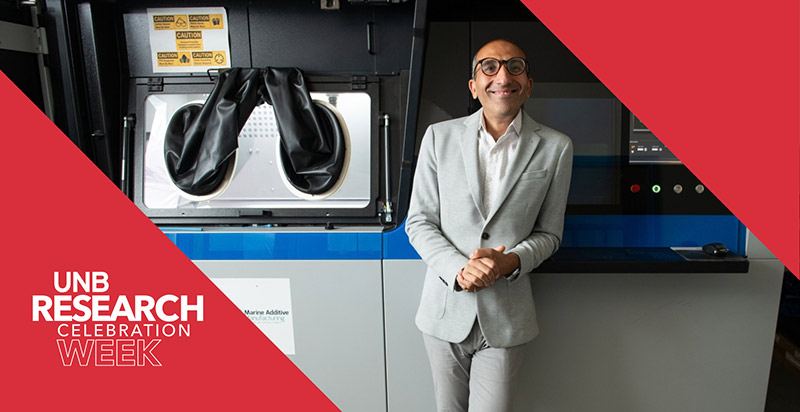
Research centres and institutes are an integral part of UNB’s research landscape. They are where groups of researchers bring their unique perspectives to a shared topic and take on some of the most pertinent questions facing our world. They also provide industry, government, and community groups with access to that breadth of expertise in a single place. As part of Research Celebration Week, we’re taking a closer look at a handful of UNB’s 21 research centres and institutes and highlighting some of their recent milestones.
As part of our annual Research Celebration Week, UNB highlighted its research centres and institutes through a tradeshow-style showcase open to industry, government partners, and the public.
“We organized this event as part of our Research Celebration Week to encourage people to meet these teams and learn about their activities — and to be inspired in seeing new opportunities for collaboration,” said Dr. Kelly Scott-Storey, Associate Vice President Research, Innovation and Partnerships.
“We chose to highlight research centres and institutes because of their focus on applied research and their engagement with organizations in our communities, because of the breadth and strength of expertise they bring to particular topics, and because of the relevance of these topics to our world.”
Shared goals in research and community
While these traits may exist within any group of collaborating researchers, proposals for new research centres or institutes need to demonstrate the importance of the topic to the province or region, the strength of research excellence within UNB, or, as is most often the case, both. They must also demonstrate an ability to form new partnerships and engage external interest-holders in their activities and operations.
This means that the research focus and activities of centres and institutes are often of interest to groups from outside the university, ranging from government departments and non-profit community organizations to companies and industry groups. This interest has led to a variety of successful, dynamic partnerships with UNB.
For some groups, like UNB’s Muriel McQueen Fergusson Centre for Family Violence Research, the primary organizational funder and partner is in the non-profit sector. In this case, that partner is the Fergusson Foundation, a charitable foundation committed to being the catalyst for the prevention and elimination of family violence. The foundation has been this centre’s primary partner since the centre was established in 1985.
For others, like the Off-Site Construction Research Centre (OCRC), an industry group was the cornerstone partner in its creation. Recognizing the importance of innovation in the construction sector for the region’s economic growth and success, OSCO Construction Group has been a leading industry supporter of the OCRC since its inception, most recently committing $2.5 million to the centre’s continued growth. In addition to sponsored research projects the centre carries out for its partners –— more than 90 to date — it also offers non-credit seminars, courses, and events to grow knowledge in the sector.
DataNB meanwhile, has built its capacity, partnerships, and reputation primarily through government departments, first with New Brunswick’s Department of Health, then expanding to include about a dozen federal and provincial departments and arm’s length agencies. For DataNB, these partnerships are fruitful not only for its continued operation, but also for expanding the breadth and quality of data available for its analytical work.
Looking outward to support more partners
Even with major partners supporting their activities, research centres and institutes generally remain open to new partnerships and projects. Some, like UNB’s Canadian Institute for Cybersecurity (CIC), deliberately build that openness into their partnership model. The CIC offers memberships to companies and other groups, and members gain access to the institute’s experts for their research questions and projects.
Working with multiple partners not only helps support the operation of these units, but also helps foster fresh perspectives and approaches.
This diversity of perspectives is also enabled by the topic-oriented nature of centres and institutes, which focus on themes more than on disciplinary specialization. This creates opportunities for researchers with different backgrounds and approaches to apply their expertise to shared research questions. For partners, it means easier access to the right knowledge, without having to navigate multiple individuals or departments.
“Our centres and institutes represent a breadth of research expertise focused on a specific topic,” said Scott-Storey. “Most often, this is also a topic of relevance and importance in our wider world, like human safety, artificial intelligence, or innovations in building construction. This makes centres and institutes ideal connection points for partners looking for applied research expertise on that topic.”
Recent achievements and impacts
What does all this look like in practice? How are UNB’s centres and institutes making an impact? Here are a few recent successes:
- At UNB’s Wood Science Technology Centre, researchers recently completed a project supported by Natural Resources Canada through its Green Construction Through Wood program. The project looked at the feasibility of repurposing decommissioned buildings to create affordable, transitional shelter villages for people experiencing homelessness and others in need. The project included the design of individual housing units and the overall shelter village layout, selection and testing of materials, design and evaluation of assembled wall sections, life cycle assessment and cost estimation of a unit, and a building-specific constructability study.
- The Gregg Centre for the Study of War and Society recently completed a project to help bring into the spotlight the often-omitted stories and experiences of Canadian Black and Indigenous soldiers during the First World War. The project not only sought to make these stories more visible, but also to provide resources for teachers and students using them in the classroom, reflecting the centre’s strength in translating between military, history, and education contexts.
- Also responding to Canada’s housing needs, researchers at our Off-site Construction Research Centre led the development process for an Atlantic Off-Site Housing Innovation Roadmap, working with more than 300 participants across the region to develop a strategy for increasing our capacity to keep up with housing demand. OCRC also contributed to a national Roadmap to Transform the Canadian Construction Industry through Industrialized Construction, Research and Innovation, developed with the National Research Council of Canada, the University of Alberta, and Cast Consultancy, which was awarded a 2025 Best in Innovation award for Academia and Research from Building Transformations.
- At the Cyber Attribution Data Centre (CADC), housed in UNB’s Canadian Institute for Cybersecurity, researchers developed a suite of cyber attribution tools to help identify the source on malicious digital attacks. These tools demonstrate how academic research and innovation can be used to develop real-world solutions that help make the digital realm safer for Canadians. The CADC recently celebrated its first anniversary.
- The Muriel McQueen Fergusson Centre for Family Violence Research launched a podcast, In Conversation, to help make the centre’s work more accessible to a broader audience.
- Researchers at the Dr. Jack McKenzie Limerick Pulp & Paper Research & Education Centre developed strong paper straps with controllable water resistance to replace single-use plastic straps for green packaging applications. The paper straps are made with wood pulp fibers, and are completely recyclable and re-pulpable, even while remaining resistant to rain and other ordinary moisture levels.
- At the Centre for Policing and Criminal Justice Research, researchers developed crisis intervention training for frontline police officers in New Brunswick to help them better respond to mental health-related calls. Their research in this area continues, evaluating officers’ baseline competencies in de-escalation and crisis intervention. Researchers will soon assess the impact of this training.
- The Marine Additive Manufacturing Centre of Excellence recently completed work with an industry partner that reduced wait times for spare part support from more than 13 months to less than one by enabling them to 3D print metal replacements onsite, rather than waiting for them to be manufactured and delivered.
Activities like these, from inventing new solutions and testing ideas and products, to supporting policy development, strengthening communities through expert knowledge, and helping industry solve complex challenges, happen every day across UNB’s nearly two dozen research centres and institutes.