Space happens here: The women helping shape the future of planetary exploration
Author: Hilary Creamer
Posted on Sep 17, 2026
Category: Space Happens Here , Research , Faculty of Science , UNB Fredericton
Two UNB researchers spotted something unusual on the surface of Mars. What they found is changing what we know about the Red Planet and helping show the next generation of women that they belong in space research.
To Dr. Lucy Thompson and Dr. Catherine O'Connell-Cooper, the bright field of Martian rocks stood out like a sore thumb.
The geologists, based at the University of New Brunswick's Planetary and Space Science Centre, were helping guide NASA's Curiosity rover through a region of Gale Crater known as Gediz Vallis when some very different looking rocks caught their attention.
"We noticed a field of really unusual looking rocks and they were very bright," Thompson said. "They really stood out."
The team decided the rocks warranted a closer look.
"We thought maybe they're pure silica, maybe they're some kind of calcium sulfate,” or something," Thompson said. "And then we analyzed them."
The results surprised everyone.
Using the Canadian-built Alpha Particle X-ray Spectrometer (APXS) aboard Curiosity, the international team determined the rocks were composed of pure elemental sulfur, something never before identified on Mars.
The discovery has attracted international attention and added an important new piece to the story of how Mars evolved.
For Thompson and O'Connell-Cooper, however, it highlights something else: women are not simply participating in space exploration. They are helping lead it.
From participants to leaders
Space exploration has long been perceived as a male-dominated field. While challenges remain, both researchers say the landscape has changed dramatically throughout their careers.
"The MSL team has a lot of women scientists in prime roles as well," said O'Connell-Cooper, referring to NASA's Mars Science Laboratory mission.
"A lot of younger women are moving into positions of real leadership, and a lot of the campaigns are actually run by women."
For O'Connell-Cooper, one of the most rewarding parts of her career has been watching early-career researchers step into leadership roles.
"It's really heartening to see the young women that we work with come in and start to move up" she said.
Thompson has witnessed the same shift.
"There are some days where the team is 60 per cent female and only 40 per cent male," she said of mission operations. "There are a lot of women and, as [O’Connell-Cooper] said, young women — even undergraduate students, are involved all the way through."
From UNB to Mars
Neither researcher planned on having a career exploring Mars.
Both arrived at UNB to pursue graduate studies under Dr. John Spray, Director of UNB's Planetary and Space Science Centre. Thompson's work focused on impact cratering, while O'Connell-Cooper studied the composition of impact melt at Quebec's Manicouagan impact structure.
Those experiences eventually connected them to NASA's Curiosity mission, where they help operate the APXS instrument, analyze data returned from Mars, collaborate with researchers around the world, and most recently, contribute to scientific discoveries that are shaping our understanding of the planet.
Their careers also challenge a common misconception that meaningful contributions to space exploration only happen at major space agencies or research centres.
The discoveries may happen on another planet, but the work behind them can happen at UNB.
Opportunity beyond Mars
For Thompson and O'Connell-Cooper, one of the most exciting aspects of planetary science is the opportunity it creates for students to contribute to real research while still completing their degrees. At UNB, those opportunities can extend far beyond the classroom and onto the international stage.
This summer, Thompson travelled to Germany with undergraduate student Julianna Piques-Viana to attend the Meteoritical Society's annual conference, where Piques-Viana presented alongside scientists from around the world.
For Thompson, watching students seize those opportunities is as rewarding as the discoveries themselves.
"When students first arrive, international conferences can seem intimidating," she said. "But giving them those opportunities is important. Julianna chose to go, she presented her work, and she did an excellent job. We were very proud of her."
“Getting to present as an undergraduate was a pretty big deal for me,” said Piques-Viana. “It’s not something a lot of undergrads get to do, so I felt really lucky. Lucy and the team have been amazing, and I’m really grateful for all the support I’ve had from everyone at PASSC.”
Piques-Viana's research examines chemical clues preserved in Martian rocks and meteorites, helping scientists better understand how water may have altered the Martian environment over time. While the work is still ongoing, Thompson says that is exactly what makes research exciting.
"I don't know if we're going to find the answers to all the questions we're asking," Thompson said. "That's research. You collect the data, look for patterns, develop ideas, and then share that information so the scientific community can build on it."
The experience also reflects how space research at UNB is helping prepare the next generation of scientists. As more women enter the field and move into leadership positions, Thompson and O'Connell-Cooper are ensuring more students have opportunities to participate, contribute and make discoveries of their own.
As Thompson sees it, the future of planetary exploration depends on creating those opportunities and encouraging young researchers to take them.
"There are a lot of young women involved all the way through," she said. "They're contributing at every stage."
This story is one of a series highlighting how the University of New Brunswick is helping advance space science and Canada's role in space exploration.
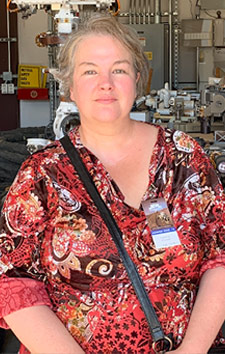
Photo: Dr. Lucy Thompson (pictured) is a researcher with UNB’s Planetary and Space Science Centre.