Lessons from the past: Preserving traditional Indigenous Knowledge through birchbark canoe building
Author: Kathleen McLaughlin
Posted on Sep 29, 2026
Category: UNB Saint John
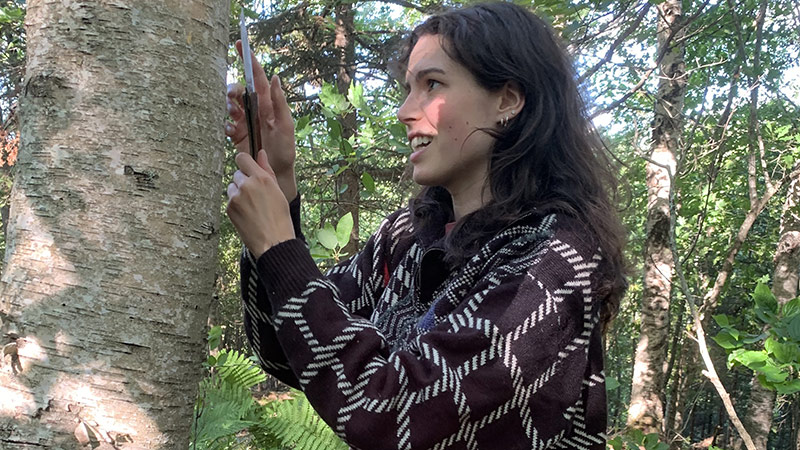
Kaitlyn Pelletier, a fourth-year biology student and Indigenous Student Representative at UNB’s Saint John campus, is taking on the ambitious project of building a traditional birchbark canoe while documenting the knowledge, skills, and connections she gains along the way.
While creating a vision board for her work-study position as an Indigenous Youth Coordinator at the University of New Brunswick, Kaitlyn Pelletier didn't know exactly what project she wanted to pursue. One image, however, kept coming back to her: a birchbark canoe. A member of Madawaska Maliseet First Nation, Pelletier soon discovered that curiosity was leading her toward a much larger journey.
Now, Pelletier is building a traditional birchbark canoe while learning from Elders, Knowledge Keepers, and experienced canoe builders from New Brunswick and Maine.
In this Q&A, she shares what inspired the project, what she's learned so far, and what she hopes its legacy will be.
Can you tell us about yourself and how you became involved in this project?
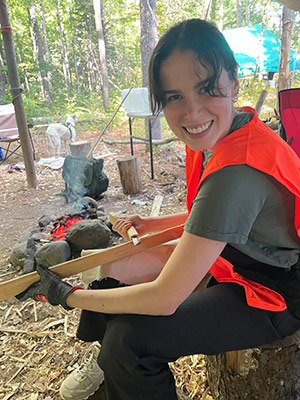
My name is Kaitlyn Pelletier, and I’m a fourth-year biology student at UNB’s Saint John campus and a member of the Madawaska Maliseet First Nation in the Edmundston region.
I became involved in this canoe-building project through UNB’s work-study program. I applied for a position as an Indigenous Youth Coordinator, thinking I would be assigned a project. Instead, I was encouraged to develop my own.
At the start of the program, two other students and I created vision boards to help shape our projects. I kept coming back to images of canoes. As I learned more, I discovered that members of my community had already built two.
After learning this, I connected with my community, including a distant family member who gave me a tour of the tools and equipment used in canoe building. Seeing those tools and hearing those stories made the project feel much more personal and gave me the encouragement I needed to take on this project.
Tell us a bit about your process and who has supported you so far.
When I first mentioned the idea of building a canoe, my Indigenous Advisor from the Office of the Piluwitahasuwin, Ande Mosher, immediately supported it and has helped guide me through every stage of the project. She has taught me so much, especially how to connect, build relationships with people, and apply for grants. I hadn't even considered the funding side of a project like this, but securing funding has been an important part of turning the idea into reality. I’ve received two major grants and the Menahqesk Wellness Circle is supporting me a lot, as well as the Blueberry Hill Nature Preserve where I first started learning how to harvest birchbark.
I have been able to speak with many Elders about my canoe project and met with many people willing to share what they know about traditional canoe building. Recently, I travelled to Barry Dana's canoe-building project in Concord, Maine, where I had the opportunity to help build parts of their canoe and learn through hands-on experience.
I've also connected with canoe builder Steve Cayard, who was incredibly enthusiastic about the project and generously shared his personal notes, recommendations, and advice. When I told Patricia Bernard, the Chief of Madawaska Maliseet First Nation, about the project, she was equally supportive, offering encouragement and connecting me with additional people and resources.
Todd Ross and the Office of Piluwitahasuwin have been instrumental in championing the project and explore opportunities to create dedicated spaces for cultural learning on campus.
What has stood out most is how willing people have been to help. They haven't just shared their knowledge; they've introduced me to others who can contribute as well. The project has become a network of relationships, teachings, and support, and it means a lot to see so many people excited about it.
What stage of the project are you at now?
This year has been focused on laying the groundwork for the project. Over the winter, I spent much of my time planning, applying for grants, and figuring out the logistics needed to bring the canoe build to life. This summer, I was finally able to begin gathering materials and putting some of those plans into action.
One of the main activities has been harvesting spruce roots and spruce gum. Spruce roots are especially important because they're used to sew the canoe together. We need quite a lot of them, and once they're harvested, they must be cleaned, prepared, and stored until they're ready to use.
I've learned that spruce roots can be harvested right up until the ground freezes, which has allowed me to continue gathering and preparing them throughout the season. While I've also collected spruce gum for pitch, community members encouraged me to focus more on harvesting roots, since spruce gum can be purchased if needed.
Throughout the summer, I've hosted weekly community harvesting sessions at Blueberry Hill as well as the UNBSJ trails, where participants learn how to gather materials responsibly, as well as the ecology, history, and traditional uses of the trees themselves. That's been one of my favourite parts of the project.
How has studying biology at UNB shaped your approach?
I've learned so many things through this project, and being a biology student has added another layer to that learning. I've enjoyed exploring how Indigenous Knowledge and Western science can complement one another, offering different perspectives on the same plants and ecosystems.
I've relied on resources like the Peterson Field Guide and knowledge shared by community members to learn about harvesting, different uses, and preparing traditional materials. At the same time, my studies, including courses in botany, help me understand what's happening within the plants themselves, from how they grow to the biological processes that make them useful for specific purposes.
Understanding both perspectives has deepened my appreciation for the knowledge embedded in these traditions and made the entire process even more meaningful.
What traditional techniques have you learned along the way?
Learning how to harvest birchbark has been one of the most challenging parts of the project. Traditionally, the bark is removed from a living standing tree in early summer when the sap is running, allowing the outer layer to separate more easily.
Finding suitable birch trees is increasingly difficult. Canoe builders look for tall, straight trees with few branches or knots, but old-growth forests are much harder to find today. Through this process, I've learned about the Seven Generations Principle, where decisions should be made based on evaluating the potential future impact. In this case, communities would identify and care for trees over time so future generations could use them for canoe building.
I've also learned that canoe-building traditions vary from region to region. Different communities adapted their canoe designs to local waterways, creating shapes and styles suited for lakes, rivers, or coastal waters. No two canoes are ever the same. They each have their own histories and stories that makes each canoe special.
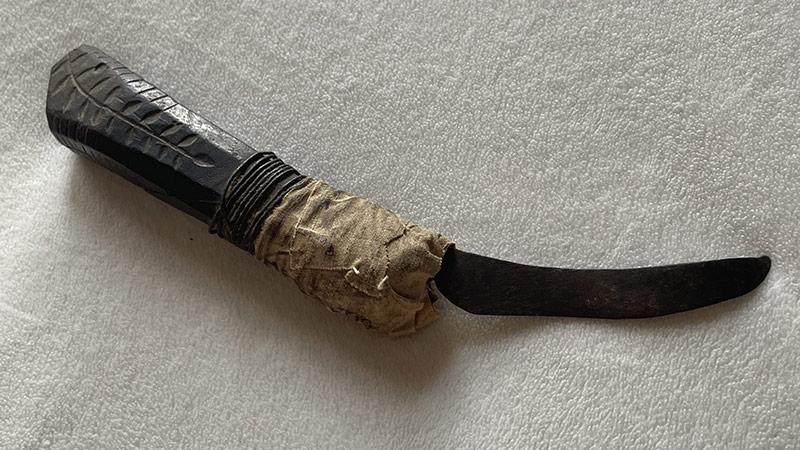
King's Landing has also supported my learning by lending me a Mocotaugan, or crooked knife, from their personal collection. I had been searching for one, as it's an essential carving tool historically used in birchbark canoe building. They have even offered to create one for me using their forge, allowing me the opportunity to learn the process of making a Mocotaugan with them!
What are the next steps for this project and what do you hope it will represent?
The goal has always been to make this a community project. While I'm coordinating it, I hope people will join in, learn alongside me, and help bring the canoe to life. I'm still learning myself, so it's very much a process of learning together.
One of the reasons this project is so meaningful to me is that there are few dedicated Indigenous gathering spaces in Saint John. I hope the canoe-building sessions can serve as a place for people to connect, share knowledge, and build community.
One of the things we're hoping to build is a longhouse. From what I've heard, the current plan is to move the sweat lodge that's already on campus, since it needs to be rebuilt every fall. The area where it currently stands would then become the site of the new longhouse, which would serve as a space for building the canoe.
I’ve also been encouraged to think about the project's long-term legacy. I've been documenting what I learn, recording contacts, teachings, and resources so the knowledge can continue to be shared after the canoe is finished. What started as a personal project has grown into a network of more than 20 people who have contributed their knowledge, guidance, and support.
Ultimately, I hope the project inspires others, especially young people, to explore traditional crafts, connect with culture, and discover their own creative interests. Knowledge can only continue if it's shared, and I hope this project encourages others to learn and carry that knowledge forward.