UNB researchers join $5M national effort to improve weather forecasting with AI
Author: Jeremy Elder-Jubelin
Posted on Sep 24, 2026
Category: UNB Fredericton , UNB Saint John , Faculty of Science , Research
A new national research project led by Concordia University is bringing together universities, government, and industry leaders to combine AI and advanced mathematics to deliver more accurate weather forecasts, including better extreme weather predictions in Atlantic Canada.
For many people, checking the weather forecast is a daily ritual: from planning what to wear, to making work or leisure plans, to figuring out when to run errands and dodge the rain.
Underlying those simple infographics and numbers, however, is a whole lot of complicated math.
That complex math is the subject of the new WxAlliance project, led by researchers at Concordia University. Those researchers are joined by colleagues at eight other universities, including at the University of New Brunswick, and at eight partner organizations across government and industry, including Environment and Climate Change Canada.
The project has been awarded $5 million in funding through the NSERC Alliance Society program, announced on Sep. 21.
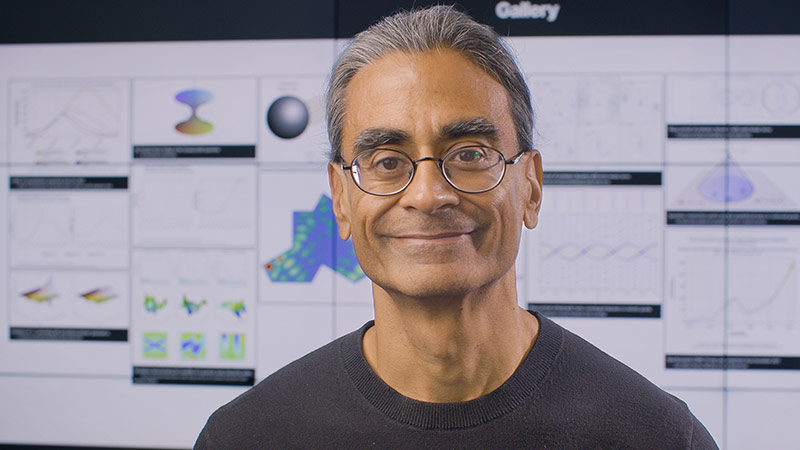
Dr. Sanjeev Seahra, Dean of the Faculty of Science and a professor of mathematics and statistics at UNB, will lead UNB’s contribution to the project.
The weather in any given area is affected by all kinds of environmental factors and features, and by what has happened in the past — how cloudy it is one day can affect the temperature at ground level, which can in turn affect the likelihood of a storm the next. Weather prediction models use information about current conditions and how they interact to estimate what conditions will be in the future.
But the further out we look into the future, the more uncertain predictions get — the models are based on approximate solutions to complicated equations, which means that smaller details or inaccuracies can get magnified over time.
To try to compensate for the mathematical complexity of current models, and to make faster, more accurate forecasts more quickly, some groups have turned to machine learning-based AI models, which take massive amounts of data to train neural network models that can be used to predict future weather.
Simple AI models, however, have their own challenges: because they are inferring patterns from raw data without an understanding of how nature works, the algorithms can predict weather that is not physically possible. Additionally, these models need a lot of localized data to predict the weather, so in places where that data is harder to come by — like Northern Canada, for example — the models aren’t very precise.
The WxAlliance project seeks to improve weather prediction by marrying mathematical models and AI prediction, using the strengths of each to compensate for the weaknesses of the other.
If they’re successful, the improved accuracy in weather forecasts will have widespread benefits: safer maritime operations for ships, better planning for major storms, and fewer disappointments opening the door on a day off, to name a few.
Their ability to accomplish this success hinges on not only engaging the right experts, but also in bringing them together in a collaborative environment that prioritizes the needs of the end users of these solutions.
To manage the work of such a large, complex project and group of partners, the project is divided into nine workstreams.
Seahra will lead one of the project components; his team’s contributions will focus on the challenge of downscaling data.
“Downscaling” is an approach where high-resolution data is inferred from low-resolution data.
Think of it like enlarging a digital photo: if you simply make it bigger, the photo will get fuzzy. Instead, when you zoom in on an image, the program uses algorithms to guess what colour a pixel should be based on a variety of factors, keeping the image sharp. How good the result looks depends on how well the algorithm can infer smaller-scale data from larger-scale data, and how well it works is the domain of computer scientists and mathematicians.
“Traditionally, to make accurate weather predictions relatively far into the future, you need to run high-resolution simulations that use up a lot of computer time,” said Seahra. “That is, there is an inherent trade-off between accuracy and resource consumption. My work tries to get around this by using AI to infer localized weather patterns from low resolution computer simulations that are much faster to run.
“This kind of small-scale modelling is crucial for predicting the effects of extreme weather events, like thunderstorms and hurricanes, in Atlantic Canada.”
Seahra’s work in this area will be supported by funding for one PhD student and one postdoctoral fellow, providing two emerging researchers the opportunity to develop their research and technology skills, and contributing to the training of the next generation of scientists.
The WxAlliance project is intended to run over five years, wrapping up in August 2031.