Agility, collaboration key drivers of UNB climate change research
Author: Alexandra Graham
Posted on Aug 12, 2026
Category: Research , Faculty of Science , UNB Fredericton , UNB Saint John
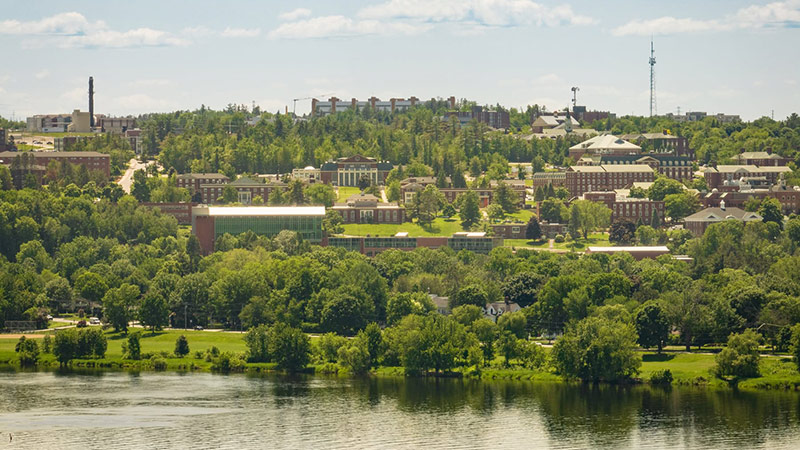
UNB's collaborative, multidisciplinary approach to climate research is driving national recognition and helping communities understand and adapt to a changing world.
Canada’s Top 50 Research Universities ranked the University of New Brunswick fourth in Canada among comprehensive universities for climate change research share and publication growth.
The ranking was based on climate change publications as a percentage of total research output and five-year publication growth from 2019 to 2023.
Climate change research is a core and growing area at UNB, and the university is uniquely positioned geographically and academically to confront its challenges. With access to the UNESCO-recognized Fundy Biosphere Region, and proximity to critically endangered Acadian forest, UNB researchers are well-positioned to see the first-hand effects of climate change.
UNB’s multidisciplinary approach to this increasingly important issue has produced world-class research in several fields. Here’s just a taste of what’s happening at UNB in climate change research.
Protecting forests from drought
Dr. Loïc D’Orangeville is no stranger to the frontlines of climate change research. In 2024 the adjunct professor (with Laval University) of forestry and environmental management, along with UNB colleagues Anthony Taylor and then-master’s student James Broom, published a study in Frontiers in Forest and Global Change entitled “Investigating climate anomalies associated with the sudden mortality of balsam fir trees in Eastern Canada.”
“We saw a climate change mortality event, which is quite rare,” D’Orangeville said of the 2018 drought that led to the death of balsam fir trees from Wisconsin to New Brunswick.
“It was the first event in recent years that we could really pinpoint to climate change.”
The D’Orangeville Lab team is using several unique technologies to determine how trees adapt to warming temperatures and drier conditions, employing everything from gathering data to input into computer modelling software, to creating vegetation indices of the Acadian forest that covers New Brunswick and Nova Scotia.
D’Orangeville is thrilled with what he’s been able to achieve so far in his climate change-related forestry research.
“The relatively small size of UNB compared to bigger research universities makes it more agile, and better able to provide support for research,” he said.
Managing bird populations
With easy access to the unique environment of the Bay of Fundy and the surrounding Atlantic waters, biological science chair Dr. Heather Major’s Atlantic Laboratory for Avian Research (ALAR) at UNB, investigates relationships between bird populations and environmental change.
“Recent work focused on responses of seabirds to ocean warming by my research group have found that Atlantic puffins and razorbills respond differently,” Major said, citing her paper The Incredible Shrinking Puffin which looks at the birds on Machias Seal Island in the rapidly warming Gulf of Maine.
Major said that long-term datasets UNB researchers have created and maintained, uniquely position UNB to address questions related to climate change.
“Body and bill size of puffins are changing in response to warming, and although populations are generally stable or increasing, important metrics such as adult survival are decreasing, which suggests that population declines could start.”
In the paper, Major and the other researchers also note that changing climate has had an impact on the quality of food the baby puffins have to eat, and that could also be impacting their size and shape.
“The impact of nutritional stress on Atlantic puffin chicks on Machias Seal Island may help the population adapt to rapid warming in the Gulf of Maine. However, future work is required to assess the mechanistic processes responsible.”
Educating all about climate change
Dr. Dion Durnford is the chair of biology at UNB, and teaches “The Science of Climate Change," a course he designed to introduce students from all disciplines to climate change science.
“I wanted to start a conversation about climate change from different perspectives,” Durnford said.
The course leverages the expertise of over 10 instructors from five departments: biology, chemistry, physics, math and earth sciences.
This year Durnford joined his colleague political science professor Dr. Don Wright, the acting chair of historical studies who teaches The Politics of Climate Change course, in hosting the UNB Undergraduate Climate Conference in Fredericton.
The conference brought students from the two courses together, where they worked in groups to create and present posters, describing in words and visuals, a climate change topic.
They even managed to nab “America Adapts the Climate Change Podcast” host Dan Parsons to visit and deliver the keynote address to the students, as well as record a podcast episode on the conference from UNB Fredericton.
“Not everyone understands the science of climate change and not everyone has thought about the politics of climate change, or the historical aspects of climate change,” Durnford said.
“The students are introduced to the complexities of a problem that they’re going to be faced with when they exit the university.”
Adapting to changing waters
Dr. Jennifer Lento, UNB research scientist and director of the Canadian Rivers Institute (CRI) has found the focus of her research is on climate change impacts in the north.
“Through my role in the Circumpolar Biodiversity Monitoring Program’s freshwater expert group, I led the first circumpolar assessment of the state of Arctic freshwater biodiversity, which was a critical step to establish baselines and help us understand what changes are expected with continuation of climate change,” she said.
Lento co-authored an astounding 11 papers in the 2022 special issue of Freshwater Biology: Ecological change in Arctic freshwaters.
“One of UNB's great strengths is in collaboration,” Lento said.
“I’ve been able to contribute to publications in Canada and internationally, bringing the important issue of climate change impacts on Arctic freshwaters to the forefront.”
Seeing beyond the horizons of climate change
Another UNB researcher who spends time in the Arctic harvesting data from the Polar Environment Atmospheric Research Lab is physics professor Dr. William Ward.
“Our atmosphere knows no boundaries,” Ward said of the observations being made at the Eureka, Nunavut facility that takes measurements from the ground up to 300 km in the air.
“We are seeing smoke overhead from remote wildfires thousands of kilometers away.”
His area of focus is instrumentation for collecting information, and data assimilation, improving how that collected data is expressed in models including those that predict weather changes resulting from climate change.
In addition to his involvement with the northern observation station, Ward has embarked on an ambitious project with HAWC — high-altitude aerosol, water vapour, and clouds — Canada’s first atmospheric satellite mission in two decades. This project will improve extreme weather prediction, climate models, and air quality forecasting.
HAWC has a 2031 projected launch date, but Ward has already published his paper “The High-Altitude Aerosols, Water Vapor, and Clouds Mission: Concept, Scientific Objectives, and Data Products”, providing a foundation for the expected abundance of research ahead.
“There are now enough of us that we are one of the causes of climate variability,” he said. “I think it’s important to have a sense of what those possible changes are so we can ameliorate and accommodate them.
“We should be gardeners rather than exploiters of what we have. Understanding climate change is part of that gardening process.”