
University of New Brunswick nursing program prepares students for a palliative approach to an aging population
Author: Tim Jaques
Posted on Jun 1, 2026
Category: UNB Fredericton
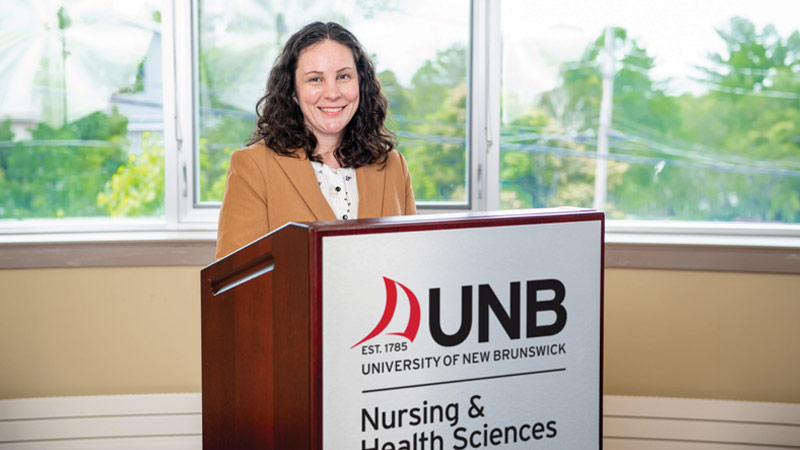
A University of New Brunswick program teaches nursing students a palliative approach that focuses on quality of life for older adults in long-term care. The approach could reshape how care is delivered across New Brunswick.
A few minutes of fresh air. A familiar voice. A cup of tea at the right time.
For many older adults living with chronic illness in New Brunswick, small moments like this can define a good day. Yet they are often the first things lost when healthcare focuses only on disease.
At the University of New Brunswick’s Fredericton campus, nursing professor Dr. Pamela Durepos is pushing for a broader palliative approach to care, one that focuses on quality of life for older adults across long-term care settings.
“We prefer to use the language, ‘a palliative approach,’ which includes palliative care interventions and strategies, but it’s also an approach where care is focused on enhancing quality of life,” Dr. Durepos said.
A broader view of a palliative approach
Dr. Durepos is an associate professor in UNB’s faculty of nursing and health sciences and the provincial lead for Strengthening a Palliative Approach in Long-Term Care (SPA-LTC). Her work focuses on older adults, especially people living with dementia, and on the places where they spend their final years.
The term “palliative” is often misunderstood, she said.
It applies long before the final months of life, sometimes as soon as someone is living with a life-limiting illness, including frailty linked to aging.
“A palliative approach to care is meant to be introduced early, or at any time throughout the illness trajectory, not just with end-of-life care,” she said.
Moving beyond end-of-life thinking
Part of the challenge is language as the “palliative” state is widely believed to imply the weeks and months leading to one’s death, which is better termed “end-of-life" or dying.
“The intention of palliative care and a palliative approach has always been on supporting quality of life throughout the illness trajectory. Understanding what quality of life means to the person and family is essential to helping them make decisions about the care they want to receive.”
New Brunswick has one of Canada’s oldest populations, and Dr. Durepos sees this approach as both dignified and practical. Many older adults live with chronic illnesses that may never be cured but often can be well managed.
“We should always be thinking about what is needed to enhance quality of life and what care aligns with a person’s wishes and values, not just how to live as long as possible,” she said.
Challenges applying a palliative approach in long-term care
Dr. Durepos’s research includes nursing homes and special care homes, which have complex needs and limited resources. Residents are more likely than the general population to live with multiple chronic conditions.
“In our research we have found only 36 per cent of staff in nursing homes and in special care homes have had training in palliative care since completing their education program, which may have been five or more years ago. As a result, many staff are hesitant to discuss a palliative approach or end-of-life with residents and families,” she said.
Families also have fears and assumptions. The word “palliative” can sound like a verdict to them.
That can shut down conversations that might ease suffering. It can also trigger unnecessary transfers to the hospital.
“Most of the care you need to manage pain and other symptoms of distress, such as social or spiritual care, can be given in nursing and special care homes,” she said.
“They can be more comfortable in their home facility than they would be in a hospital, where care is often invasive and may not align with the person’s wishes.”
Supporting a palliative approach in nursing homes
SPA-LTC offers a structured model to enhance palliative capacity within long-term care settings.
Important to this is the creation of in-house champion teams. Staff members receive added education and support from their colleagues. Another aspect focuses on education for residents and families, so expectations are clear early on.
Standardized tools help staff recognize when a resident is declining and when it is time to discuss end-of-life care openly.
“Sometimes people are sick, but they seem to bounce back,” Dr. Durepos said. “And then we don’t realize until it's too late that someone is actually now dying.”
Processes tied to the model encourage early advance care planning and family meetings when major changes occur. This ensures that when people transition to end-of-life, they receive the care they want in the location they want.
In New Brunswick, SPA-LTC operates out of UNB. Sixty-one of the province’s 75 nursing homes now take part. Provincial educators meet monthly with each home’s champion team. Site visits allow the university team to see what is working and where homes struggle.
“What we found is that homes implementing the model are having more people die within the nursing home, which is most people’s choice,” Dr. Durepos said.
How UNB nursing students learn a palliative approach
The University of New Brunswick’s nursing program integrates the palliative approach throughout its curriculum. Undergraduates encounter it in courses on older adults, communication, chronic illness and acute care.
Students also access online learning tied to SPA-LTC and work on the research team as assistants. Dr. Durepos sees this as essential preparation.
“Every area of nursing, health and social care encounters pain, suffering and grief,” she said. “Every student and graduate in these fields should be competent in a palliative approach.”
Expanding a palliative approach across New Brunswick
Dr. Durepos recently brought that perspective to a broader audience at the SPA-LTC summit held at the Wu Conference Centre on the University of New Brunswick’s Fredericton campus. The event gathered leaders from long-term care, hospitals, and the provincial health and social development departments.
Success in nursing and special care homes, she said, needs other parts of the system to change, too.
Hospital staff expressed interest in the education long-term care workers are receiving from SPA-LTC. Participants noted they already use many of the same assessment tools within extra-mural care and the Horizon Health Network. Speaking the same language across settings might smooth care transitions, reduce unwanted hospital transfers at the end of life and increase satisfaction with care.
A palliative approach should begin while people are still at home, in the clinic or awaiting placement.
Asking the questions that shape quality of life
Dr. Durepos recommends a simple shift: Instead of asking only what can be treated, ask what matters.
One question she returns to stays with families long after the conversation ends.
“What are you willing to go through to get more time?” she asks them.
Answering that is not morbid, she said. It is practical and humane.
“It’s our responsibility to do anything that we can do to ease suffering, to help smooth transitions, to focus on quality of life and what that means to the individual,” Dr. Durepos said.
“It’s also our privilege.”