A UNB start-up is proving seaweed can help gardens weather dry spells
Author: Tim Jaques
Posted on Jun 11, 2026
Category: UNB Saint John , UNB Fredericton , Faculty of Science
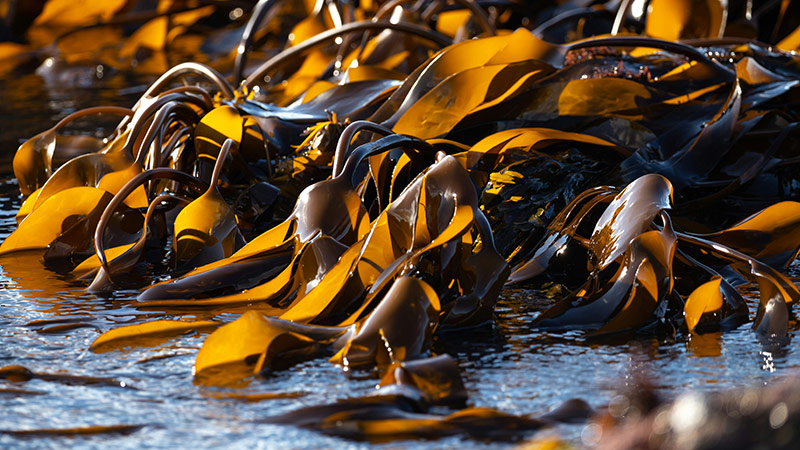
Seagreen Solutions uses seaweed to help soil retain moisture longer, reducing watering needs for home gardens and agricultural landscapes during hotter, drier summers.
Marie Dankworth was a teenager wandering the rocky coast of Brittany, France, tagging along with marine biology students during a six-month internship. They were studying seaweed along the shore.
She was fascinated
“It was like an underwater garden,” said Dankworth, who is pursuing a doctorate in biology at the University of New Brunswick, where her research is focused on Bay of Fundy seaweed, supervised by Dr. Gary Saunders.
“Since that time in Brittany, it has always been in my mind. Seaweed is so interesting. I wanted to do something with it.”
That idea was the foundation of Seagreen Solutions NB, a Fredericton-based start-up that turns seaweed into biochar, a charcoal-like soil product that improves growing conditions, holds moisture and supplies nutrients to plants.
By turning academic research into a practical product, Seagreen is testing whether coastal biomass can address two challenges: soil stress on land and excess atmospheric carbon.
From research to practical use
Dankworth studied marine biology in her native Germany before arriving at UNB to pursue her doctorate. Like most graduate students, she spent years reading academic papers that she realized few people outside her field would see.
“How many people like my parents would understand what I’m writing there?” she asked.
That question led her to an online course that encouraged researchers to seek commercial applications for their work.
Climate change was already central to her studies. Seaweed, she realized, grows quickly and absorbs carbon as it does so. The missing piece was how to lock that carbon in place.
That turned out to be biochar, which became the key to her business.
Locking carbon in soil
Heating organic material in a low-oxygen environment, a process known as pyrolysis, creates biochar. What remains is mostly carbon, along with any minerals present in the original material.
Dankworth began exploring seaweed-based biochar after realizing that growing kelp for carbon credits alone was not a viable business.
“Biochar has two benefits,” she said. “When you burn the seaweed in a low-oxygen environment, it locks in carbon for a long time. And while you do that process, you also have a product that acts as a soil amendment.”
Most biochar on the market today is made from wood. It can improve soil structure but contains few nutrients. Seaweed is different. Growing in the ocean, it absorbs minerals such as potassium, calcium and magnesium. Those nutrients remain in the biochar.
“The wood has few nutrients,” Dankworth said. “You have to put nutrients into the biochar made from it.”
Support close to home
Dankworth, the CEO, launched the company about a year ago with her partner, musician Joel Thompson (the COO).
Dankworth spent months working on the idea before the company was incorporated. Support from UNB played a major role in turning research into a start-up company.
Seagreen gained significant momentum through UNB’s J Herbert Smith Centre for Technology Management & Entrepreneurship and participated in the centre’s Summer Institute program. Seagreen was one of the six ventures in the 2025 Summer Institute cohort.
Dankworth credits Dr. Dhirendra Shukla, professor and chair of the centre, and Dr. John McLaughlin, professor emeritus of engineering and UNB president emeritus, in particular.
“I didn’t know where to start,” Dankworth said. “They guided me through it all.”
Seagreen took first prize in the growth category at the centre's RBC Pitch Competition on March 16. It had previously participated in the City of Fredericton’s 2026 Boost Ideation Camp held at Planet Hatch, where it was recognized for the best video.
In addition, Seagreen has been chosen as one of 23 start-ups to participate in the 2026 Ocean Idea Challenge. Participants will receive professional support, connect with potential partners and industry leaders and gain access to up to $8,000 in funding.
Early pilots and customers
The City of Fredericton is testing the product in its summer planters.
“The biochar holds moisture well, meaning less watering for flowerpots and green spaces,” Dankworth said.
She said pots with biochar hold about 30 per cent more moisture than those without it. That matters during hot summers, when containers can dry out fast.
The city pilot will run this season, along with other trials with organic growers and gardeners. This summer, Seagreen’s biochar will be tested in 10 of the city’s flower planters along Queen Street.
“Fredericton is Atlantic Canada’s knowledge capital, and the city is pleased to be piloting innovative technology developed locally by Seagreen Solutions, a company with roots at UNB. As the City of Fredericton continues to advance projects that support a resilient, sustainable community, we remain open to exploring new technology that will help our city thrive well into the future,” said Mike LaCroix, foreman in the parks and trees division at the City of Fredericton.
Seagreen also hopes to sell through some independent commercial garden centres in Fredericton this summer. For now, the company is focusing on business-to-business sales. Products for commercial agriculture could come later, once sufficient data is available to demonstrate consistent results at scale.
Collecting seaweed close to shore
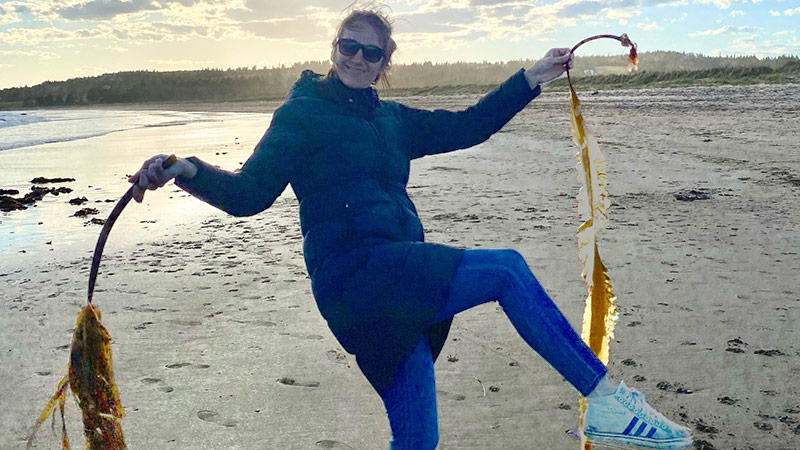
For the time being, Seagreen is sourcing seaweed from beaches rather than growing it at sea. Washed-up seaweed (known as beach wrack) usually rots there. Collecting it uses material that would otherwise decay, releasing carbon back into the air.
“This summer we really want to move fast,” Dankworth said. “So right now we’re just taking the amount we need from the beaches.”
Similar practices have existed elsewhere for decades. In Prince Edward Island, she said, a company has long used horses to rake beaches and collect seaweed for sale. However, collecting seaweed for conversion into biochar is new.
Longer term, Dankworth sees kelp farming as a path to scale. That would take time and permits, but the Bay of Fundy has areas suitable for cultivation. Kelp farming could also open doors to other products, such as additives and thickeners, food for humans and animals, and cosmetics.
“There are lots of options,” she said.
Small change, wide reach
Dankworth says biochar is not a cure-all, nor does she expect instant results. Chemical fertilizers are not going to disappear overnight.
“I’m not saying this is an all-round solution,” she said. “It’s a solution towards the bigger picture of healing the earth.”
To her, success is not measured only by revenue. If people use less water and fertilizer, and start seeing seaweed as a resource rather than debris, the effort will have been worth it.
“It would be wonderful if people say, ‘I use biochar from Seagreen, and it works great,’” she said.
“It doesn’t need to be millions of dollars in revenue. It’s what we can do for the benefit of the planet.”