Learning from porcupines: How roadkill helped this Mi’kmaw PhD student find her academic path—and what it taught her about healing trauma
Author: Jeremy Elder-Jubelin
Posted on Jun 30, 2026
Category: UNB Fredericton , Research , UNB Saint John
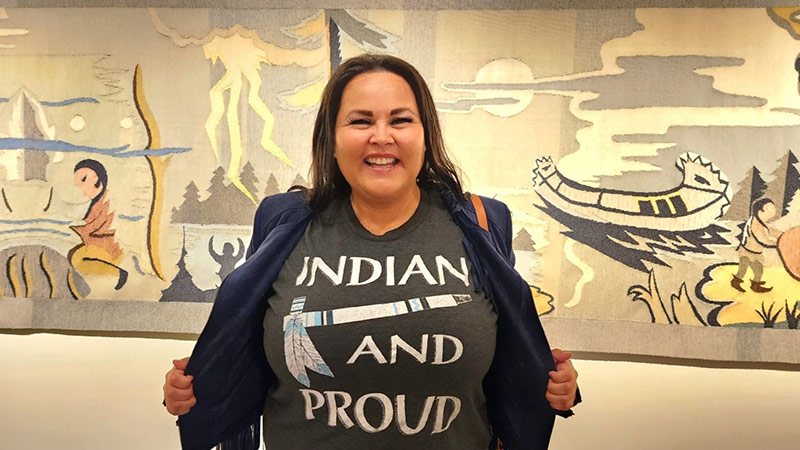
Four years ago, UNB Indigenous PhD student Starlit Simon was struggling to find belonging in academia. Feeling caught between worlds, she found her path by embracing, rather than rejecting, contradiction and dichotomy; now, she is finding personal and academic success in learning by embracing wholeness, slowness, and a connection to the land.
Below, Simon shares what harvesting porcupine quills has taught her, how her grampa’s art has helped her navigate the world, and how reclaiming tradition in the modern world can help people heal.
Almost four years ago, Mi’kmaw writer, artist, and graduate student Starlit Simon almost quit her PhD studies.
“In 2022, I hit a moment where I was feeling like, ‘I'm done. I don't want to do this,’” she said. “My background has never been strong in academic writing. I struggled because the way that I learn and the way that I understand things, it's different. I struggled with the rules of English big time—I still do.
Simon's research on educational pedagogy and epistemology explores how we know and learn about the world, and is rooted in reflections on her own experiences. Reaching a point where the personal and the academic felt like they belonged together was as much a struggle for Simon in her research as it was in her self-reflection.
“I felt like I was expected to do the work twice: once as someone guided by my feelings and through embodied, whole-self learning, and a second time as a distanced, objective intellectual.”
This concept of embodied, whole-self learning is a central one for Simon: How do we learn not just through abstract thought and mental effort, but also through how we engage all the parts of our being—body, mind, feeling—in learning from the world around us?
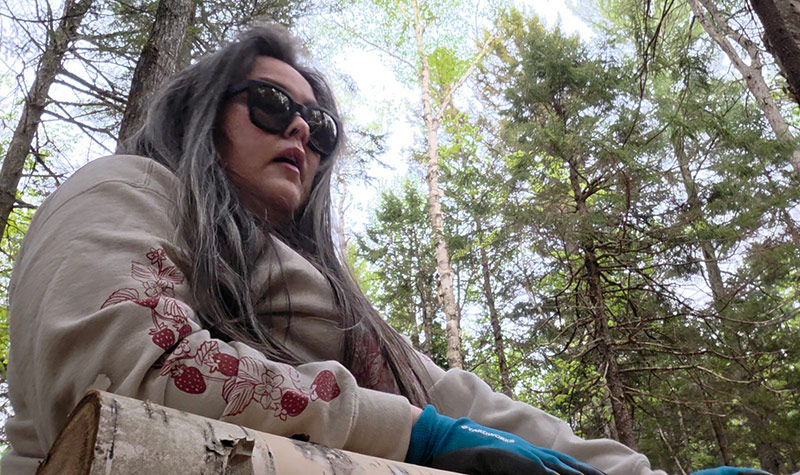
What helped Simon persevere was a combination of funding support, professors who saw her potential and encouraged her, and a story about her grampa.
Her supervisor, Dr. Casey Burkholder, then an associate professor of education at UNB, has been an unwavering supporter of Simon and her ability to accomplish her goals.
“I had applied for a SSHRC [Social Sciences and Humanities Research Council] grant, one I had been hearing that most people don’t get on their first try. Dr. Burkholder had so much confidence in me, and knew that it would relieve the financial pressure I was feeling.”
That financial support, and Dr. Burkholder’s moral support, encouraged Simon to continue her academic journey. But the real turning point came from an unexpected encounter with a piece of her grampa’s artwork.
Travelling the river in a grandfather’s canoe
Simon was hosting a series of online workshops on Indigenous art for Saint John’s Third Space Gallery.
While setting up for one of the sessions, Simon was speaking with the workshop’s presenter, birchbark artist and Knowledge Keeper Gina Brooks, about her struggles. Brooks offered her some wisdom: she reminded Simon that her journey was underway—she was already in the canoe, on the water, going down the river.
To emphasize her point, Brooks pointed her laptop toward a piece of artwork she was using in her presentation: a tapestry of a birchbark canoe—which to Simon’s shock, was one created by her great-uncle, whom she calls her grampa.
“There’ve been these really impactful moments along the way where I feel like he's been guiding me,” Simon said of her great-uncle, Mi'kmaw artist Michael William Francis, who died in 1995. Francis was a leading figure in the Micmac Indian Craftsmen collective, which was active in Elsipogtog (then called Big Cove) the 1960s.
“He’s sort of the spiritual component of my work,” she said. “He truly lived the concept of Ta’n Teloltiek-p, which is the idea of going back to how we once were.
“He was such an example of somebody who was tuned in and tapped into how we once were. He kept all the stories that his grandfather told him, these old legends he shared with all of us. He sang, told stories, and spoke Mi'kmaq regularly—I think as resistance to what residential school tried to take from him.”
Two-eyed seeing, whole-self being
When speaking with Simon, it quickly becomes evident that she herself is an integral part of her research, and that talking about her work means talking about her own story— the two are fundamentally connected.
As an Indigenous academic, Simon felt pulled between two ways of writing, of thinking, of knowing: On the one hand, one rooted in Indigenous knowledge, stories, traditions, and ways of life long predating contact and reemerging after years of suppression; on the other, educational institutions, rooted in Western traditions and perspectives, that have only recently started to open themselves to a consideration of these ideas. Simon’s work is centred around that very tension: the challenge of bridging Indigenous and non-Indigenous perspectives.
Trying to separate these dualities, though, is what almost made her leave academia.
By incorporating creative writing and storytelling, her academic writing fluidly incorporates both scholarly and Mi’kmaw language, weaving together academic theory, lived experience, personal reflections, and family stories.
Recognizing that she did not have to compartmentalize her knowledge, her learning, or her self to make a PhD work was a turning point, inspiring her confidence and in turn the purpose of her academic work.
Now, four years later, Simon’s doctoral work—a project that includes academic articles, land-based learning, reflection and storytelling, and quillwork art—is nearly complete.
She’s working to reconnect with Ta’n Teloltiek-p, the way we [her people] once were, using videoconferencing, social media and other digital tools.
How do you pronounce Ta’n Teloltiek-p? Learn from Starlit.
Embracing these “cultural collisions” (a phrase Simon adopted from Gina Brooks) in her life and her work has become one of the most significant throughlines of her PhD.
Sometimes, the metaphor is more literal: porcupines struck by cars on highways, emblematic of the collision of the natural world with contemporary ways of life.
For Simon, this is especially emblematic of her experience in reconciling two worlds—of trying to resolve the tension of being Indigenous in contemporary Canada.
Roadkill epistemology: Learning by processing
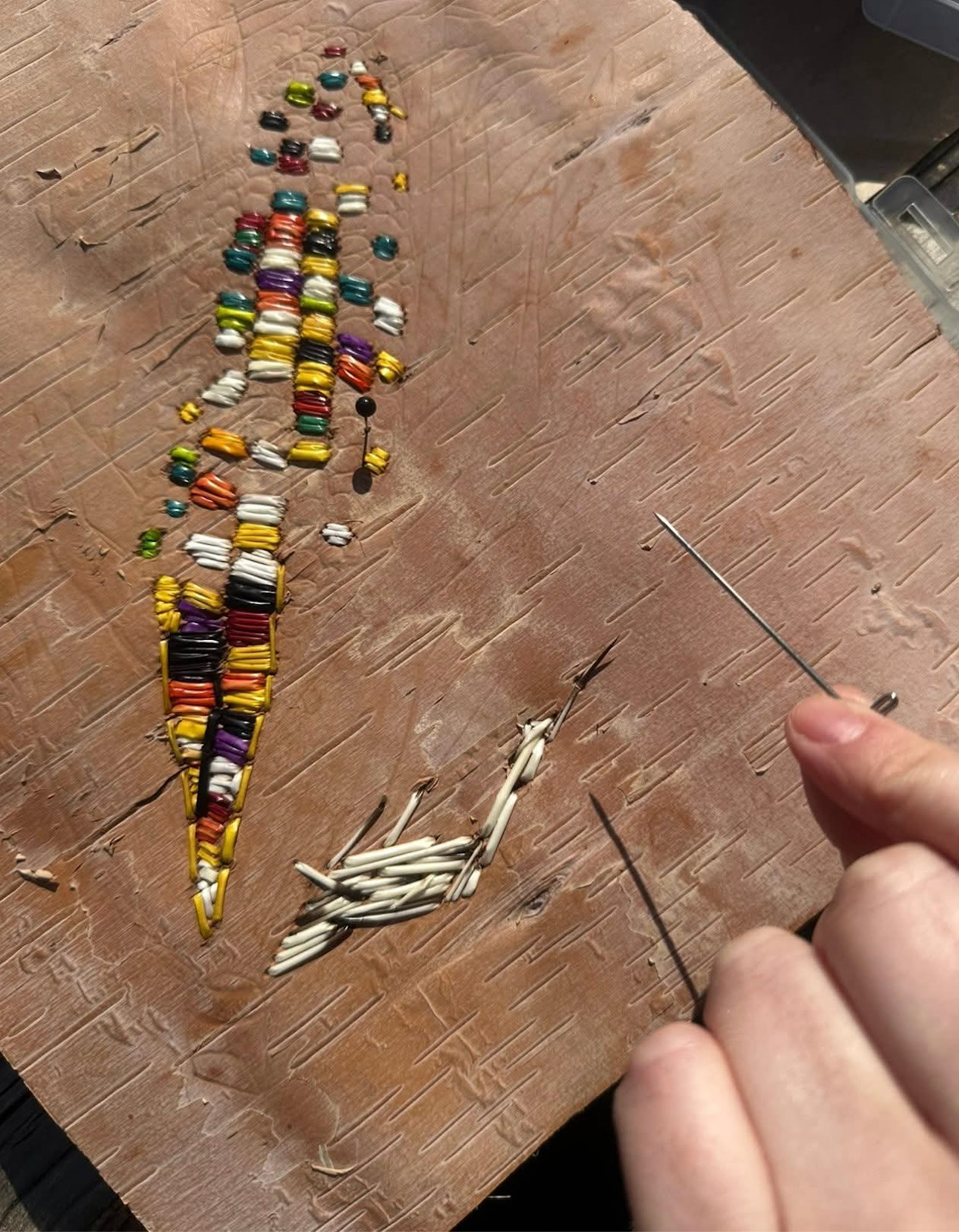
“Roadkill epistemology” is the term Simon uses to describe the learning that comes through and from harvesting quills from porcupines that have been struck by vehicles. Porcupine quills are traditionally used as an arts-and-crafts medium by Indigenous artists, including Simon herself.
The harvesting process is slow and effortful. A porcupine can have up to 30,000 quills that need to be individually—and carefully—removed by hand, a process that can easily take a full day for someone new to the process. Simon can now harvest a porcupine’s quills in two to three hours, depending on its size and the season.
“While I was harvesting the porcupines, it started to dawn on me that I'm activating every part of myself.
“I'm starting with the repetitive, physical labour of it until I'm physically exhausted. That puts me in this meditative mental state. So now I’m calm physically and mentally, and that allows my emotional self to come through in a safe way.
“In that state, I get these epiphany-like moments that I see as coming from the spiritual self. I feel connected to the land, to myself, to my history, and I’m learning what I need to learn about becoming whole.”
For Simon, this is emblematic of a full-self, embodied way of learning about the process, the self, the world, and the relationship between all three, all at once.
“My theory is that this whole-self activation is why so many people report feeling better when they’re working on the land,” says Simon. “For Indigenous people, I think it’s a way that we can heal from the historical, colonial trauma. The Eurocentric perspective breaks us down into parts, especially in institutional settings, whereas traditional Wapana'ki ways kept us fully intact through this connection to the land.”
This experience, according to Simon, has helped her value slowness—specifically, a slowness that counters the ever-increasing pace of contemporary life.
“The focus on excess growth and greed in a Western worldview keeps us moving faster and faster, and detaches us from ourselves. In slowness, I'm learning to resist what has been ingrained into me by a system that wasn't meant for me, and in fact was built with the intention of destroying who my ancestors were.
“In slowness, I’m learning to reconnect with Wapana'ki worldviews and ways of being.”
Simon has shared her process and experiences on social media, in video workshops, and in community workshops that teach Wapana’ki people about land-based art and harvesting and in forming practices of their own.
From storytelling to social sharing
This exploration of sharing through social media allows Simon to connect more people with her roadkill epistemology land-based learning.
For Simon, the digital sphere holds distinct and competing tensions.
While it can seem inauthentic, she says, she also sees it as a place for empowerment.
“By not sharing Ta’n Teloltiek-p land-based art and harvesting practices on social media, we risk losing access to people who may need or prefer to connect digitally, and we make it harder to share our knowledge with our Indigenous kin who have fewer resources.”
She also sees it as a place of resistance and reclamation—a place for sharing knowledge as story in the ways her ancestors, like Francis, did.
“The Indian Act’s damaging effects have forced Indigenous people into more than a century of being in constant survival mode,” she said. “That survival further complicates the issues of the Indian Act in how it turns people on each other, and all of this erodes further our traditional Wapana'ki ways, like storytelling.”
By critically embracing the digital world, Simon sees opportunities for a kind of storytelling and sharing at once new and rooted in tradition.
How we once were, how we are now
“Ta’n Teloltiek-p isn’t about going back to pre-contact ways of life,” said Simon. “Instead, it’s about reconnecting with a way of being that we have lost, that has been taken from us over time.
“It’s about fully embracing who we are and can be today, and finding where we can be our authentic Wapana'ki selves, with our own unique worldviews and ancestral blood memory within a contemporary world.”
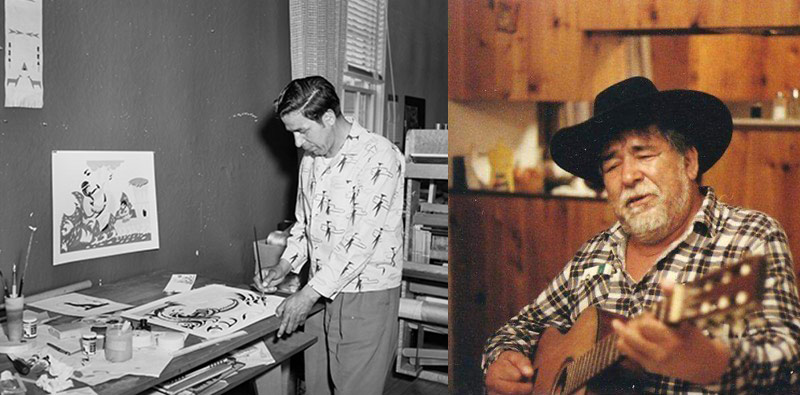
That perspective influenced the connection Simon had with Francis.
“In the 1960s, [my grampa] was creating artwork connected to our legends from way back, from stories that he heard from his grandfather, who heard it from his grandfather. But he was putting a modern twist on it. He was doing silkscreen at a time when that was modern.”
Simon’s connection to Francis and his art led her to the final part of her project: a posthumous collaboration with him rendering his art in quillwork—using the porcupine quills she has harvested.
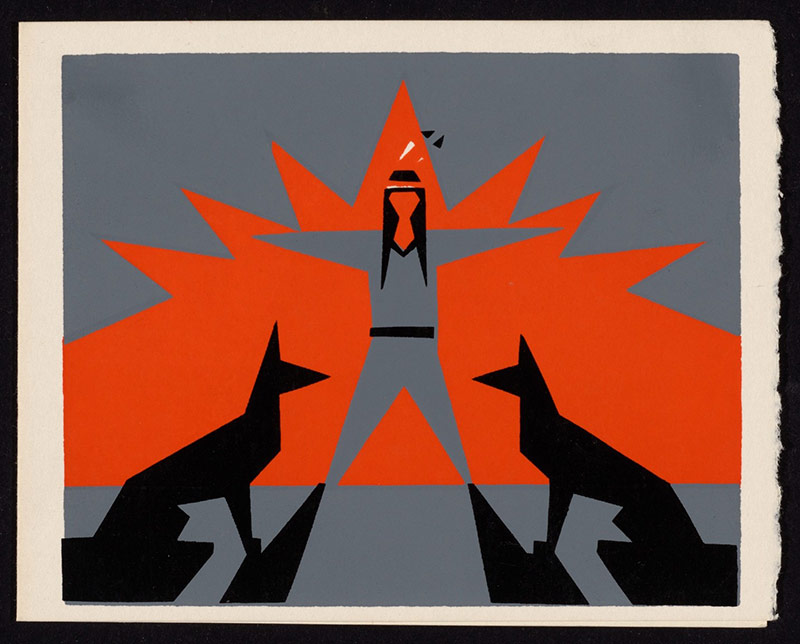
“The porcupines have been guiding me throughout this whole research process, as has my grampa. It makes the most sense to create these pieces with the quills I've harvested throughout the past four years of this journey,” she said. “It feels very full circle, it feels very whole.”
Ultimately, Simon’s goal with all of this work—quill harvesting, leading workshops, sharing videos, writing and publishing academic articles, and creating artwork steeped in meaning and relationship—is to motivate people, especially other Indigenous people, to seek their own journeys in land-based learning.
“I hope the impact of my work will be to encourage other Indigenous scholars to let the land speak to them to let the land help in shaping their research,” she said.
“More than that, I hope it encourages and piques the interest of young Indigenous people, and even the workaholic adults and anyone seeking to feel connected to themselves out there; that they're motivated to get outside and begin engaging with the land, and seeing where it leads them.”