
Think first, solve later: UNB students earn place at Oxford systems‑thinking competition
Author: Hilary Creamer
Posted on May 20, 2026
Category: UNB Fredericton
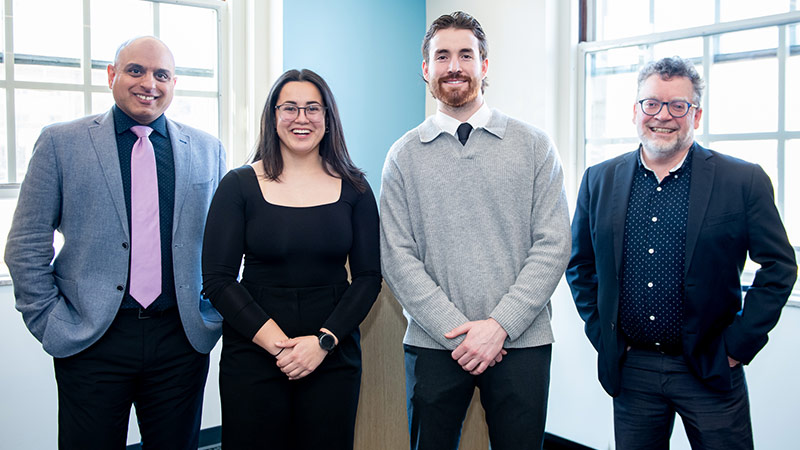
A systems‑thinking course at UNB is preparing students to tackle complex real‑world challenges through understanding them first. It’s also propelling its top team to Oxford to compete on the international stage.
An interdisciplinary systems‑thinking course developed at the University of New Brunswick is drawing attention. Not for how quickly students solve problems, but for teaching them to slow down, sit with uncertainty and understand complexity before jumping to solutions.
That approach has now earned three UNB students a place on the world stage. This year’s top team from the course has been selected to present at the 2026 Map the System competition at the University of Oxford. This international competition challenges students to analyze complex problems that span social, political, environmental, technological, and legal dimensions, all without proposing solutions.
UNB engineering professor and course designer, Dr. Kush Bubbar, has one rule for students enrolled in the course: speed is not rewarded.
In fact, he says, students lose marks for rushing to a solution.
“We live in a culture that’s constantly pushing us to solve problems immediately,” Dr. Bubbar said. “This course is about learning how to really understand them first. And that can be uncomfortable.”
The third-year course is inherently interdisciplinary and open to students from across campus, and has brought together students from engineering, computer science, business, political science, sociology, leadership studies, economics, and kinesiology. Its focus is systems-thinking, which is a way of understanding how complex challenges emerge from the interaction of social, technical, economic, political and psychological forces.
“Honestly, this is the best systems‑thinking design course I’ve seen in Canada,” said James Stauch, a leading global systems‑thinking expert. “There are very few universities doing this well. From what I’ve seen, UNB is emerging as a natural hub for this kind of learning.”
Stauch just completed a two-year term as visiting fellow at the University of Oxford’s Skoll Centre for Social Entrepreneurship, is founding director of the Institute for Community Prosperity at Mount Royal University, and is author of The 55 Minutes: An Atlas to Navigate Problems, Reveal Systems, and Ask Beautiful Questions in a Radically Shifting World. After attending the course’s end‑of‑term poster symposium, he said UNB’s approach places it in rare company.
Because systems-thinking cuts across disciplines, it can struggle to find an academic home. At UNB, Bubbar leaned into that challenge by designing a highly-structured course that asks students to get comfortable with uncertainty.
Students move through the “wicked problem” they have identified in stages: beginning with careful framing, gathering data and performing research, mapping relationships, understanding incentives and feedback loops. Only once this work has been done can teams consider the impact of potential solutions.
“We don’t really look at any solutions at all,” said Dr. Bubbar. “Instead, students consider where an intervention in a system can have impact and express why based on systems principles.”
Each team spends the entire semester grappling with a deceptively simple question: What is the problem, and do we even agree that it is a problem?
“One of the first things students tell me after taking systems‑thinking courses is that they never read the news the same way again,” Stauch said. “They hear a story and immediately ask: ‘How did this problem become the way it is? What’s underneath it? What are we missing?’”
This year’s winning team examined Canadian undergraduate education in the age of generative artificial intelligence. Rather than framing AI as a technology that academic institutions should restrict or manage, the students reframed the issue entirely.
“We realized AI isn’t really exposing a technology problem,” said Colten Kammerer, one of the team’s representatives and a graduating business student. “It’s exposing a grading problem. That institutions are using a 20th‑century evaluation systems in a 21st‑century learning environment.”
That kind of reframing is typical of the course, which blends experiential learning, reflection, theory, applied research, and systems analysis. Students work with community partners, conduct primary and secondary research, and create detailed systems maps showing how policies, behaviours, and incentives interact over time.
“The moment students stop rushing to fix something, the analysis gets deeper,” Dr. Bubbar said. “That’s when the magic happens.”
For fourth‑year computer science student Danielle Irrinki, the course challenged her academic instincts.
“In computer science, things are usually right or wrong. Either it works or it doesn’t,” Irrinki said. “This class completely changed that for me. It taught me that some problems don’t have answers, that there isn’t always a formula. And that’s actually okay.”
Irrinki’s team studied how small and medium‑sized businesses in Canada are adopting AI. While many are eager to use the technology, the team found that unclear policies, regulations, and internal knowledge gaps often prevent meaningful adoption.
“What we realized is that understanding the system matters more than jumping to solutions,” she said. “Especially with something that’s moving as fast as AI.”
At the end of each semester, student teams present their work to a judging panel that includes deans from science and arts, faculty chairs from sociology and political science, nursing leadership and senior government officials.
This year’s symposium featured four projects judged by 25 panelists. Students delivered five‑minute presentations and were evaluated on clarity, rigour and systems-awareness.
“It’s incredibly powerful to watch,” Stauch said. “Students arrive nervous, but as the day goes on, you can see them refining their story and becoming more confident in explaining the system, not just the issue.”
He also notes how the course’s interdisciplinary collaboration mirrors real‑world complexity.
“Many of the students in this course have come from completely different faculties. This is a microcosm of what you see in the real world, where stakeholders who don’t normally interact are brought together.”
For the members of this year’s winning team—Sohan Kobiri, Colton Kammerer and Aditya Raval—the opportunity to present at Oxford in July shows where this kind of training can lead.
“Systems-thinking isn’t about giving a better answer,” Stauch said. “It's about grasping a fuller picture.”
UNB's course is still relatively new, and enrolment continues to grow. About half of its alumni have returned as mentors, and universities across Canada have reached out for guidance on developing similar programs.
“If you create a space where students can thrive, they will exceed your expectations,” Dr. Bubbar said.
For Stauch, the stakes are clear.
“The world is very complex,” he said. “What [Dr. Bubbar] and UNB are doing helps students make sense of that complexity in a way that’s essential in today’s world.”