
New ResearchNB priority sector funding supports five UNB-led projects
Author: Jeremy Elder-Jubelin
Posted on May 11, 2026
Category: Research , UNB Saint John , UNB Fredericton
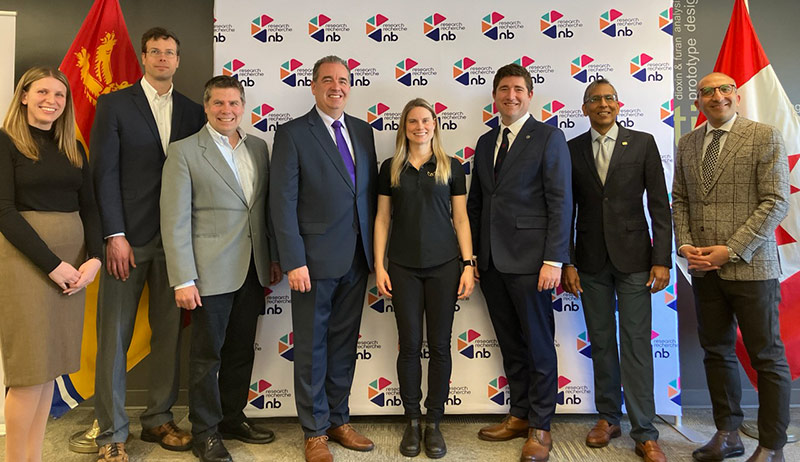
Five projects led by University of New Brunswick researchers have been awarded funding from ResearchNB’s Priority Sector Development Fund.
UNB-funded projects cover a wide range of topics: from supporting New Brunswick’s bustling seaports, to tracking the seasonal movements of predatory striped bass, to developing new ways to repair and maintain hydroelectric power turbines, to creating automated greenhouses with a delicate touch, and to increasing healthcare efficiency ethically in the age of AI.
The project funding was announced by ResearchNB on May 11, 2026.
A project supporting New Brunswick’s commercial ports has been awarded $350,000. Led by Dr. Ian Church, associate professor of geodesy and geomatics engineering, the funding will enable comprehensive understanding of a port’s environment—whether on the water, or under it.
This builds on previously announced federal and industry support for the project, which will create digital twins of the Port of Saint John and the Port of Belledune, supporting their growth, productivity, environmental sustainability and security. It will leverage UNB expertise in ocean mapping and modelling, digital twinning, ocean surface surveillance, coastal infrastructure monitoring and advanced AI and IoT infrastructure, among others. Partners include Teledyne CARIS, SeafarerAI, Spatialnetics and Kongsberg Discovery.
Moving inland, a project that will map the movement of striped bass, an aggressive predator of the juvenile Atlantic salmon—a species in rapid decline—will receive $97,645 in new funding.
The work is led by Dr. Scott Pavey, professor of biological sciences and Canada Research Chair in Aquatic Molecular Ecology and Ecological Genomics. He is also founder of CRI Genomics.
In collaboration with the Atlantic Salmon Federation, Pavey’s CRI Genomics lab is using environmental DNA techniques, which look for trace amounts of DNA shed by fish in the water being sampled, to determine the seasonal patterns of striped bass movement.
UNB’s advanced manufacturing research has long been a leader in maritime additive manufacturing; now, they are turning their attention to a different kind of marine technology. The project, led by Dr. Mohsen Mohammadi, professor of mechanical engineering, Canada Research Chair in in Marine Additive Manufacturing , and director of UNB’s Marine Additive Manufacturing Centre of Excellence (MAMCE), has been awarded $220,000 in funding to support the development of new techniques and solutions for the overhaul and maintenance of hydroelectric power generation turbines.
The project will leverage UNB expertise in areas including specialized metal alloys and 3D metal printing of parts for use in challenging operational environments, intelligent predictive maintenance, additive repair and digital twinning for Canada’s green energy sector.
As climate, population, labour, and economy-induced pressures on food supply continue to intensify, research supporting intelligent, automated greenhouse farming may prove important in helping to minimize food shortages.
Dr. Rickey Dubay, professor of mechanical engineering, is exploring the design, development and testing of a lightweight, modular, automated robot with multiple arms designed for delicate greenhouse tasks.
Many of the tasks involved in greenhouse operations are precise but repetitive; these are tasks that are well-suited to robotic automation. However, these tasks also require a delicate, but variable, grip—something humans can easily do, but which require more advanced approaches for robots.
His project has been awarded $6,750 in ResearchNB funding in addition to $47,000 in existing financial and in-kind support.
Healthcare remains one of the most essential and expensive services to deliver today. Finding ways of increasing efficiency without compromising care is challenging in these complex systems, and while data science and analytical AI models offer a way to cut through this complexity, they bring with them significant privacy risks for people’s medical information.
That challenge is one Dr. Jon Sensinger, professor of electrical and computer engineering and director of UNB’s Institute of Biomedical Engineering, hopes to resolve as part of his STREAM-Health project, which has been awarded $400,000 in funding.
Joining Dr. Sensinger in this work is Dr. Ted McDonald, director of DataNB, and Dr. Stijn De Baerdemacker, Canada Research Chair in Quantum Chemistry and associate scientific director of UNB’s Research Institute for Data Science and Artificial Intelligence.
In part, the project will explore the use of synthetic data—data that doesn’t represent any real person or people, but that is as realistic as possible—for analysis using specialized AI models known as ‘curious AI.’
Read more about ResearchNB’s Priority Sector Development Fund and all seven funded projects.
Photo credit: ResearchNB