
Transforming primary care access through Connect to Care initiative
Author: Kathleen McLaughlin
Posted on May 14, 2026
Category: Research , UNB Saint John , UNB Fredericton
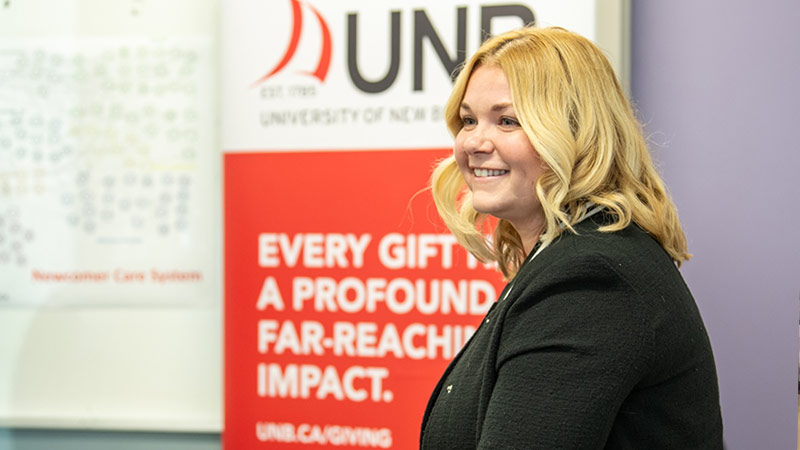
Through the Connect to Care initiative, UNB researcher Ali McGill is reimagining primary care delivery across New Brunswick to better support people experiencing homelessness.
For many, accessing healthcare means booking an appointment, arranging transportation and arriving on time. For individuals experiencing homelessness or unstable housing, these steps can become significant—and sometimes impossible—barriers.
Meeting basic survival needs, such as finding a meal, securing a safe place to sleep or seeking employment, often takes priority over scheduled appointments, even when health concerns are urgent.
During Nursing Week, the University of New Brunswick is highlighting how nursing faculty, staff and students are redesigning healthcare systems to meet people where they are and make primary care more equitable.
One example is the evolving Connect to Care initiative, a nurse-led, student-supported outreach and research project guided by Ali McGill (BN ‘02), an assistant professor in the faculty of nursing and health sciences who practices clinically as a nurse practitioner.
The initiative builds on more than a decade of outreach led by UNB nursing clinical instructors and UNB nursing students through a memorandum of understanding with Horizon Health Network and the Fredericton Downtown Community Health Centre.
Understanding the problem through research
McGill leads the Health Systems Lab at UNB, which primarily focuses on systems thinking research.
Systems thinking is an approach that views healthcare not as a collection of isolated tasks or departments, but as a complex, adaptive system made up of interrelated functions, people and environments.
Grounded in this approach, McGill’s research examines the complexity of healthcare delivery, including how care is accessed, where it is succeeding and where it falls short.
In her clinical role, McGill sees patients both in person and through referrals from outreach nurses and UNB nursing students who provide care twice a week through community partnerships, including the John Howard Society of Fredericton, for individuals experiencing homelessness.
On average, students provide care under the direction of their clinical instructors to about 10 to 12 patients during each shift.
In the field, outreach nurses can encounter situations that fall outside their scope of practice. This can include patients who require prescriptions, antibiotic treatment or more comprehensive assessments.
These patients are typically scheduled for follow-up appointments at the clinic later the same day.
McGill began noticing a pattern: even when transportation is arranged, many patients faced challenges getting to those appointments, prompting her to rethink how care could be delivered more effectively.
“We started asking ourselves how we could adapt the system instead of expecting patients to adapt to us.”
That question became the foundation for Connect to Care.
Through interviews and systems-based analysis, the initiative explores how care really happens on the ground, how different roles connect across sectors and where breakdowns occur in real-world practice.
The goal is to inform policies and practices that accurately reflect the realities of everyday care.
A new model: the mobile unit
The next phase of Connect to Care will bring these insights into action.
This June, McGill will launch a mobile unit designed to deliver care directly to individuals experiencing homelessness. Funded through support from the Joan Kingston Foundation and a federal granting agency, the van will serve as both a care delivery site and a research platform.
“Accessing and navigating the healthcare system for individuals experiencing homeless is complex, there is no single solution.” said McGill. “There isn’t one provider who can fix this alone.”
Telehealth will play a central role in this model. Using technology, outreach teams in the mobile unit will be able to connect patients with nurse practitioners, physicians or social workers during a single visit.
“Telehealth removes the need for second, third or fourth appointments and prevents patients from having to retell their story.”
Mobile outreach is also an accessible service that can potentially reduce unnecessary emergency department visits and improve access to follow up care for individuals discharged from hospital.
Decisions to use telehealth services will be made by the clinical team based on the patient’s needs, clinical complexity and safety considerations.
Research driving system change
Through interviews and systems-based analysis, workers across health, social and community sectors will be asked to describe their everyday work functions, how those functions are interconnected with others across the system, and the challenges and successes they encounter daily.
At the same time, patients with lived experience of homelessness will be consulted so that services can be designed to best fit their needs.
Their perspectives will be critical in identifying where gaps exist between how services are intended to operate and how they are actually experienced in practice.
“Housing and income insecurity, mental health, chronic disease and access to primary care are deeply interconnected,” said McGill. “A collaborative approach allows teams to understand the broader context influencing health and ensure that care plans are person-centered and achievable.”
“When we work together, and work with patients rather than around them, we make better informed decisions and our patients benefit.”