
We have contact! UNB researchers successfully track signals from NASA’s Artemis II moon mission
Author: Hilary Creamer
Posted on Apr 9, 2026
Category: Research , Space Happens Here , UNB Fredericton
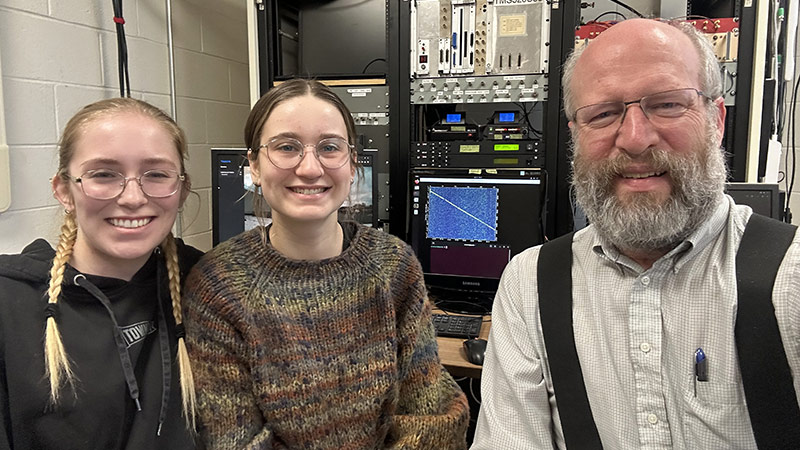
High-fives soared as researchers at the University of New Brunswick successfully picked up signals from NASA’s Integrity spacecraft on its journey around the Moon.
It’s a major milestone for UNB, the only Canadian university involved in tracking the Orion spacecraft Integrity as it orbits the moon.
Dr. Brent Petersen, a professor of communications in UNB’s department of electrical and computer engineering, along with student researcher Megan MacDonald, confirmed detection of a radio frequency transmission from Integrity during early‑morning operations at the UNB Earth Station. It was a moment that underscored years of preparation, collaboration and research.
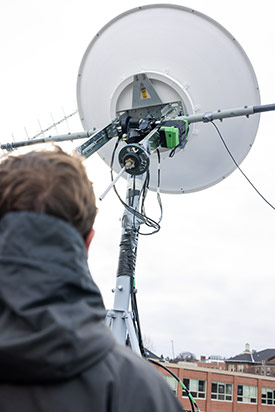
“On Saturday, April 4, at the UNB Earth Station, Megan MacDonald and I were able to detect the radio frequency transmission of Integrity at 08:12 Coordinated Universal Time,” said Peterson. “That’s 5:12 a.m. Atlantic Daylight Time. Integrity was 16.5 degrees above the horizon, and the azimuth was 186.5 degrees, which meant the antenna was looking over the Student Union Building.”
“There were high-fives in the control room,” he said.
NASA selected UNB as one of only three Canadian contributors helping to track Integrity during its approximately 10‑day mission around the moon. Of the three Canadian contributors, UNB is the only Canadian university involved.
UNB’s contribution brings together expertise from CubeSatNB, the department of electrical and computer engineering, the department of geodesy and geomatics engineering, and the UNB Earth Station. The multidisciplinary team supports hands‑on learning and advanced research in satellite communications.
As part of a global network of academic partners, commercial providers and volunteer stations, UNB is helping to passively track Integrity’s radio signals during its voyage to and from the moon, contributing real‑world data to a historic space mission.
“Aerospace engineering is alive and well at UNB,” said Dr. Richard Langley, professor of geodesy and precision navigation in the department of geodesy and geomatics engineering.
For Dr. Langley, involvement in the project feels like déjà vu in some ways. As a postdoctoral fellow at the Massachusetts Institute of Technology decades ago, he analyzed lunar laser ranging data. "In a way, I'm going back to the moon just like the Artemis program,” Dr. Langley said.
Artemis II marks NASA’s first crewed mission to the moon in more than 50 years. Four astronauts are aboard the spacecraft, which is travelling around the moon testing critical life‑support, navigation and communication systems to help pave the way for future lunar exploration.
Photo 1: Celebration at the UNB Earth Station: From left, Megan MacDonald, Olivia Gerry Rice and Brent Petersen after successfully receiving radio signals from NASA’s Artemis II mission.
Photo 2: The UNB Earth Station antenna used to track radio signals from NASA’s Artemis II mission. UNB is the only Canadian university involved in the historic moon mission.