
Engineering design symposium highlights student innovation at UNB
Author: Tim Jaques
Posted on Apr 16, 2026
Category: UNB Fredericton
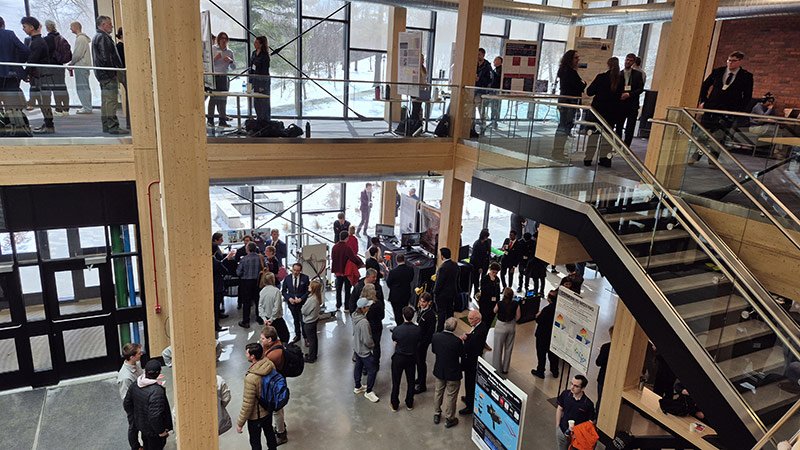
Capstone projects demonstrate how classroom theory translates into real-world engineering solutions.
The Allison D. McCain Commons on the University of New Brunswick Fredericton campus shone on April 2 as it hosted the 12th annual Engineering Design Symposium.
It was the first time the symposium had been held at the McCain Commons since the 1,500-square-foot, three-storey structure—built of mass-timber-and-glass at the entrance to the Sir Edmund Head Hall engineering building—opened in May 2025.
During their final year, engineering students work in groups to develop capstone projects under the supervision of academic advisors and industry mentors. These projects are then presented to the symposium judges. In all, 210 students presented 56 projects.
“The capstone symposium is really the culmination of our students’ degree,” said Joshua Leon, dean of the faculty of engineering.
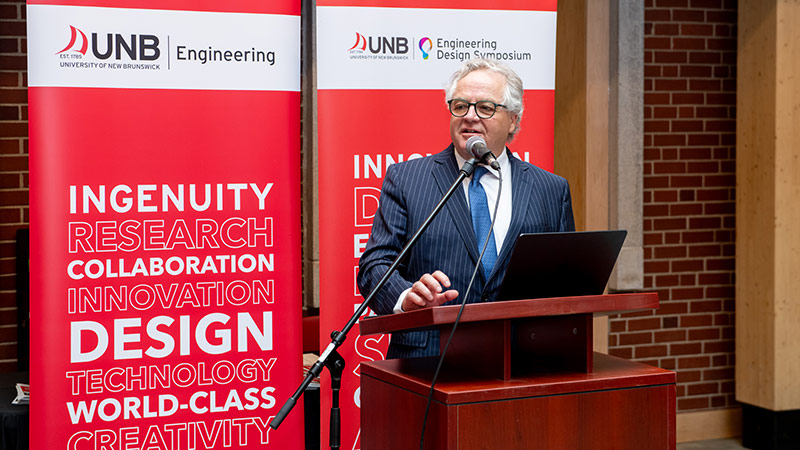
“When they come to us from high school, they have creativity and energy. Our goal is to teach them the science, math, economics, ethics, respect for society and the environment and the teamwork they need to harness their natural creativity and enthusiasm.”
Industry partnerships put learning to work
UNB values its strategic partnerships with industry, and several of the projects involved such collaborations. One project focused on improving operational efficiency at Grand Lake Timber on behalf of J.D. Irving, Limited.
Material buildup under the twin band saws was identified as an opportunity for improvement. By addressing this issue, the team reduced production interruptions and eliminated a process that had been consuming approximately 2,300 labour hours and nearly $80,000 each year.
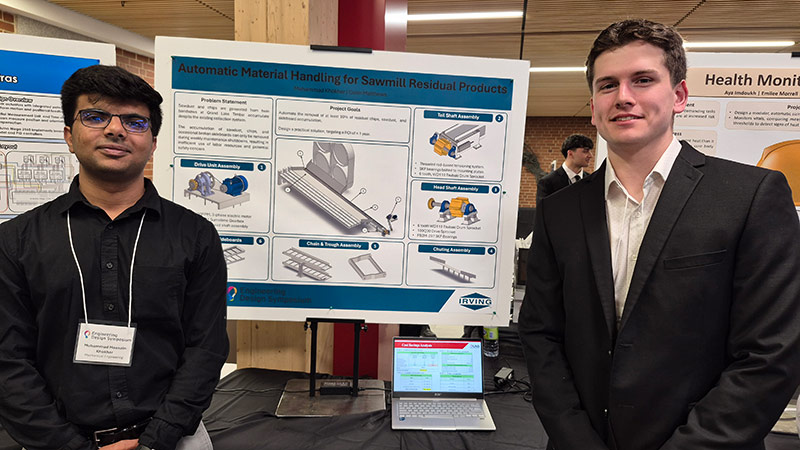
In their project, Sawmill Residual System Automatic Cleaning System , Muhammad Khokhar and Colin Matthews designed an automated drag-chain system to move most of that waste as it falls. The system fits a tight space, avoids existing log flow and needs little upkeep. Their analysis shows it would pay for itself in about nine months.
Both students said time in the mill shaped the work.
“We like getting out of the classroom and seeing some of the concepts we learn in real life,” Khokhar said. Matthews described it as “fast, but fun at the same time.”
The project involved hands-on work.
“We got dirty. We wanted to collect the data and understand what the workers were facing. So, we went and cleaned it out by hand. We understand the pain of that manual labour,” said Khokhar.
The company values its partnership with UNB, said Linda Speedy, vice-president of human resources at JDI.
“We’re proud to support students as they develop their skills, confidence and leadership potential,” she said.
“By combining strong academic foundations from UNB with hands-on experience, students are better prepared to reach their potential and make a meaningful impact in their careers.”
The value of the partnership is also evident in JDI’s mentoring of engineering students.
"Collaborating with university engineering students throughout their senior design capstone course allows JDI to support hands-on education while gaining fresh perspectives on real operational challenges,” said Ashlyn Moody, operations manager at Grand Lake Timber.
“These partnerships give us the opportunity to work closely with emerging engineers over an extended period, develop meaningful relationships and introduce them to the realities of modern sawmill operations before they begin their careers."
Electrifying possibilities
With electric vehicles the wave of the future, one group suggested a novel approach.
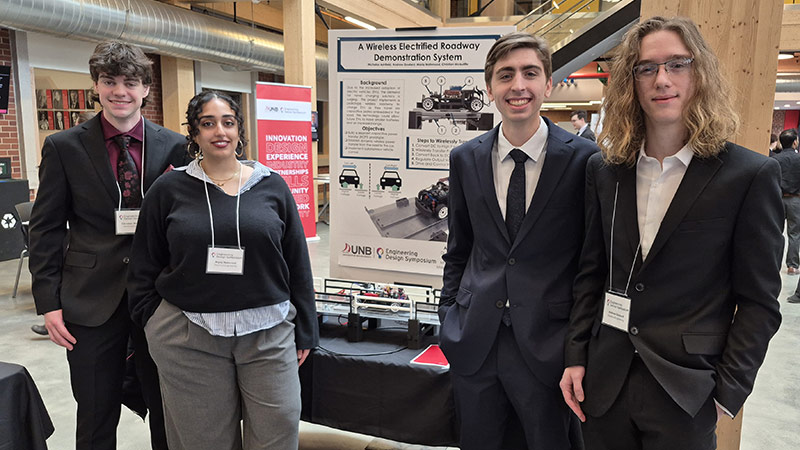
A Wireless Electrified Roadway Demonstration System, presented by Andrew Goulard, Christian McAuliffe, Maria Mahmood and Nicholas Ashfield, was a 1:18-scale model of a road that delivers power to a moving electric car.
Goulard said the team chose capacitive power transfer because it avoids costly rare-earth magnets and relies instead on metal plates and electronics installed under the road. (“Capacitive power transfer” sends electricity through the air or across a tiny gap using electric fields.) The road sends alternating current through an electric field to plates on the car, which convert it to direct current to run the motor.
“You can just use simple aluminum plates and power electronics,” said Goulard.
McAuliffe said scaling would mean sending power through asphalt, not air, and turning on the plates only when a car is present.
“The plates on the road and the car are coupled together with electric fields.”
Aqua Charge: A Trustless Energy Management System, by Mackenzie Cooper, Aiden Foster, Alex Ian Groom, Lucas Paul Savoie and Cristian Gabriel Vadureanu, lets electric ships send power back to the grid when demand is high.
Another group saw the possibility of harnessing power from electric ships while they were in port.
“These vessels have huge power banks that remain unused,” explained Savoie.
Large electric cargo ships often sit in port for days with their batteries fully charged. AquaCharge lets ship owners charge batteries when power is cheap and sell some energy back during peak hours. The ship owner controls when power is sent and makes money while the ship is docked.
Engineering for safety
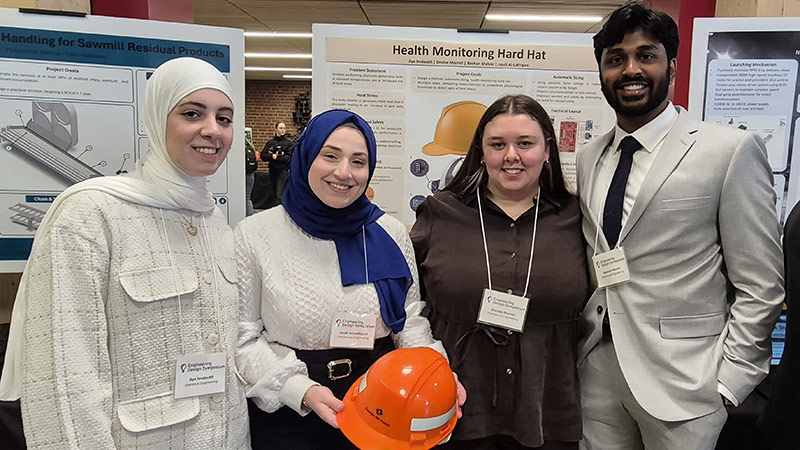
Inspired by a co‑op experience at Point Lepreau, the Hard Hat Health Monitoring System by Joudi Al-Lathqani, Roshan Melvin, Emilee Morrell and Aya Imdoukh created a health‑monitoring hard hat.
The CSA-compliant hard hat fits any worker quickly and continuously monitors heat stress using temperature and heart rate, providing real-time alerts to prevent overheating on the job.
Al‑Lathqani said their hard hat is different from those already on the market.
“There isn’t a specific one that tracks for heat stress that also includes an automatic sizing mechanism and can abide by CSA standards.”
South Riverfront Walking Trail Berm Design by Nathanial Doiron, Lucy Kidney, Charlie MacPhee and Townsend Robichaud was a plan to reduce flooding along Waterloo Row in Fredericton in the area of Morell Park and the Bill Thorpe Walking Bridge.
The design would raise the riverside walking trail to act as a berm, keeping floodwater off the road and the area neighbourhood.
“It balances flood protection with maintaining river views for residents and includes measures to prevent backflow from drains,” said Robichaud, who added that the work could be done when stormwater drains are upgraded in the area.
Smarter tech for sport and recreation
Some projects addressed challenges from sports and recreation.
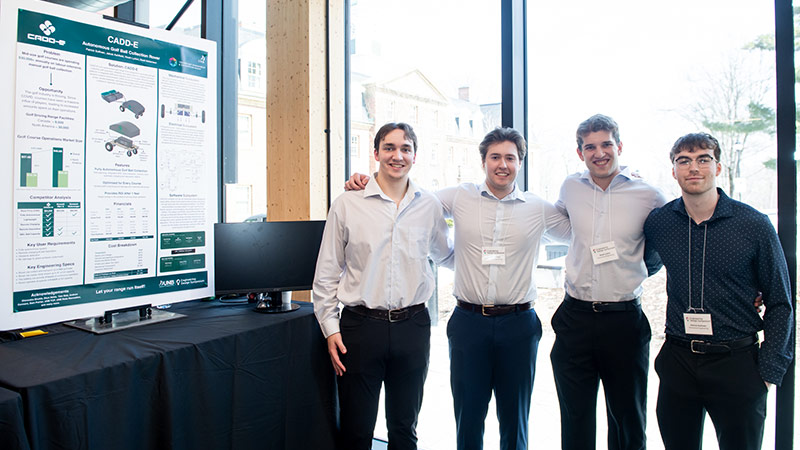
Brett Melanson, Jakob Ashfield, Patrick Sullivan and Noah Lydon developed an autonomous, battery‑powered golf ball collection rover named CADD-E to make automation affordable for small‑ and mid‑sized golf courses.
The rover independently navigates driving ranges using GPS, ultrasonic sensors and camera vision to collect golf balls while avoiding obstacles such as trees, sand traps and debris.
Inspired by their own experiences as golfers, the team identified high labour and fuel costs—and a lack of accessible automation options—as a key industry gap.
While comparable systems can cost upwards of $70,000, their rover targets a much lower price point without sacrificing performance. The rover is capable of collecting up to 600 balls and running for 10 to 15 hours on a single charge under typical conditions. The team believes their approach offers strong durability, scalability and a return on investment within a year.
Raghav Talwar, Ayush Jagtap, Anshul Rattesar and Michael Bridgland presented a smart, mobile soccer training device called PassTek, designed as a moving, data‑driven teammate.
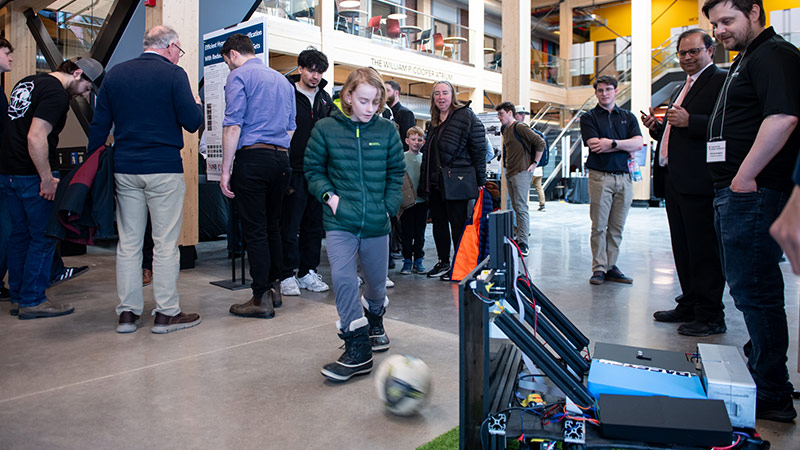
The prototype is an autonomous rebound board equipped with sensors that measure passing force, accuracy and reaction time, controlled via a mobile app. Inspired by their own experiences as soccer players, the team sought to make training more engaging and effective.
With a seven‑hour battery life and customizable drills, the group plans to refine the design, lower manufacturing costs, and pilot the system with coaches and soccer academies.
Turning ideas into practical solutions
Across the symposium, common threads were apparent: practical problem‑solving, thoughtful design and a willingness to test ideas against real constraints.
The projects demonstrated how classroom theory becomes applied knowledge, refined through teamwork, industry input and hands‑on experience. For those watching the students present, the results spoke loudly about the strength of that process.
“When I see the work here today, I feel confident saying that UNB engineering has done its job,” said Leon.
Award winners
Poster award winners
- TME: HEXORIS Engineered for Extremes (Isaac Richard, Josh Pothier, Lance Keddy, Will Wilcox) $1,000
- ME: Semi-Autonomous Platooning for Forestry Logistics (Caleb Enns, Darian Gray, Zack Duncan) $750
- ECE: High-power battery module (Benjamin Hughes, Christopher Taylor, Connor Breen, Tyler Jenkins) $350
- ME: 3D Printing Aboard a Ship (Craig Bush, Said Obaid, Vincent Poitras) $350
ENGG4000 Electrical Design winners
John F. Murphy Prize in Electrical and Computer Engineering
- CubeSat NB – VIOLET2 Satellite Comms System (Blake Dauvin, Chris Carson, Morgan Kini, Olivia Gerry Rice) $1,000
IEEE NB Section prize
- A Wireless Electrified Roadway Demonstration System (Andrew Goulard, Christian McAuliffe, Maria Mahmood, Nicholas Ashfield) $1,200
Excellence in SWE
- SmartLIMS: Integrating Deep Learning into an ISO-Compliant Laboratory Information Management System for Thermophysical Property Prediction (Dennis Cristian, Emma Mattinson, William Mazerolle, Pierre Ekotto Mebande, Mya Beth Welton) $1,000
David Macneil Prize
- EmgLab: An AI-Assisted EMG Validation Platform for Collaborative Signal Analysis (Tina Kashwani, Ahmad Adnan Khan, Leora Prakash Mascarenhas, Pratik Mishra, Daniel Oluwatoyosi Olorunfemi) $500
Process Design (Chemical Engineering) Section of ENGG4000
- 1st place: Carbon Dioxide Capture and Recycling for Trailway Brewing (Myles Barnett, Ethan Crowley, Landen MacDonald) $500
- 2nd place: Small Scale Post-Combustion Carbon Capture (Jaswin Krishnamoorthy, Meghna Mandaliya, Mahmoud Moustafa, Noelle Tapley) $300
- 3rd place: Upgrading Chlorine Dioxide Generation to Support Project NextGen at Irving Pulp & Paper (Maxime Basque, Mackenzie Keenan, Luke Myers-Leblanc, Peter Nyenhuis) $200
Geodesy & Geomatics winners
- 1st place: Process Improvement for the New Brunswick Land Registration System. (Owen Crawford, Eric Grenier, Jadon Williams) $1,000
- 2nd place: Geodetic Control Network Design for New Brunswick. (Kallum Fletcher, Bergen Fraser, Ben LeBlanc) $750
- 3rd place: Machine Learning for Hyperspectral Classification for Vegetation Monitoring. (Julien-Patrick Chavy-Waddy, Eric Douglass) $500.
ANBLS Award
- Process Improvement for the New Brunswick Land Registration System (Owen Crawford, Eric Grenier, Jadon Williams) $500
Best poster
- Geodetic Control Network Design for New Brunswick (Kallum Fletcher, Bergen Fraser, Ben LeBlanc)
Technology, Management & Entrepreneurship winners
- 1st place: Ozone Hockey (Michael Doiron, Nathaniel Dryden, Dominic Losier, Jake Profit) $2,000
- 2nd place: CADD-E (Jakob Ashfield, Noah Lydon, Brett Melanson, Patrick Sullivan) $1,000
- 3rd place: Hexoris (Lance Keddy, Joshua Pothier, Isaac Richard, William Wilcox) $500
Civil & Geological Engineering winners
Best reports
- Coastal Erosion and Seawall Rehabilitation at Miscou Island (Kate MacKenzie, Charles Toole, Maren Wheaton, Ava White)
- Low Carbon Concrete: An Evaluation of Natural Pozzolans from Southern NB as Supplementary Cementitious Materials (Jonathan Beers, Sean Beland, Callen Dockendorff)
- Route 105: Keswick River Bridge Replacement (Shawn Carrier, Cameron Harris, Rebekah Kierstead, Kyle Leblanc)
Best presentations
- Big Hole Tract Subdivision Master Plan - Road, Trail, and Park Networks and Drainage Solution (Isaac Buchanan, Chandler Campbell, Josephine Chisholm, Félix-Adam Fournier, Olivia Gourley, Waylon Matchett)
- South Riverfront Walking Trail Berm Design (Nathanial Doiron, Lucy Kidney, Charlie MacPhee, Townsend Robichaud)
- Route 105: Keswick River Bridge Replacement (Shawn Carrier, Cameron Harris, Rebekah Kierstead, Kyle Leblanc)
Best posters
- Coastal Erosion and Seawall Rehabilitation at Miscou Island (Kate MacKenzie, Charles Toole, Maren Wheaton, Ava White)
- Improving Concrete for the Future: Exploration and Mine Design for Pozzolanic Rocks in Southern NB (Sidney Easthouse, Shannon Hegger, Adam Helmke, Vele Rafa Nonan, Kayla Winters)
- Pabineau Band Office Design (Caleb Curwin, Daniel Kamala, Finlay Kearney-Staunton)
Photo 1: The 12th annual Engineering Design Symposium was held April 2 at the Allison D. McCain Commons at the Sir Edmund Head Hall engineering building.
Photo 2: Joshua Leon, dean of the faculty of engineering, called the Engineering Design Symposium “the culmination of our students’ degree.”
Photo 3: Muhammad Khokhar and Colin Matthews created Sawmill Residual System Automatic Cleaning System, which automated a maintenance issue at a J. D. Irving, Limited sawmill.
Photo 4: A Wireless Electrified Roadway Demonstration System, presented by (from left) Christian McAuliffe, Maria Mahmood, Nicholas Ashfield and Andrew Goulard was a 1:18-scale model of a road that delivers power to a moving electric car.
Photo 5: Inspired by a co‑op experience at Point Lepreau, the Hard Hat Health Monitoring System by (from left) Aya Imdoukh, Joudi Al-Lathqani, Emilee Morrell and Roshan Melvin created a health‑monitoring hard hat.
Photo 6: From left, Jakob Ashfield, Brett Melanson, Noah Lydon and Patrick Sullivan developed an autonomous, battery‑powered golf ball collection rover named CADD-E to make automation affordable for small‑ and mid‑sized golf courses.
Photo 7: A young soccer fan tests PassTek, a smart, mobile soccer training device designed as a moving, data‑driven teammate by Raghav Talwar, Ayush Jagtap, Anshul Rattesar and Michael Bridgland.