The poetry of physics: UNB graduate student wins national quantum arts prize
Author: Kayla Cormier
Posted on Apr 14, 2026
Category: UNB Fredericton , Faculty of Science
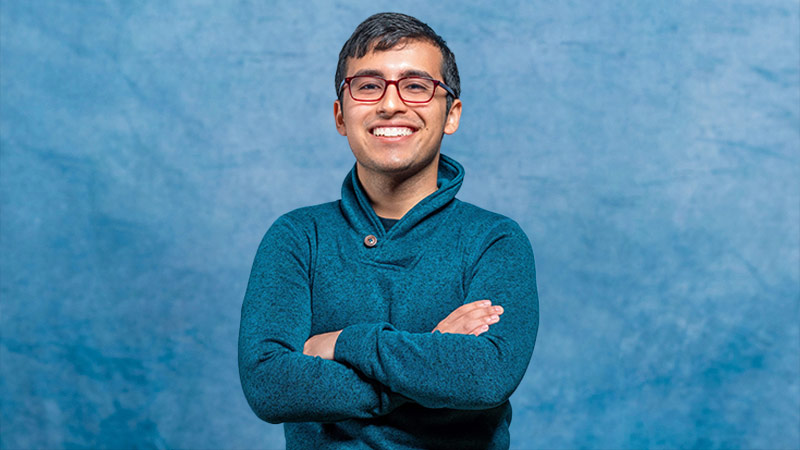
To Cristian Ramirez Rodriguez, a UNB graduate physics student, physics and poetry go hand in hand—and his poems prove it.
Ramirez Rodriguez won first place in the literature category of the 2025 Canadian Association of Physicists Quantum Arts Competition, a national initiative celebrating creativity inspired by quantum science.
Ramirez Rodriguez’s winning poem, “Pauli Matrices with Scaling Factors,” came to him as he was improving an evaporative cooling system at UNB’s Quantum Sensing and Ultracold Matter Lab. The piece merges complex quantum ideas with personal memories by weaving the mathematics of 2×2 Pauli matrices—used to represent the polarization states of light—with personal reflections on family, displacement and his home in Venezuela.
It also connects directly to the themes of his thesis, using the physics of evaporative cooling as an analogy for the challenges facing Venezuela.
As he worked on developing the lab’s evaporative cooling stage, the poem emerged organically, merging complex quantum ideas with his own personal memories.
For Ramirez Rodriguez, physics and poetry have always felt connected. He cites the analytical and abstract thinking required in his graduate physics training as having fundamentally shaped how he writes and interprets the world.
“As a graduate student in physics, my program has encouraged me to think deeply and critically in more abstract ways,” he said, noting that this shift hasn’t distanced him from poetry but instead expanded his creative tool kit.
“It’s given me another vocabulary to use in my poetry.”
Conversely, poetry has made Ramirez Rodriguez more comfortable navigating quantum physics.
“My background in poetry has allowed me to be more comfortable in physics when something doesn’t immediately make intuitive sense,” he said, pointing to examples such as learning that lasers can cool atoms even though “pop culture seems to imply that lasers heat things up.”
The connection between art and science is not unique to Ramirez Rodriguez. Creativity, he notes, is a shared and often foundational quality in many of his colleagues within UNB’s physics department.
"What has been most valuable was finding out that many of my fellow graduate students share artistic impulses, whether through music, dancing, writing, painting, fashion or other forms of art,” he said.
“This allows us to connect at a personal level. Ultimately, I believe institutions work when we see each other as humans, and to be human is to be connected.”
That sense of connection extends beyond the physics department.
“UNB, and Fredericton in general, is a hub for writers and artists,” Ramirez Rodriguez said. “I’m glad my physics journey brought me here.”
Shortly after arriving in Fredericton, he began attending readings, concerts and arts events across campus—from Goose Lane poetry evenings to performances by local musicians.
He recalled that the first book he bought after moving to New Brunswick was UNB associate professor Dr. Sue Sinclair’s Almost Beauty, and the most recent was Sorry About the Fire Colleen Coco Collins, UNB’s current writer‑in‑residence.
“The culture of creativity here at UNB, and Fredericton in general, has provided endless inspiration and a feeling of connectedness,” he said.
Rodriguez Ramirez attributes much of his success to the support he has received at UNB.
“My supervisor, Dr. Brynle Barrett, encouraged my interdisciplinary interests and provided opportunities to present my work—including invitations to speak on mathematical poetry at conferences.”
His fellow students and friends in the physics department, Tim, Owen, Chayse, and Devika also encouraged him to submit his work to the Quantum Arts competition.
Beyond his graduate research in physics, Ramirez Rodriguez has mentored undergraduate students in the lab, an experience that has reinforced his belief in early research opportunities. In just a year and a half at UNB, he has worked directly with four undergraduate researchers and notes that many other groups in the department do the same.
His creative work continues to grow alongside his scientific research. A poem written during his first year in the lab, “Imagen Refractada,” won the inaugural Spanish‑language poetry contest of the Oregon Poetry Association. Another poem, “Rubidium 87,” inspired by the atomic species central to his experiments, will be published in The Ampersand Review this summer.
Ramirez Rodriguez’s win not only highlights his talent but also underscores how deeply creativity runs through scientific discovery. In quantum physics, as in poetry, imagination is essential.
Read Ramirez Rodriguez’s winning poem, “Pauli Matrices with Scaling Factors.” The Quantam Arts Competition is part of the International Year of Quantum Science and Technology, designated by the United Nations, to highlight quantum research and discovery around the world.
Learn more about Cristian and follow his future creative endeavours on Linktree.