
Dual-Use Technology Summit highlights Atlantic defence research opportunities
Author: Jeremy Elder-Jubelin
Posted on Mar 12, 2026
Category: UNB Fredericton , UNB Saint John , Research
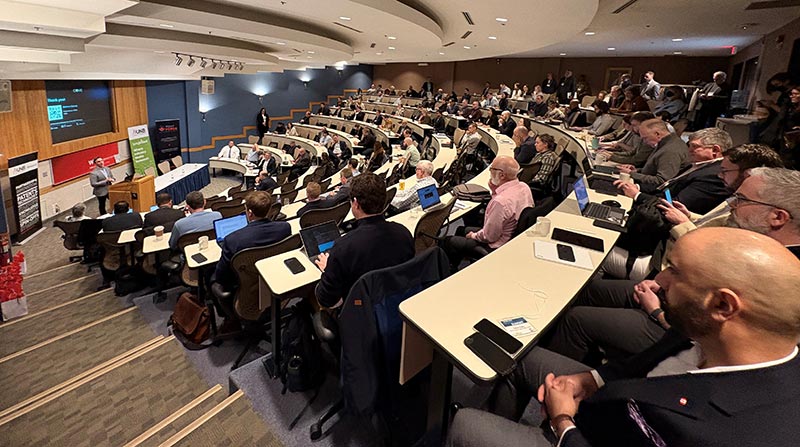
More than 100 researchers, industry leaders, government officials and funding agency representatives took part in the Springboard Atlantic Dual-Use Technology Summit. The summit focused on the needs and opportunities for domestic research and development tied to Canada’s defence, security and sovereignty.
In late February, The University of New Brunswick brought together industry and government representatives, funders and researchers to explore the increasingly prominent topic of defence-aligned innovation and technologies.
More than 100 attendees took part in the two-day Dual-Use Technology Summit, which included lessons learned from past commercialization successes, insights from export control and public safety experts, a look at the funding and startup support landscape, emerging partnership opportunities, and discussion of the federal government’s new Defence Industrial Strategy, among other topics. The program also included rapid-fire presentations on research capabilities and industry needs in the region, as well as the first announcement of a new dual-use technology funding program from ResearchNB.
The event brought together a unique mix of knowledge, both from presenters and attendees, and made for an engaging and dynamic program that generated conversation and excitement around future opportunities.
‘Dual-use technology’ refers to a specific type of defence-aligned research and innovation. These are technologies that have both civilian and strategic defence applications—think anything from drones and rocket technology, to GPS and other positioning systems, to encryption and artificial intelligence systems and more.
The summit was organized by members of the Springboard Atlantic network as part of their Springboard 360 series. UNB’s Research and Innovation Partnerships team led the event development, in collaboration with colleagues from Acadia University, Memorial University of Newfoundland and St. Francis Xavier University, and industry partner Vimy Forge.
A ready, reliable partner
The decision to focus an event on dual-use technology research emerged as part of broader conversations around research efforts that can support Canada’s defence, security and sovereignty needs.
“Along with the rest of the world, we have been watching the world change, and watching Canada move accordingly,” said Dr. David MaGee, UNB vice president research. “We can see the opportunity, and indeed the need, for university research and innovation to contribute to ensuring a safe, secure, responsible future for Canada and its global partners.”
With UNB’s proximity to CFB Gagetown, the largest military base in Eastern Canada, and several longstanding research partnerships with both government and industry groups working in the defence space, increasing an already active role in supporting national security, economic resilience and human safety was a logical decision.
“UNB has a long history of supporting a wide variety of research partners, including those in the defence space,” said Dr. Kelly Scott-Storey, UNB’s associate vice president of research, innovation and partnerships. “This history has built experience, credibility and trust in this sector, giving our institution a reputation as ready and reliable and enabling us to respond rapidly and efficiently to the emerging opportunities we are seeing at a national level.
“Today, between our trusted reputation, our partnerships, and the subject matter expertise of our research community, UNB is well-positioned to help drive innovation and positive impact in this space.”
Beyond military use
The term ‘dual-use’ has traditionally been used in the context of direct military application, but as the nature of conflict and instability has changed, the definition has also broadened. The European Union, for example, refers to technologies that can also “serve strategic objectives related to competitiveness, resilience, defence and security” as dual-use.
This shift mirrors an evolving approach to defence beyond the strictly military sphere and into areas including cybersecurity, protection of critical infrastructure, economic resilience, increased autonomy and domestic capability and many others. Canada’s new Defence Industrial Strategy reflects this shift in thinking.
“Our research community is active in many areas of importance for our collective resilience,” said Scott-Storey. “We have researchers exploring human sleep in extreme environments, including military deployments. We have researchers developing new techniques for making, wearing and controlling prosthetics. We have researchers helping us find domestic sources and alternatives to critical minerals. We have researchers looking at how to best reinforce concrete to protect against explosions. We have researchers working on securing critical digital infrastructure, such as power grids and hospitals.
“While this recent event focused on dual-use specifically, when we talk about how UNB research is defence and sovereignty aligned, this is what we mean. It’s about working to protect—and improve—what Canada is, from our borders to our values.”