
UNB’s PEADS Lab welcomes Canada’s first infant metabolic chamber, opening new doors for early‑life health research
Author: Kayla Cormier
Posted on Mar 27, 2026
Category: UNB Fredericton , Research
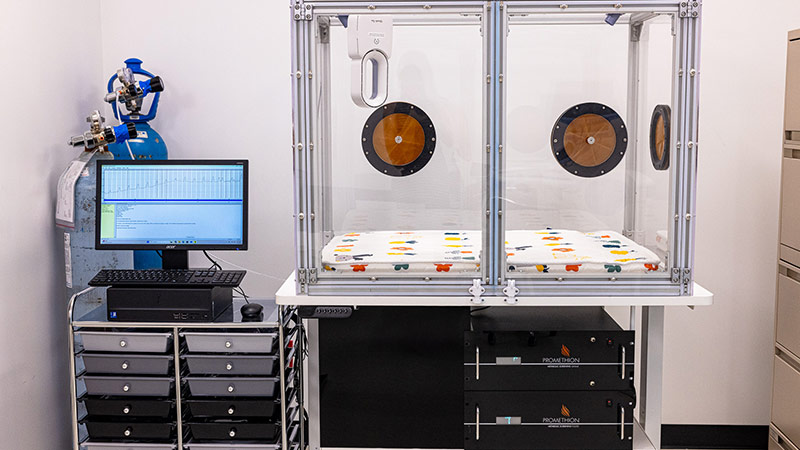
The University of New Brunswick is now home to Canada’s first infant metabolic chamber—one of only three custom-built machines of its kind in the world, positioning UNB as a national leader in infant metabolism research.
Delivered to Dr. Maryam Kebbe’s Perinatal‑Pediatric Health & Development Studies (PEADS) Lab at UNB in early 2026, the chamber’s arrival marks the beginning of a new era in understanding how the earliest days of life shape long‑term health.
UNB is now the only Canadian institution capable of collecting whole‑body metabolic data from infants within days of birth through the custom-engineered infant metabolic chamber. This is critical because metabolism peaks during the first months of life and then stabilizes—precisely the period when the chamber provides the most meaningful data.
The chamber also completes the lab’s full metabolic suite, spanning infancy through adulthood, allowing for measurement of an individual across their growth development.
“We currently don’t have a full understanding of early infants’ metabolism and factors that can affect their metabolism. This chamber allows us to measure a baby’s resting metabolic rate as early as one day old,” said Dr. Kebbe.
Unlike larger metabolic rooms used for adults, the infant metabolic chamber is a controlled, transparent enclosure. The chamber allows researchers to safely measure the resting metabolism of infants and toddlers.
The chamber connects to a Promethion metabolic system—technology typically used in elite physiology laboratories—to provide unparalleled precision in understanding how nutrition, genetics and early environments influence metabolic rate.
This new capability opens the door to answering foundational questions researchers have never been able to study at scale.
“We’ll be able to answer questions like: Does breastfeeding versus formula feeding affect metabolism? Do infants born into families with conditions like diabetes or obesity have different metabolic rates? And the other way around: does an infant’s metabolic rate in early life affect their long‑term risk of chronic disease?”
A custom‑engineered tool years in the making
The chamber was not an off‑the‑shelf purchase. Dr. Kebbe collaborated with engineers and specialists at Sable Systems International in the U.S. to design a custom system tailored to the unique physiological and methodological requirement of infant and toddler research.
“The chamber was custom-engineered. To our knowledge, it is the first in Canada and the third worldwide,” she said. “It represents several years of development and collaboration.”
After navigating extensive procurement, engineering and regulatory steps, the chamber was installed in the PEADS Lab in early 2026.
Dr. Kebbe acknowledges the generous support of the Canada Foundation for Innovation’s John R. Evans Leaders Fund, ResearchNB, UNB’s Office of the Vice-President (Research), and the faculty of kinesiology, whose investments made this initiative possible.
Community partnerships and future research
The lab's work depends on strong community engagement, and parents in Fredericton and throughout New Brunswick have shown real interest in participating.
“I’m very pleasantly surprised with the uptake by the community,” said Dr. Kebbe. “They’re able to learn more about their own health and their children's health while contributing to research that will benefit future parents.”
The chamber will support upcoming studies related, but not limited to:
- Intergenerational metabolic health;
- Links between early metabolic rate and long-term disease;
- Interactions between metabolism, early feeding patterns and the gut microbiome;
- Links between infant energy expenditure and nutrient utilization, and
- Metabolic adaptations in response to early growth patterns.
Dr. Kebbe aims to build on this work through collaboration opportunities.
“There is potential for commercialization of the chamber in future years. If that happens, it could enable national or international collaborations to answer even more intensive questions.”
The installation of Canada’s first infant metabolic chamber reflects UNB’s and the PEADS Lab’s growing leadership in maternal and child health research. It also positions New Brunswick as an emerging hub for foundational early‑life health science.
“Parents want to give their infants the best possible start in life. With this chamber, we may finally be able to answer questions around how those early choices and factors shape lifelong health, and that knowledge has the power to transform care across Canada.”