The day I learned I was Black
Author: Tife Aribisala
Posted on Feb 27, 2026
Category: UNB Saint John
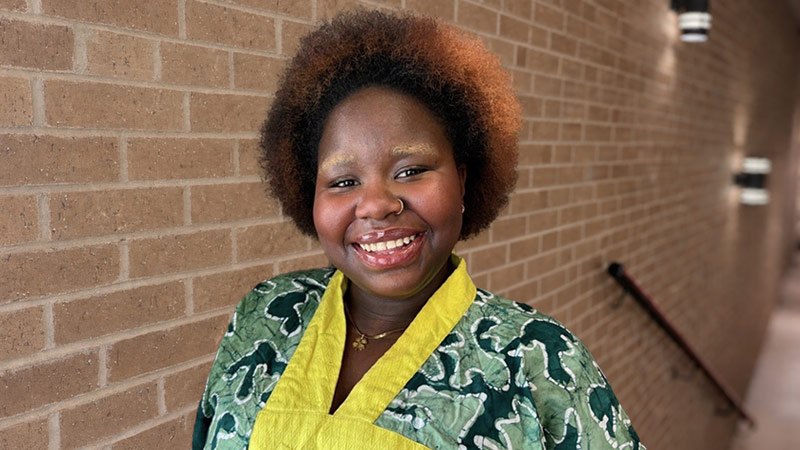
Tife Aribisala is a digital content writer with UNB’s Strategic Communications & Marketing office and a communications studies student on the Saint John campus. In honour of Black History Month, and in keeping with this year’s theme of Black Brilliance, Tife reflects on the moment she realized her Blackness, the shifting nature of identity and the pride and discomfort that can come with carrying the inheritance of Blackness.
I remember the day I found out I was Black.
I know that sounds funny, but it is the truth. Growing up, I was never seen as Black. I was seen as a woman first, but never as a Black woman. I never knew the power that came with being Black, and I never saw the beauty that came with being a Black woman.
For the first 18 years of my life, I did not claim being Black as a big part of my identity. Coming from a country where the majority of the people had black glistening skin, my skin colour was the least interesting thing about me.
In Nigeria, Blackness was not something you noticed. It was everywhere. My teachers were Black. My doctors were Black. No one introduced themselves by race. Our families, our tribes, our personalities and our success defined us. I was known for my voice, my ambition and my stubbornness. Not my skin.
There is a quiet privilege in never having to think about your race.
Then I moved.
There was no single dramatic incident that changed everything. It was gradual. Subtle. I began walking into lecture halls and noticing how few people looked like me. I became aware of how often I scanned a room before sitting down. I heard questions that sounded like compliments but carried something else beneath them. “Where are you really from?” “Your English is so good.” I realized that here, I was not just a woman. I was a Black woman.
For the first time, I felt my skin before I felt myself.
I felt hypervisible and invisible at the same time —seen immediately, but not always fully understood. I became aware of stereotypes I had never needed to consider back home. I felt an unspoken pressure to represent, to succeed carefully, to avoid confirming narratives I did not create.
It was uncomfortable. But it was also awakening.
Because in learning that I was Black in this new way, I also began to understand the depth behind that identity. I started to see beauty where I once saw normalcy. My skin was not just skin. It was history. It was resilience. It was generations of people who carried themselves with dignity in systems that were not designed for them.
In Nigeria, my Blackness blended into the background. Here, it stands in the foreground. That contrast forced me to claim something I had never consciously claimed before. I did not become Black when I left home. I became aware of it.
And awareness changes you.
It makes you more observant. More reflective. More intentional about how you move through the world. It shows that identity is not static. It shifts depending on where you are standing and who is standing beside you.
I learned I was Black when I realized the world does not treat everyone the same. But I also learned that being Black is not just about navigating differences. It is about carrying culture, brilliance, creativity and strength.
Now, I do not see my Blackness as incidental. I see it as an inheritance.
And I carry it with pride.