Building a more inclusive science community: Inside UNB’s faculty of science EDI committee
Author: Kayla Cormier
Posted on Feb 10, 2026
Category: Faculty of Science , UNB Fredericton
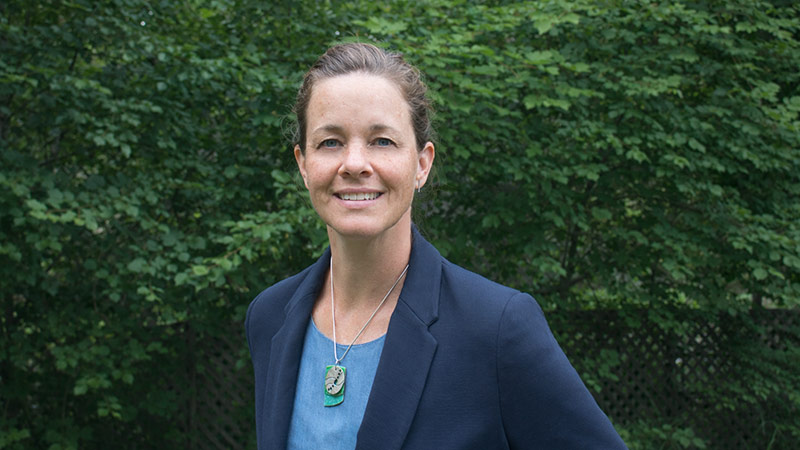
As the world celebrates the International Day of Women and Girls in Science, Dr. Janice Lawrence reflects on the inception and work of UNB’s faculty of science EDI committee. The committee’s work goes beyond gender, extending to all equity‑deserving groups whose voices have historically been marginalized in science.
“There’s still so much work to be done.”
For UNB’s Dr. Janice Lawrence, associate dean of science, associate professor of biology and chair of the faculty of science’s equity, diversity and inclusion (EDI) committee, this isn’t a pessimistic outlook—it’s a call to action.
As the world marks the International Day of Women and Girls in Science, Lawrence reflects on the faculty’s ongoing work to make science at UNB a more inclusive, equitable and welcoming place for everyone.
Building the foundation for change
The committee grew out of the faculty’s strategic planning process in 2022. What started as three faculty members drafting a section on EDI soon revealed a larger truth: meaningful change could not wait for a document to be written and approved.
“So, we started anyway,” Lawrence says. “We came up with broad objectives—understanding where we stand, where the gaps are, what our policies look like and where we should make an impact.”
The group hired an external consultant to conduct a comprehensive review of the EDI landscape in science at UNB. That review became a turning point.
The committee expanded in 2023 to include faculty, staff, graduate students and undergraduates from all departments. They developed a mission statement, core values and guidelines for membership and representation.
“We really wanted to be intentional,” Lawrence said. “These conversations are so easy to get wrong without meaning to. We didn’t want to look back later and say, ‘we should have done that differently.’”
Small steps, visible change
While much of the early work focused on gathering information, the committee also prioritized community-wide visibility and awareness.
“We didn’t want to just sit quietly and wait,” Lawrence said. “We wanted people to know this work was happening.”
In the past two years, the faculty of science EDI committee has:
- Hosted a faculty and student screening of Picture a Scientist (2020), complete with panel discussions,
- Organized Pride pancake breakfasts, celebrating 2SLGBTQIA+ members of the science community,
- Led a month-long ‘women in science’ book display in partnership with UNB Libraries on both campuses,
- Supported universal washroom signage in science buildings,
- Contributed to a multi-university grant proposal on equitable tenure and promotion practices,
- Supported internal research funding initiatives aimed at reducing gender disparities.
The book display remains one of Lawrence's favourite projects.
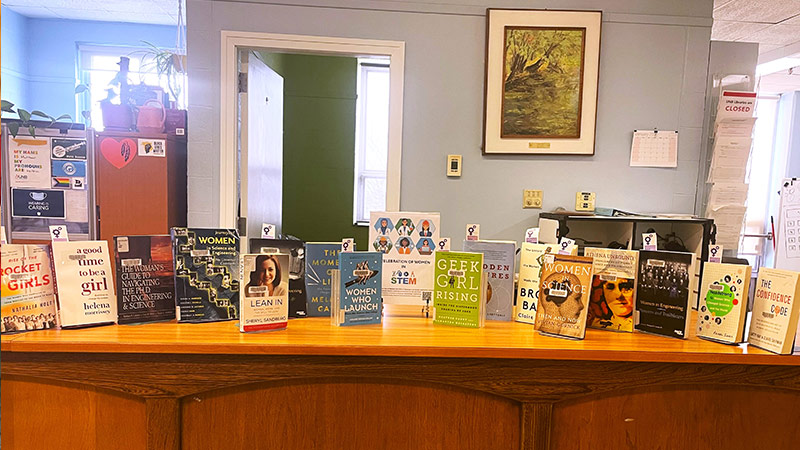
“It had the greatest chance of impacting the greatest number of students. It was so public, and the libraries did such a beautiful job. Seeing students from all faculties stop and engage—that was special.”
Their work is far from over
The external EDI review undertaken by the committee revealed data that Lawrence described as “shocking.”
“When you plot out the proportion of women from undergrad to full professor, the graph just drops. The trend is real,” said Lawrence.
Based on data pulled from Canadian universities, the proportion of women in STEM fields moves from near majority at the undergraduate level to less than a third of full professors.
For Lawrence, these numbers confirm what she has long observed through lived experience.
“As much as I’m talking about gender because that’s my experience,” Lawrence added, “our work isn’t just about gender. It’s about anyone who has been historically underrepresented or excluded in science—whether that’s based on race, culture, sexuality, disability or other identities. We want the faculty of science to be a place where all voices are supported and valued.”
“If you’re not bringing in people with diverse backgrounds, diverse ways of thinking and diverse world views, you’re going to answer questions the same way every time. That’s not discovery.
“Some scientists model problems with math, some tinker in the lab, others observe the world directly. Each gives you a different picture,” she said. “You need all of it. You need all of them.”
That’s why she wants students from under-represented groups to pursue science. But she wants them to feel prepared.
“I don’t want them to enter the field thinking they won’t face challenges. I do, however, want them to expect support, to find mentors and to know that science needs them.
“We’ve still got a way to go.”
“It’s heavy at times,” she said. “Hearing people’s stories, reliving your own experiences. It can feel like a burden. But it’s also incredibly positive to finally see progress. To not wait for change, but to help make it.”