
Research NB funds priority sector projects in health, sustainability
Author: Jeremy Elder-Jubelin
Posted on Feb 3, 2026
Category: UNB Fredericton , UNB Saint John , Research
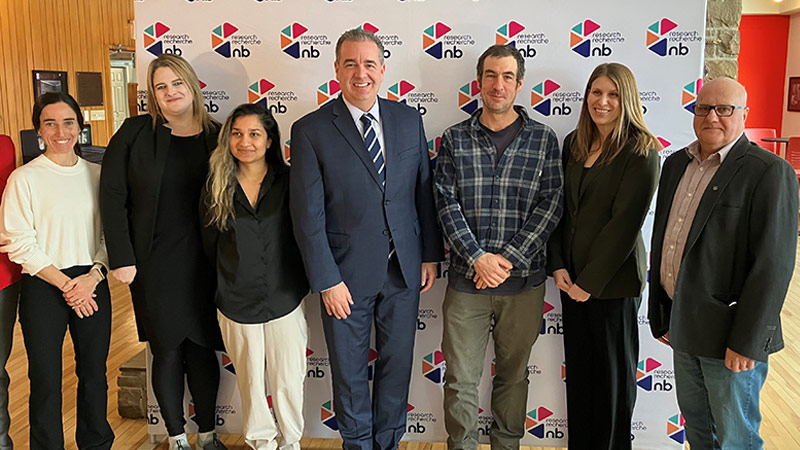
More than $1 million in Research NB funding has been awarded to four UNB research teams. The funded projects address pressing issues such as balancing economic and environmental sustainability in New Brunswick’s ocean and rivers, improving health and well-being outcomes for those experiencing precarious housing, and exploring new possibilities in primary healthcare access.
Four University of New Brunswick research projects have been awarded funding in Research NB’s first round of Priority Sector Development Fund grants. UNB’s research teams have been awarded a total of $1,119,731 through the program.
With only five awards in this cycle, 80 per cent of the funding will support the world-changing work happening at New Brunswick's postsecondary research leader.
Dr. Suchinta Arif, Canada Research Chair in Ecological Modelling and assistant professor of biological sciences and of mathematics and statistics, will receive $253,887 in support of her work in modelling the socio-ecological factors affecting marine life and coastal communities in New Brunswick. Arif’s project will look at socially and economically important species, including kelp, salmon and lobster, with a goal of supporting both the economic sustainability of fisheries and the environmental sustainability of the Bay of Fundy.
Also focusing on the aquatic environment is a project led by Dr. Philip Harrison, a fish ecologist with the Canadian Rivers Institute and research associate in the faculty of forestry and environmental management. The project builds on more than a decade of successful, high-impact work through the NB Power-partnered Mactaquac Aquatic Ecosystem Survey (MAES). The New Brunswick Aquatic Ecosystem Survey expands MAES to conduct river and reservoir research across the whole of the Wolastoq / Saint John River. With $400,000 in funding, the project ultimately seeks to support better fish passage and environmental flow management plans that consider both environmental and economic sustainability.
Dr. Julia Woodhall-Melnik, Canada Research Chair in Resilient Communities, associate professor of social sciences and principal investigator of the Housing, Mobilization & Engagement Research Laboratory has been awarded $65,844 in funding for research on one of the most universal social determinants of health: access to housing.
Woodhall-Melnik’s project will work with lived experts to better understand and improve the health of people waiting for access to subsidized housing. Access to stable, adequate and affordable housing is strongly tied to improved mental and physical health, with significant reductions to corresponding personal and societal costs. Through a deeper understanding of the issue, the research team intend to develop evidence-based approaches to support those on the extensive provincial waitlist for housing.
Health and healthcare access are also top of mind for a research team led by Dr. Shelley Doucet, Jarislowsky Chair in Interprofessional Patient-Centred Care, director of UNB’s Centre for Research in Integrated Care (CRIC) and professor of nursing and health sciences. Building on the Government of New Brunswick’s recent investment in primary care access, Doucet and her collaborators will establish a Practice-Based Research and Learning Network in New Brunswick with $400,000 in Research NB funding.
This network will bring together primary care providers, researchers and decision-makers, connecting data, research and day-to-day care to improve healthcare policy and practice through continuous, innovative and evidence-informed evaluation.
CRIC, UNB’s DataNB institute, the provincial Department of Health, the New Brunswick Medical Society, both provincial regional health authorities and the Canadian Primary Care Sentinel Surveillance Network will form the core of this network, which will include clinicians, researchers, patient partners, decision makers and community groups.
By drawing these partners together, Doucet’s project also identifies an opportunity for the province to lead Canada in pioneering a process that helps integrate primary care data with provincial administrative data to make even better decisions for the wellbeing of all New Brunswickers.
“Congratulations to the research teams whose projects are being supported by Research NB today,” said Dr. David MaGee, vice president research. “From environmental sustainability to ensuring healthcare for some of our most vulnerable populations, these projects highlight some of the many significant ways that university research can help our province and our society address major challenges and create better futures.”