
Leading the charge: UNB's century of electrical and computer engineering
Author: Tim Jaques
Posted on Feb 12, 2026
Category: UNB Fredericton
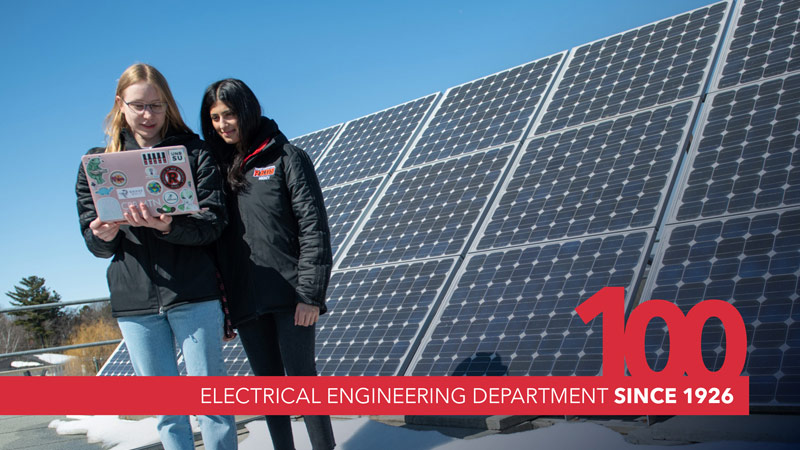
UNB’s department of electrical and computer engineering has produced global tech leaders and life-changing biomedical devices, securing the department's place at the forefront of Canadian engineering.
In 1855, a professor at what was then called King’s College used the telegraph to exchange signals with an observatory in Boston. By doing so, Dr. William Brydone Jack determined the exact longitude of Fredericton and proved that what would become the University of New Brunswick was already looking toward a technology-driven future.
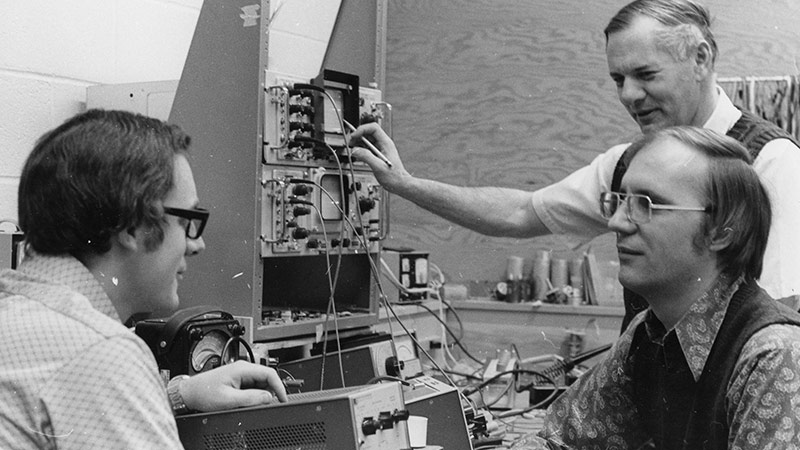
While what is now UNB’s department of electrical and computer engineering has grown into a leader in biomedical research and smart-grid technology as it marks its 100th anniversary in 2026, its history of instruction dates back further.
UNB began offering electrical engineering in 1893, two years after McGill University became the first in Canada to do so.
By 1925, interest had grown so much that the Senate approved the creation of a separate department of electrical engineering, with students first enrolled in 1926. The following year, UNB established its first chair of electrical engineering, appointing A. Foster Baird.
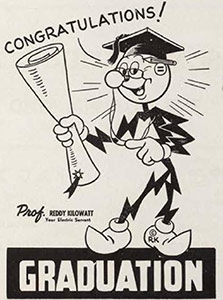
In those early decades, alumni designed the province's power lines and telephone grids. In addition to its students and graduates who enlisted in the Second World War, the department trained Air Force and Navy personnel in electronics and radar.
"Electrical engineering in the beginning was almost exclusively focused on power generation and distribution of power," said Adam Wilson (BScE'04, MScE'10), associate teaching professor and department chair.
"We later moved into solid‑state electronics and transistors, and finally to computers. Now, we have electrical and software engineers who are not just using AI but creating AI algorithms."
A shift to digital
In the 1950s, student Dana Wasson (BScE'56) used vacuum tubes to build a four-function programmable computer. Wasson later became a professor and helped bridge the gap between electrical engineering and the birth of computer science at UNB. In 1968, UNB installed an IBM 360/50G, then the most powerful computer east of Montreal.
The department's name officially changed to the department of electrical and computer engineering in 1998.
This transition followed several decades of increasing focus on computing, which began in the late 1950s and 1960s. Formal computer engineering and software engineering programs were later added, with software engineering established in 2000 through a partnership with the faculty of computer science.
Mary E. Kaye (BScE'75), an honorary research professor who joined the electrical engineering department as a faculty member in 1979, witnessed the shift to digital.
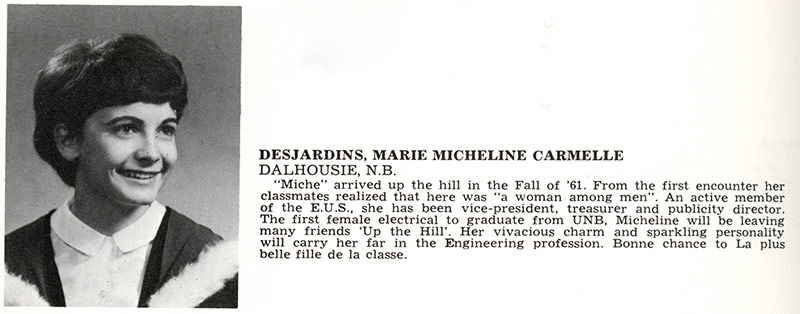
When she arrived as a student in what was then a five-year program, the professors were all male, and she was one of the few women in the program—Micheline C. Desjardins (BScE'66) had been the first to break the long run of male-only graduates. Slide rules were used for calculations, and in Kaye's final year, fewer than four students owned basic four-function calculators.
"There were no personal computers or the web," Kaye recalled. "The professor either wrote on the blackboard or used an overhead projector with notes. They could not be uploaded to a computer for viewing later. You were expected to attend class and take notes in class."
Professors were available in laboratories and expected students to understand the physical reality of the systems they studied.
She sees the establishment of formal computer engineering and software engineering programs as pivotal achievements for the department and the engineering faculty.
“The core has changed from basic principles for machines and power systems to include electronics, computers and software," Kaye said.
"But students need to learn the fundamentals—electronics, machines, digital hardware, electromagnetics, signals, control and software—so they understand how a system works even if it is built by advanced tools or AI."
The IBME
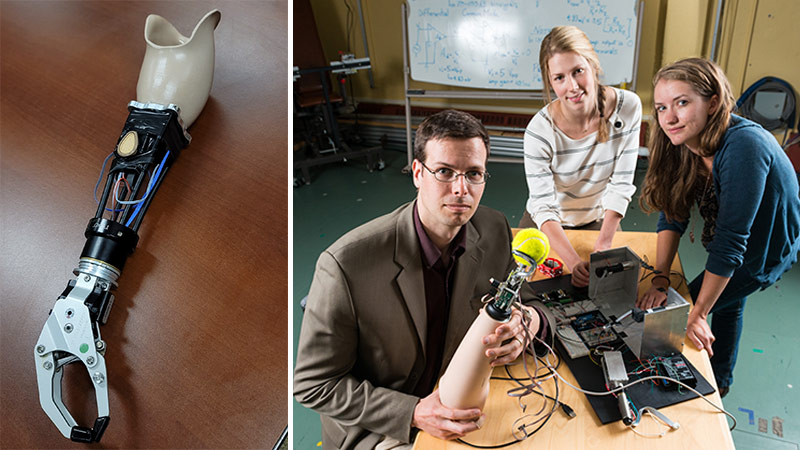
A serendipitous event occurred in 1961, when a Fredericton rehabilitation centre asked UNB electrical engineering professor Dr. Robert N. Scott (BScEng'55) to help enable quadriplegic clients to use powered wheelchairs.
Scott and his team modified the wheelchair controls to allow operation by mouth, giving users agency and freedom. That small job eventually led to a lab, and then to a clinic.
In 1965, what is now called the Institute of Biomedical Engineering (IBME) was founded, with Scott as its first director. Today, the IBME is a world leader in myoelectric control, using electrical signals from human muscles to control power prosthetic limbs.
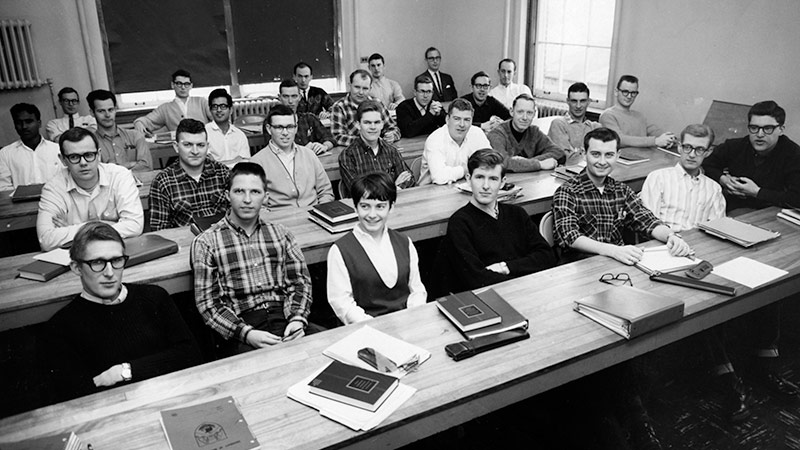
"The clinical edge was having research students, clinicians, and research faculty housed in the same building," said professor emeritus Dr. Philip A. Parker (BScE'64, PhD'75), who worked with Scott.
"It facilitated the design and testing of new controllers with a quick turnaround in results and modifications. Also, it facilitated the exchange of ideas and innovation."
Parker identifies the growth of digital computational power as the most significant shift during his tenure, enabling the application of neural networks and pattern recognition to prostheses control. He credits the department's success to a culture of practical work.
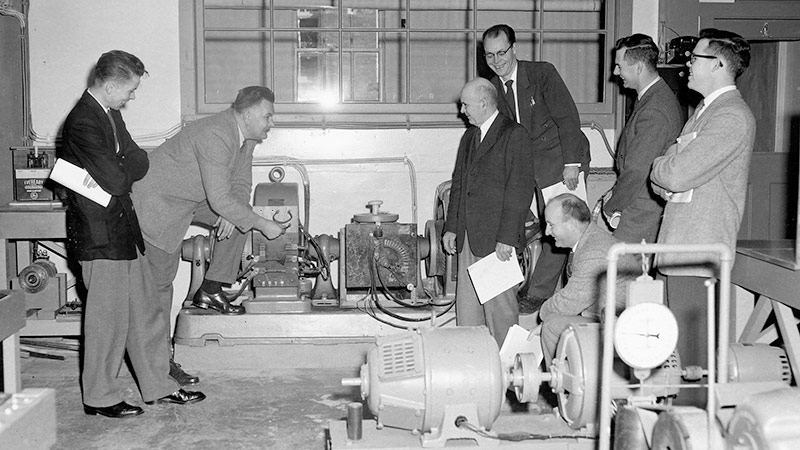
"I think the electrical engineering program at UNB is very hands-on. Every engineering course had an associated laboratory component, typically a three-hour lab per week requiring a written lab report," Parker said.
Global business reach
Alumni have founded companies that became the backbone of modern communications. While it boasts many distinguished alumni, perhaps its most famous is Subramonian Shankar (MScE’76, DSc’25), co-founder of American Megatrends Inc., a highly successful international technology company.
Gururaj "Desh" Deshpande (MScEng'75, DSc'01), a 1975 graduate, co-founded firms such as Cascade Communications and Sycamore Networks, which helped build the internet's infrastructure.
Others have seen similar success in the data and security sectors. Marcel LeBrun (BScE’92, DSc’16) and Chris Newton were part of the team behind Radian6 and Q1 Labs, companies that eventually sold for hundreds of millions of dollars.
More recently, graduates have launched start-ups such as Picketa Systems, which uses sensors to assess crop health. Graduates were also involved in Potential Motors, which recently sold its intellectual property. These ventures show how the department's training applies to diverse industries.
Research and smart grids
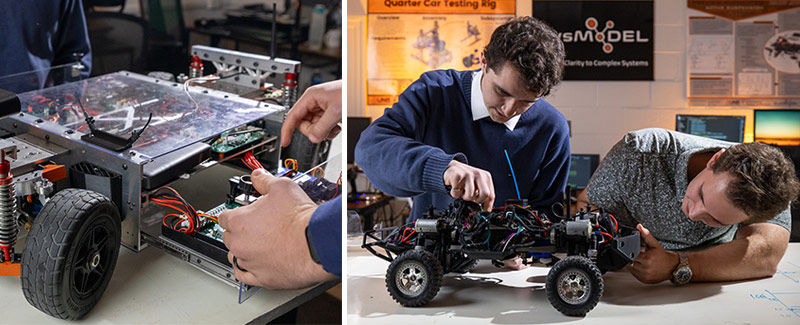
Researchers at the Emera & NB Power Research Centre for Smart Grid Technologies are developing bidirectional electric vehicle charging systems. These allow electric vehicles to act as "batteries on wheels," feeding power back into a home or the grid during peak demand.
"UNB is probably the leader in Canada in the sort of next generation of electric grids," said Dr. Joshua Leon, dean of the faculty of engineering.
"We have moved from just delivering power to managing it intelligently."
Leon noted that the department is also in space.
Researchers from the department have led a series of notable projects, including launching the province's first satellite VIOLET through the Canadian Space Agency's CubeSat program, in partnership with New Brunswick Community College and Université de Moncton.
Vision for the future
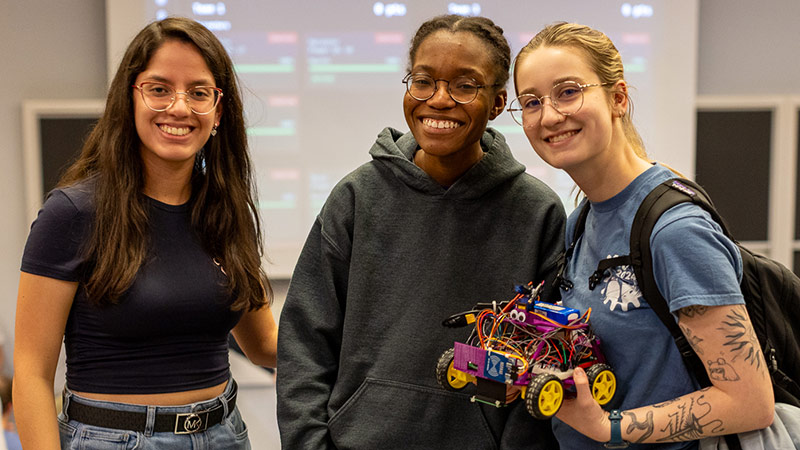
The department is reviving its mechatronics program to help students design autonomous robots and smart machines. It also integrates ethical AI into the curriculum, ensuring students understand the algorithms that underlie the tools.
"We want to make sure our students understand the impact of what they are building," Leon said. "Whether it is a satellite or a medical device, the engineering must be sound, and the ethics must be clear."
Despite these advances, the faculty maintains its traditional emphasis on hands-on learning. Parker noted that integrity, curiosity and a "directed collective mission" to solve problems define the department's culture.
Kaye believes this practical foundation is what makes the department's graduates successful. In an era of AI, students must still master the fundamentals to understand how a system works.
“Students need hands-on laboratories working with physical systems as well as simulations,” she said.
She sees opportunities for students in rehabilitation robotics, wireless power transfer and implanted embedded systems.
For high school students considering the field, the department's message is that electrical and computer engineers are the architects of the modern world. Wilson points out that every smartphone and power system starts with the work done in departments like this one.
The department has spent a century adapting to new technologies while keeping its focus on the physical application of science. Leon said looking forward defines the university.
"We've always been ahead of the curve at UNB," he said, "no matter the area."
Other sources
Baird, A. Foster. The History of Engineering at the University of New Brunswick. The University of New Brunswick Memorial Volume. Ed. Alfred G. Bailey. Fredericton: University of New Brunswick, 1950. 75-86.
Montague, Susan. A Pictorial History of the University of New Brunswick. Fredericton: University of New Brunswick, 1992, 292 pp.