
Black Researcher Showcase marks Scarborough Charter anniversary at UNB
Author: Tim Jaques
Posted on Feb 20, 2026
Category: UNB Saint John , Research , UNB Fredericton
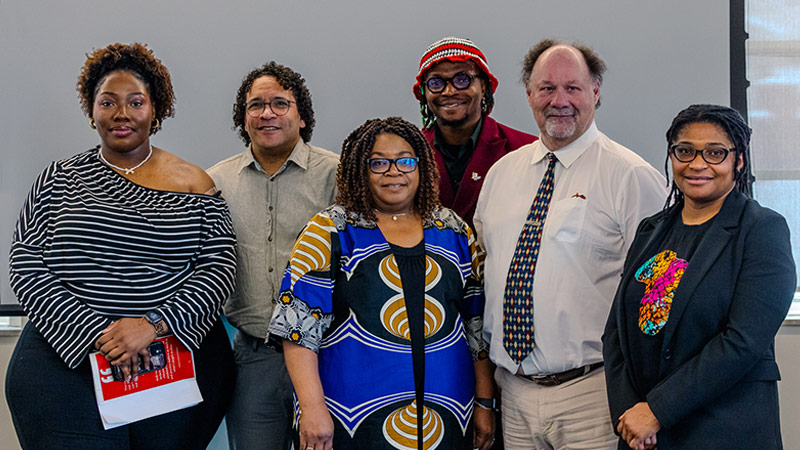
Speakers gave presentations examining gaps in healthcare, education, history and refugee support, highlighting how current systems fail Black and marginalized communities. The showcase called for better practical training, closer community ties and greater accountability.
The University of New Brunswick marked one year since the signing of the Scarborough Charter with its first Black Researcher Showcase on Feb. 11 at the Harriet Irving Library, offering oral presentations by the researchers.
"This year's Black History Month theme marks 30 years of Black History Month in Canada, honouring Black brilliance across generations, past, present and future," said Joanne Owuor, advocacy and education officer with the UNB Human Rights and Equity Office, which co-sponsored the event.
"Today's showcase sits squarely in that spirit, highlighting Black research knowledge and vision that is here within UNB. Today is about celebrating Black scholarship at UNB, making it visible, and creating space for connection across our research."
Dr. Paul J. Mazerolle, president and vice chancellor, said the event offered a chance "to celebrate Black intellectual excellence and create space for important knowledge to flourish."
"The choices we make and the initiatives we champion shape the kind of society we envision for the next generation."
Dr. David MaGee, vice president research, said there was a need to celebrate diverse voices in research.
"The world of academic research is not yet an equitable one," he said. "Access to opportunities, acknowledgement of findings and recognition of success are not always fairly distributed."
Nursing for the racialized patient
Nursing students Nneoma Amaechi and Modupe Sadiku reviewed nursing courses. Based at the UNB Saint John campus, they conducted a focused review of five syllabuses from the faculty of nursing and health sciences to examine how equity is embedded in the curriculum.
While topics such as racism, language barriers and systemic inequalities are referenced, they found that these issues may not be consistently carried through with the depth, application and continuity required for real-world clinical practice.
In addition to their curriculum review, the students surveyed 105 respondents, including students, staff, healthcare workers and community members. They also conducted two semi-structured interviews with community leaders, then turned the findings into a 12-point syllabus checklist and a set of recommendations instructors can adopt.
The checklist helps faculty identify anti‑Black and anti‑Indigenous racism, embedding measurable learning outcomes, integrating applied case-based equity learning, and establishing clear follow–up procedures in clinical contexts.
They call for diverse and representative teaching materials, stronger partnerships with community organizations, structured anti-racism and cultural safety frameworks, and explicit training on working with interpreters so language barriers do not become patient safety risks.
"Our professors can't teach what they have not lived," said Amaechi, who gave the presentation, adding there is a need for guest educators with lived experience and for sustained partnerships with racialized community groups to ensure nursing education reflects the realities of the populations it serves.
Keeping a language alive
Henrietta Obajemu (BEd'25), a graduate student in the faculty of education and a Yoruba speaker, proposed a community‑run Yoruba language program for K‑8 students in New Brunswick.
Yoruba is a West African language spoken in Nigeria, Benin and parts of Togo and Sierra Leone.
Her plan calls for weekly two‑hour sessions with bilingual instruction, stories, songs and cultural content.
The curriculum would follow Manitoba's heritage language framework to provide a clear sequence for speaking, reading, listening and writing skills in Yoruba.
Her model addresses a challenge she sees: parents juggling life's responsibilities while trying to maintain their heritage language with limited support.
She said that language loss can occur within one generation without support, and that structured community programs help children maintain a connection to their identity while strengthening their English- or French-language development.
She tied the proposal to her life as a parent.
"My children were learning English and French beautifully, but Yoruba became something that they understood but didn't own," she said.
"There is nothing quite like watching a child realize, ‘I recognize that language. That language belongs to me.’'"
A Loyalist story of Black labour
Graham Nickerson (MScE'02, MA'23), a doctoral candidate in the department of historical studies, challenged the familiar Loyalist narrative that prioritizes white colonists while pushing Black communities to the margins.
He walked through mapping projects in Shelburne, N.S. that place Black labour inside the Loyalist landscape. Individuals from the Black diaspora arrived at the same time as white Loyalist elites, who brought slaves with them to the Maritimes, including to New Brunswick.
He pointed to the number of enslaved and bound Black people around what is now called "Loyalist Corner" in Shelburne, and displayed a copy of a 1785 Shelburne handbill forbidding dancing and "frolicks" by Black residents. Some have viewed the handbill as evidence of racial dominance, but he offered an alternative explanation based on the fears induced by such a large Black physical and cultural presence.
"The density of Black people [in Shelburne] begs us to consider that instead of being motivated as a show of power, this handbill is more a fear reflex," he said.
He also showed how AI-generated images of historic Black persons showed them as white, indicating how both historic and digital sources tend to struggle with the Black presence in non-subservient roles throughout the Revolutionary War period.
His work connects the Maritimes to the wider Black experience. It traces how the definition of Loyalist shifted over time, often leaving little room for Black agency until historians read the record more closely.
Disability, gender‑based violence and access to care
Dr. Yvonne V. Simpson, a postdoctoral fellow at UNB’s Muriel McQueen Fergusson Centre for Family Violence Research, presented on the intersection of disability and gender‑based violence in New Brunswick and explained why improved access to health care is a pressing need.
She uses intersectionality to capture how disability interacts with gender, race and geography, and draws on calls from the National Inquiry into Missing and Murdered Indigenous Women and Girls to strengthen accountability.
She said that disability and gender-based violence overlap in ways that create obstacles throughout the healthcare system. Her project will create an online map of accessible health services in different health regions, compare the results to the World Health Organization's 40 actions and 10 key strategies for improving accessibility, and develop specific measures to track progress.
Simpson offered a test: if a disabled woman fleeing harm reaches a clinic, can she get in, be examined on an accessible table and receive a safe referral?
"We need to provide a tool for identifying and tracking the availability of safe, accessible healthcare services," she said.
'Ubuntu' and older African refugees
Dr. Prince Chiagozie Ekoh, a faculty member in the department of social sciences on the Saint John campus, focuses on older African refugees, who he said are undercounted and underserved.
These populations can be overlooked in data collection and may not receive adequate resources or representation. Consequently, they can be overlooked in censuses, research and policy planning.
He said that forced migration affects millions, and that older adults are likely to make up a larger portion of refugee populations as global aging accelerates.
Using narrative interviews and diagramming, he asked participants to map their journeys from their home countries through multiple host nations before arriving in Canada.
Their diagrams showed the loss of homes, separation from family, long delays and the role of individual "Good Samaritans"—not formal systems—in providing food, land or help with applications.
In Canada, these older refugees reported loneliness, racism, unemployment, language barriers and disability, and noted that programs such as ESL seldom meet their needs.
Ekoh called for policies that recognize the support networks older refugees lose when they migrate, and the gaps created when services do not account for age, culture or trauma.
Ekoh uses Ubuntu as his framework: it means, "I am because we are," referring to interconnectedness, community and mutual aid.
"If you think about the principles that we in academia preach, including social justice, respect for duty, strength and resilience, all of them are found within the context of Ubuntu," Ekoh said.
"When I was talking with the older African refugees, and I used academic jargon of anxiety, depression, PTSD, they would tell you, 'Oh, no, we don't have those things. We are fine.' But in their narratives, in their stories, many will tell you that they can't sleep because they keep thinking about what happened to them in the past and all the people that they have lost," he said.
"One of the lessons that I picked up from that aspect of the research is that we need to reframe how we inquire about their experiences."
Photo: Front, from left: Nneoma Amaechi, Dr. Yvonne V. Simpson, Dr. David MaGee, and Henrietta Obajemu. Rear, from left, Graham Nickerson and Dr. Prince Chiagozie Ekoh.