VR tech to help UNB education students face classrooms
Author: Tim Jaques
Posted on Jan 23, 2026
Category: UNB Fredericton
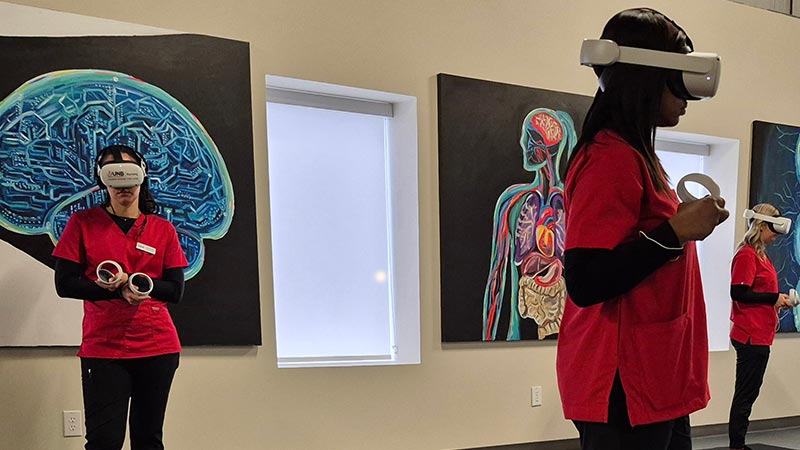
By recreating authentic school experiences, the program will strengthen readiness and reduce stress for new teachers entering the field.
For new teachers, classroom experiences can be hard to plan for.
Teaching happens in busy classrooms where many things are happening at the same time. Students have different learning needs, emotions, friendships and challenges, all while teachers try to follow the curriculum and meet school expectations.
Because these things can change quickly and unexpectedly, teachers must make constant, in‑the‑moment decisions without always knowing exactly how things will turn out.
At the University of New Brunswick’s Fredericton campus, two education professors plan to help students face those challenges and strengthen their practicums by immersing them in virtual‑reality (VR) simulations based on real stories.
Dr. Matt McGuire, assistant professor in the faculty of education and McKenna Fellow in Digital Education, and the project’s principal investigator, says the idea came from listening to students.
“Every year, I have students reporting that they could use more experiences in the classroom,” McGuire said.
UNB bachelor of education students spend 17 weeks in practicum placements during their 10-month program. That’s valuable time, McGuire said, but more can be added to cover the challenges of school life.
“The classroom is a very complex place, and it involves a lot of people and a lot of factors,” he said.
How the project will work
McGuire and Dr. Matt Rogers, a professor in the faculty of education and associate dean of graduate programs will begin by interviewing experienced K-12 teachers across New Brunswick. They’ll ask about moments that shaped their careers, such as conflicts, surprises and decisions that made a difference.
“We’re going to collect stories, synthesize them and develop scripts based on that data to get at principles and complexities that exist in classroom contexts,” Rogers said.
“We can create scenarios, ask the students to engage with them and have time to think about them in a safe and sustained way before they’re actually in a classroom.”
Actors will re-enact those stories in classrooms while Rogers films with an 11K, eight-lens, 360-degree camera that captures every angle. The result will be immersive educational videos. Students will wear VR headsets, watch the scenario unfold, and then pause to discuss what they would do next.
“There’ll be some embedded prompts during the simulation as well,” McGuire said.
“At some point, as they are immersed in these environments, there could be a question that comes up for discussion, and that’s when the students take the VR headsets off and talk together and reflect on the situation. Then they’ll put the VR headset back on and move forward.”
No single right answer
The goal is not to teach one correct response to the scenarios.
“We’re not trying to be prescriptive with the right answer,” Rogers said. “It’s more about being able to allow them to navigate complexity.”
McGuire agreed.
“The last thing we want is to have students feel after one of these scenarios that they know the definite answer or the approach that they should be taking,” he said.
“Every scenario—every student, teacher and school environment—is different and complex.”
Learning from other fields—and Scotland
The idea grew partly from Rogers’ experience with nursing simulations at UNB, and working with Dr. Rose McCloskey and her team at the faculty of nursing and health sciences.
“I became really interested in this from the experience I had working with the nursing faculty,” he said, referring to the use of VR and extended reality (XR) in the faculty of nursing and health sciences to teach nursing students.
McGuire brought another perspective after visiting universities in the U.K. last spring.
“One of the places I visited was the University of Glasgow,” he said. “I met Dr. Alan Matthews, whose primary research was the use of extended reality technology as a medium for teaching and learning. He’s going to be a collaborator on this project with us.”
Matthews manages Glasgow’s XR Teaching Lab and has developed frameworks for ethical, purposeful VR environments. His input will help shape UNB’s approach.
What comes next?
The project has seed funding from the Fergusson Foundation and is seeking more funding from the Social Science and Humanities Research Council.
The first months will focus on ethics approval and teacher interviews. By mid-year, McGuire and Rogers expect to be writing scripts and planning shoots. Year two will bring pilot testing in bachelor of education courses and analysis of feedback.
“This is not meant to replace the practicums,” Rogers said. “This is meant to supplement and support that experience.”
The two hope the VR scenarios will become a shared resource for instructors, school districts and even the department of education. They also see potential for graduate research and a future master’s program in digital pedagogies, which is the study of how to teach using digital technologies.
For now, the goal is to give future teachers a chance to practise thinking through challenging moments before they face them for real.
“The learning isn’t just the scenario itself; it’s how we use it within the context of the teaching experience,” Rogers said.
Photo 1: Inspired by the use of virtual reality to teach UNB nursing students, Dr. Matt McGuire and Dr. Matt Rogers plan to use similar technology with students in the faculty of education.
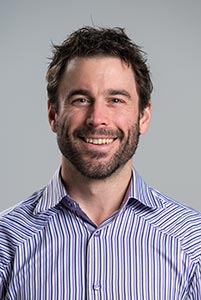
Photo 2: Dr. Matt McGuire
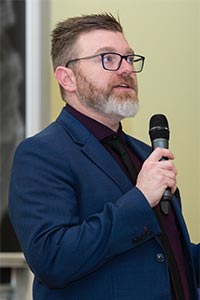
Photo 3: Dr. Matt Rogers