8 Cafés gives emerging filmmakers a fast, focused shot at the craft
Author: Tim Jaques
Posted on Jan 6, 2026
Category: UNB Fredericton
- What it is: 8 Cafés, a series of eight short films and related documentaries.
- Where to watch: Premieres on Bell Fibe TV1 on Jan. 8, 2026.
- If you don’t have Bell Fibe TV1: A launch gala will be held at Tilley Hall, room 102, on Jan. 9, 2026, at 6:30 p.m. Admission is free with advance tickets.
This past summer, Livia Steeves (BA'25) was new to directing and about to shoot a five‑minute short film in only four and a half hours.
After a sleepless night, she arrived at the Grad House on the UNB Fredericton campus before dawn, ready to go, her crew already moving.
“It was so exciting,” she said. “Even though it got stressful, it was a very supportive environment.”
The New Voices Film Lab at the University of New Brunswick trained eight filmmakers over the summer and fall of 2025 by giving them on-set authority, short production windows and hands‑on mentorship.
Their short films are set in the Grad House, which was transformed into a café. This eight-episode series, called 8 Cafés, was created for Bell Fibe TV1, with each episode paired with a behind-the-scenes documentary that showcases the filmmaking process from table read to screening.
The format came from Dr. Robert W. Gray, a professor in the department of English on UNB’s Fredericton campus, who said he kept hearing from graduates who wanted to direct but had been steered to art department work or ignored by more assertive crewmates.
He and education professor Dr. Matt Rogers (BA’05, BEd’07, MEd’10, PhD '14), along with teacher and filmmaker Jon Dewar (BA'11, BEd'13) of Leo Hayes High School, formed the core team through their company, Frictive Pictures, and brought in mentors and secured funding for paid internships.
“Constraints make art happen. Limited budget, limited location … if you had no limits, you wouldn’t create as well,” Gray said.
“Film sets are more Darwinian than democratic, which is why so many groups are still under-represented in key roles. And this lack of representation still makes it hard for women and creatives from marginalized groups to imagine themselves stepping into these roles. The project aimed to change that while providing mentor support in each role so the participants could build confidence and find their voices in those opportunities.”
Preparing under pressure
Gray separated writing from directing. He issued a call for scripts set in a café with five or fewer characters. From the 25 submissions, story editors helped develop a dozen.
After eight directors were chosen, each picked a refined script. They spent the summer in seminars and workshops before building shot lists. On set, they had only four and a half hours to shoot.
Steeves, who studied film in UNB’s media, arts and cultures program, said preparation mattered most.
“It was hard to narrow down all the shots I wanted,” she said. “We didn’t have a lot of time. I had to cut a lot and focus on coverage.”
Workshops on set etiquette and shot listing helped her simplify and stay organized under pressure.
Dani Clayton (BA'24) juggled the lab with a full‑time job. They said the most challenging part was planning a shot list that told the story with the fewest setups, in the order that maximized efficiency.
“Even the night before, I was rewriting the order of how I’d do the shots,” they said.
“I prepared as much as I could, sat in the café and envisioned how we’d make it work together.”
On set: roles and mentors

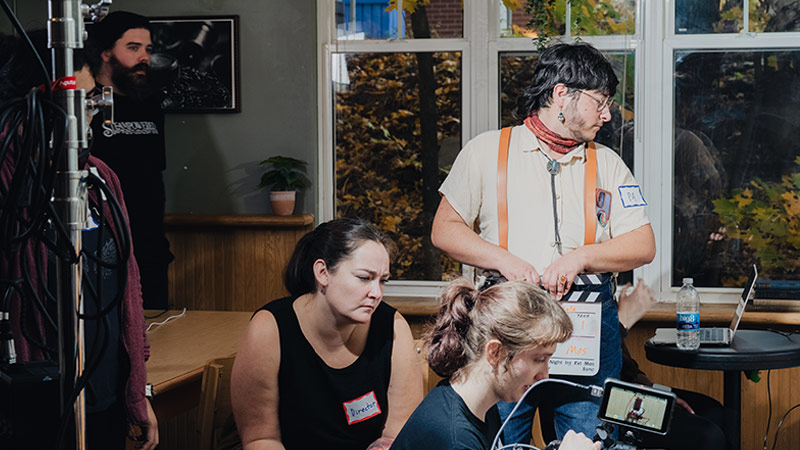
The eight rotated through principal crew roles across all eight films, including director and assistant director. That taught communication, pace and the demands of creative decision‑making.
Clayton said the toughest day was when “three of us had to direct and be assistant director on the same day,” moving from the assistant director’s time-driven energy to the director’s focus on the creative.
“You need to let some of that go so you can focus on your part,” they said.
Steeves described a clear structure that kept days moving.
“Each set we’d switch roles,” she said. “We’d get name tags saying what we were doing. It was always exciting to see who was doing what on each day.”
Mentors were present, she said, and the crew respected each role.
“Even when things got stressful, everything went smoothly because we knew who the assistant director was and who was directing.”
Clayton said mentors helped novices turn broad tasks into specific responsibilities.
“They helped make it go. They’d say, ‘Here’s your specific role, here’s how you can communicate most effectively. Here’s how you can keep people on track.’”
Workshops covered cameras, lenses and lights, with hands‑on practice assembling and using gear.
“You can’t go in on the day of the shoot, being like, ‘I don’t know how to put this together,’” they said.
Gray said the pace was intense by design.
“We hit the ground running,” he said. “Everybody was so on it. One of them even finished early.”
He recalled a filmmaker who stepped outside after calling cut and cried from the emotional effort. Mentors sat with her and said that the feeling meant she had given everything.
Why a café?
Gray chose a single location to encourage focus and to keep logistics lean.
“Anything that can happen in Fredericton can happen in a café,” he said.
The script plots ranged from suspense to romance to an action‑styled duel over the last power outlet, framed like the Western film The Good, the Bad and the Ugly. Grant tied the choice of a café setting to Bell’s mandate for local stories and said his experience running the 48 Hour Film Competition made him favour this simple format.
Steeves said the setting clicked for her comedy script.
“I could totally see this happening in a café,” she said.
Building a pipeline
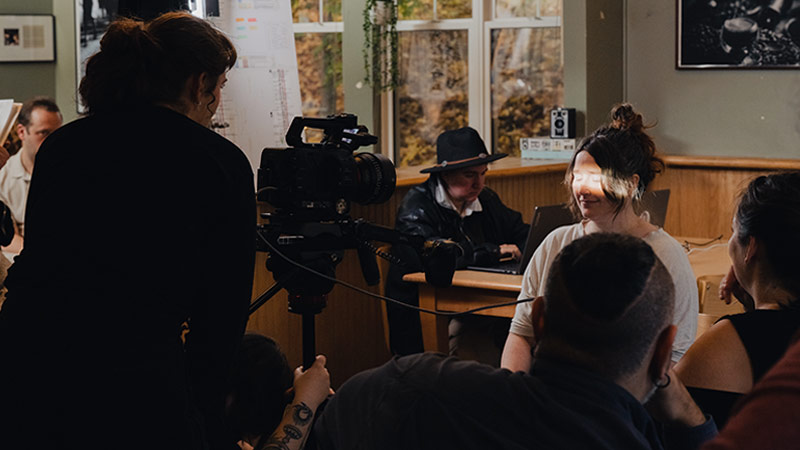
UNB and Mitacs funded paid internships, with a people‑heavy model designed to put participants on screen and in credits as directors and department heads. The lab sought a following for the broadcast and crowdfunded to submit the shorts to festivals.
Steeves hopes viewers will enjoy the shorts, and plans to send hers to festivals.
“It’s my first film,” she said. “I’m seeing it as a learning experience and going up from there.”
Clayton also wants to submit their work and advance new projects. They said their film explores how people have become desensitized to larger issues, making minor things feel more important than they really are.
“I think it’s very topical right now,” they said.
Clayton said the experience changed their outlook. They learned how to communicate as an assistant director, how roles connect on a professional set and how editing and lighting skills carry forward.
“The more you do it, the better you get,” they said.
If the lab had a key requirement, it was to give full effort within clear limits. Gray called it “failing fast,” i.e., not spending years on a first short. The directors came up with plans, set the pace and made the necessary choices.
Steeves said the experience helped her shake off self‑doubt. Clayton said the set was where they felt most themself.
“When I was on set, that was when I felt most alive,” Clayton said.