How can AI be used with sustainability in mind?
Author: Bre Atkinson
Posted on Jul 13, 2026
Category: Opinion
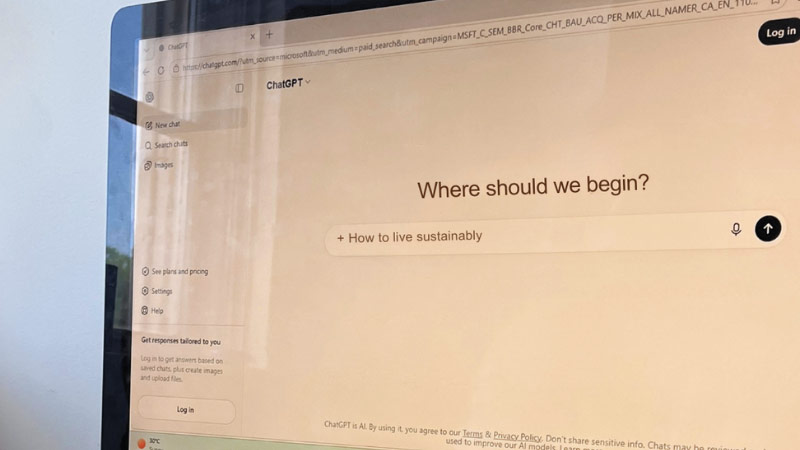
As the use of AI gains popularity amongst professionals, students and the general public, there are growing concerns of the environmental impact such a rapid explosion and its accompanying infrastructure has. While a beneficial tool created to streamline workflows, aid in data processing and overall create efficiency in our day-to-day tasks, the quickly gaining integration of this technology has been met with negative environmental impacts.
As a university institution, we understand the incorporation of new technology into our learning and support continual progress towards implementation of tools within our educational system. However, as an institution known for its sustainability initiatives and growing desire to become a leader of sustainability and environmental stewardship across Canada, we would be remiss to not also mention the effects our use of AI is having on the planet.
While AI tools are being implemented within the environmental sector and advances in this technology can aid in how we approach the mitigation of climate-related events, it is apparent we must proceed with caution and consciousness of our use with this technology. Currently, AI is utilized for analyzing historical climate data, monitoring and detecting current patterns of environmental conditions, and for its ability to predict future outcomes.3
The irony in using a tool that is causing negative environmental impacts to find ways to lessen our overall environmental impacts seems counterintuitive. But maybe there is some value in this, maybe it’s less about the use of AI and more about how we use it. If this technology is going to be integrated into various areas of our lives, it seems wise to learn how to consciously use AI as a tool, rather than a “fix-it-all” system.
To begin, it is essential to recognize the actual cost of utilizing AI before we dive into how to use this technology in a mindful way. The full effect of AI’s impact on the environment is not yet known, though the data that has been derived is concerning.3 With roughly 2.5 billion prompts per day entered into ChatGPT, the energy, water and resources required to fulfill this is high.1 An “average” ChatGPT text query is ~ 200 times more energy-demanding than text classification (such as language detection and spam filtering).1 Generating AI images are 1,450 times more energy-demanding, with video generation the most intensive deriving enough energy to create 200,000 text classifications.1 To put this into a more tangible context, one AI-generated image’s electricity-associated water footprint is roughly 29 mL of water (two tablespoons). For a complex video generated by AI, ~ 4.1 litres of water are used, the equivalency of drinking water for one person for two days.1
While a prompt here and there doesn’t feel like it adds up to much, when we put it in perspective on a global scale, the energy and water consumption is worrisome. In 2025 alone, data centres worldwide consumed an estimated 448 TWh of electricity.1 While that number seems high, it is hard to contextualize. United Nations University has provided us with some tangibility to this number. 448 TWh of electricity is enough to provide the residential electricity needs of the Sub-Saharan African population, of 1.3 billion people, for 2.6 years.1 The water footprint for 2025 from global data centres reached 4.5 trillion litres of water, enough water to provide the annual basic domestic water demands for over 600 million people in Sub-Saharan Africa.1
“If data centers’ electricity use were considered a country, it would have ranked 11th globally by electricity consumption” (Aczel, et al., 2026).
Green AI, a movement developed to transition towards a more intentional development and utilization of AI, emerged to reduce the environmental impact of AI.2 Through changes to how algorithms and architectures are created to adoption of efficient hardware and infrastructure, and transitioning to renewable energy, these initiatives support the United Nations Sustainable Development Goals (SDGs).2
While the general public is not (often) involved in the behind-the-scenes development and design of AI, we do have control in how we use these technologies being offered to us. A rapidly developing technology, AI’s expansion can be found in many areas of our lives, with and without our direct use, so it is important to have the discussion on how we can be more conscious in our use of this technology. Rather than a “one-size-fits-all” tool, we can choose the extent to which we use AI in our daily lives.
Some suggestions on a more sustainable approach to the use of AI:
- Don’t make AI an automatic option. Ask yourself if a non-AI search engine can provide what you are looking for before seeking AI.
- Reduce verbosity: Say less in your prompts.1 Remove the “please” and “thank-you’s”, for example.
- Reduce number of prompts. Try to explain what you are seeking within 1 prompt, in a concise and direct format.
- Opt for lower resolution, fewer frames and fewer steps if needing to generate an AI image or video.1
- Reuse previous results from AI searches, rather than asking again.1
Small skips create ripples. Be in charge of how you choose to use the emerging technologies and how you engage with the tools provided to us. Create and invite space to conversate on topics surrounding technology and sustainability with fellow students, professors and family and friends. How we choose to show up today, matters tomorrow.
Sources
- Aczel M., Chamanara S., Matin M., Farsi A., Marwala T., Madani K. (2026). Environmental Cost of AI's Energy Use: Carbon, Water and Land Footprints, United Nations University Institute for Water, Environment and Health (UNU-INWEH). Richmond Hill, Ontario, Canada.
- Khan, S., Naz, N. S., Mazhar, T., Tariq, M. U., Shahzad, T., Guizani, S., & Hamam, H. (2026). Green AI techniques for reducing energy consumption in AI systems. Array, 29, 100652.
- United Nations Environment Programme. (2024). AI has an environmental problem. Here’s what the world can do about that. UN Environment Programme.