Sustainability Research Champion: Maggie Cassidy
Author: UNB Sustainability
Posted on Apr 20, 2026
Category: Sustainability Research Champions
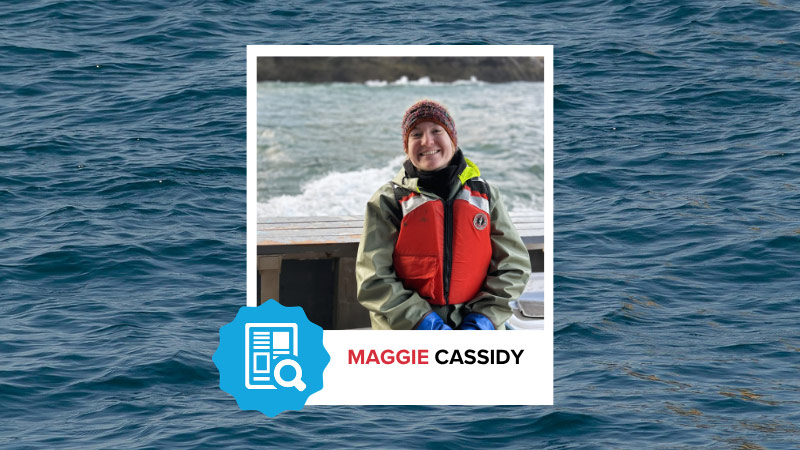
Universities play a crucial role in achieving a sustainable future, especially through their research. Considering this, we are excited to highlight individuals and groups at UNB that have dedicated their time to pursuing sustainability-related research.
Our newest Sustainability Research Champion is Maggie Cassidy
Research project
Hidden biodiversity of seaweeds: Unraveling cryptic species complexes in the red algal family Galaxauraceae (Nemaliales)
Overview of your research project
My project falls under collections-based research, using preserved specimens stored in macroalgal herbaria to investigate species diversity within a family of tropical red algae called the Galaxauraceae, named after a water nymph from Greek mythology.
Identifying red algae from appearance alone is particularly challenging due to both high variation within a single species (i.e., phenotypic plasticity or heteromorphic alternation of generations) or the existence of multiple different species that look almost exactly the same (i.e., morphological crypsis from either convergent evolution or recent speciation events).
In my research, I use macroalgal collections which serve as relatively non-invasive snapshots in time of which species are present, as well as provide spatiotemporal data on when and where they occur, but most importantly act as permanent reference points for species identification.
My research focuses on the seemingly basic but surprisingly difficult question: how can we accurately identify each species? I use a combination of morphological and genetic data to identify and describe new species in the Galaxauraceae, working with samples collected and preserved from the 1970s to present day.
What were once thought to be a handful of widely distributed species are now understood to actually be upwards of 100 distinct species often with much smaller geographic distributions.
How does your work intersect with sustainability?
While my work focuses on a specific group of marine macroalgae, seaweeds are incredibly diverse and have economic, ecological, and cultural importance that deserve to be protected for generations to come.
Probably the most well-known of these organisms are the charismatic kelp forests of the west coast or the problematic Sargassum blooms in the Caribbean, but even locally in New Brunswick, a red alga called dulse (Palmaria palmata) has been a successful industry and food source for generations of Grand Manan fishermen.
Although the Galaxauraceae have not yet made the news as a valuable seaweed resource, their importance, along with other underrepresented marine organisms, cannot be overlooked simply because we do not yet understand them. These and other marine species are particularly susceptible to climate change, with shifting ocean currents, warming waters, and ocean acidification.
Through my research in identifying and describing these macroalgal species, we gain a greater understanding of what needs protecting and, therefore, how we can sustainably manage them with the ultimate goal of a lasting and thriving marine ecosystem despite changing oceans.
What impact do you hope this research will have?
My hope is that this research will serve as the foundational building block for future investigations to ask even more complex questions. Now that we know what these species are and how to tell them apart, we can truly explore.
From an ecological point of view: What does their entire life cycle look like? When and where do they grow? What is their role in their local ecosystem? From a more applied point of view: How can they benefit people? Is there an extract from one species here that could cure cancer? It may seem far-fetched, but recent studies have found compounds from species in this family with various applications, such as preventing the spread of malaria and stopping harmful algal blooms.
However, to answer these questions, we must be able to take the first and most critical step, which is to accurately identify a sample to the species level, and my research provides the tools and information to do that for the Galaxauraceae.
Where can people find information about your work?
You’re welcome to contact me at margaret.cassidy@unb.ca with any questions, comments or if you’d like more information.
Know someone who should be a Sustainability Research Champion? Tell us about them by filling out our nomination form!