SGS Celebrates Graduate Student Winners of Federal Tri-Council Awards - Charlotte Toner
Author: Andrea
Posted on Jan 14, 2026
Category: News and Events , Student Stories
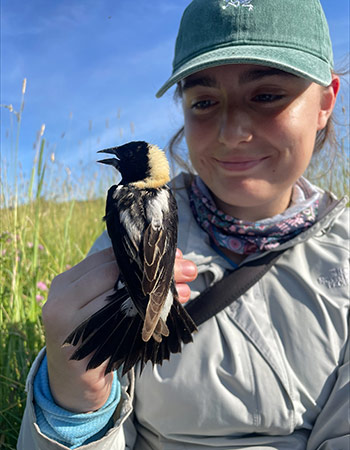
Profile of: Charlotte Toner
Award received: NSERC Canada Graduate Scholarship - Masters
Awarded for the project: Dietary patterns of Bobolink (Dolichonyx oryzivorus) during fall staging
GAU: Forestry & Environmental Management
Supervisor: Dr. Joe Nocera
The Bobolink (Dolichonyx oryzivorus) is the longest migrating North American passerine, travelling approximately 20,000 kilometers between its breeding and wintering grounds annually. The Bobolink has been extensively studied during their breeding season and on their overwintering grounds, but little is known about their pre-migratory staging.
Migration allows species to maximize the exploitation of seasonal resources, yet it also represents a calculated risk, given that mortality rates are highly elevated during this time. Preparation is crucial, especially for long-distance avian migrants, as the breeding and wintering grounds may be thousands of kilometres apart. The accumulation of important nutrients, fat, and protein, known as staging, is an essential part of this process.
To better understand this crucial life-stage, my research seeks to determine the dietary patterns of Bobolink staging for fall migration, specifically the dietary composition and quality. Across eight agricultural sites in the Annapolis Valley of Nova Scotia, we captured 155 Bobolinks and collected biological fecal samples to determine what they eat and generate a full lipid profile from diet, including fatty acid composition. This allows us to better understand the physiological requirements of staging. We expect to see a change in dietary patterns over time as the Bobolinks begin staging for migration and fall departure approaches.
Recognition of these shifts highlights the potential importance of specific prey eaten and foraging habitats-- aquatic versus terrestrial -- for sustaining birds in the weeks preceding migration. Understanding the dietary ecology provides valuable insight for habitat-specific conservation actions aimed at supporting Bobolinks, a declining species, during a key life stage.