
Political scientist receives honourable mention for debut sole-authored book
Author: Jeremy Elder-Jubelin
Posted on Dec 10, 2025
Category: Research , UNB Fredericton
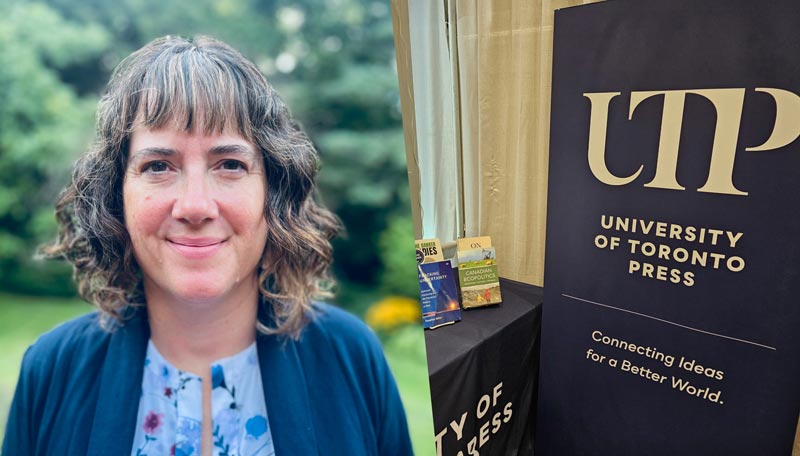
Dr. Heather Millar’s debut sole-authored book recognized for its exploration of the complex narratives that underscore policy and practice around hydraulic fracturing in Canada.
Congratulations to Dr. Heather Millar, an associate professor of political science at UNB, whose book has received an honourable mention for the American Political Science Association’s Seymour Lipset Best Book Award.
“The award is meaningful for me because it comes from the Canadian Politics section of one of the leading scholarly associations in Political Science,” said Millar.
“Historically, this field has focused on Canada in a global perspective, such as comparing Canada with other nations. More recently, scholars have started to focus more on subnational comparison, and I think this recognition of my work demonstrates the value in studying smaller, more peripheral places.
In Fracking Uncertainty: Hydraulic Fracturing and the Provincial Politics of Risk, Millar looks at how the regulation of fracking in different jurisdictions is shaped by narratives of uncertainties and risks. These scientific and political uncertainties, and the controversies surrounding fracking, argues Millar, are not just limitations in our understanding, but are used as political resources to lend support to differing positions on the issue.
“My book examines the puzzle of why different provinces decided to regulate a new technology in the oil and gas industry—hydraulic fracturing, or fracking in different ways,” said Millar. “Why did some provinces think it was a problem and ban the practice, while others were permissive?”
“In the book I argue that both industry desires and environmental concerns are important, but that calculations about economic benefits and environmental harms are mediated through policy makers' ideas about risk, which I call ‘risk narratives.’
“When policy makers think that an industrial practice is scientifically uncertain, or that there is an electoral risk because of public concern, they are more likely to consider environmental harms. When they are convinced that the harms generated by an industrial practice can be contained or managed by government or scientific experts, they are more likely to see the practice as worth the risk to try to get the economic benefit.
“A significant part of understanding the debate around environmental politics, then, is understanding how environmental movements, policy makers and industry try to shift these risk narratives,.” Millar said.
The association commented that “Millar offers a disciplined comparative analysis across provincial cases in Canada to reveal the contingent ways that risk, expertise, regulatory capacity and local mobilization interact in governing energy development.
“…Through theoretically grounded, empirically rich analysis, Fracking Uncertainty makes a compelling contribution to literatures on environmental politics, provincial governance, regulatory politics and science–policy interfaces in Canada.”
Fracking Uncertainty: Hydraulic Fracturing and the Provincial Politics of Risk was published by University of Toronto Press in September 2024. Millar has also co-authored The Canadian Environment in Political Context, Third Edition, with Dr. Andrea Olive. Published by the University of Toronto Press, it was released in May 2025.