
Digging into critical minerals with economic geologist, Dr. David Lentz
Author: Jeremy Elder-Jubelin
Posted on Dec 11, 2025
Category: Research , Faculty of Science , UNB Fredericton
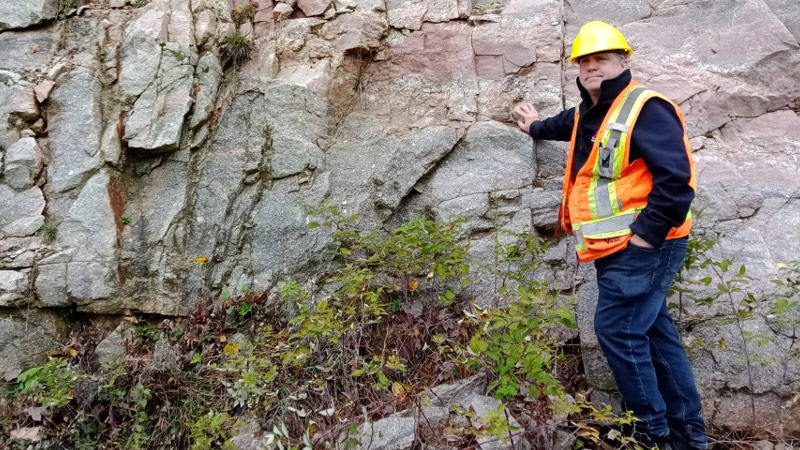
UNB’s research chair in economic geology explains why tungsten from New Brunswick’s Sisson mine matters, and how modern mining can balance economic opportunity with social and environmental responsibility.
The Government of Canada recently announced support for a number of nation-building projects across the country. Among those projects are opportunities to domestically-source critical minerals, including interest in the Sisson mine.
But why does a domestic tungsten source matter?
For answers, we spoke with Dr. David Lentz, professor of earth sciences and research chair in economic geology at UNB, about critical minerals and mining in Canada.
What are ‘critical minerals,’ and why are they important?
Critical minerals are those natural resources that are key to a society's needs, typically in the context of green energy transitions and digital technologies.
The fundamental materials are diverse and wide ranging, especially in today’s high-tech society, where we use most of the elements on the periodic table.
We call them “critical” for two reasons: how important they are for industry, as well as their supply availability, especially domestically.
In Canada, critical minerals are those where we find a lack of natural resources developed and in production to meet our domestic needs and the needs of our closest trading partners.
Critical minerals are those where our economy and industry are vulnerable—where we need more of the minerals that are in high demand around the world, but that we don’t produce enough of domestically to support our current and future needs.
Why are critical minerals becoming such an important topic?
With our current global reality and increasing demand for these resources, we need to plan ahead.
Canada has considerable natural resources, including both mineral and energy resources, but a great quantity of these remains untapped. Although we have some 200 operating mines, almost all in rural Canada, there are opportunities to unearth more, generating supply and wealth.
What makes the Sisson Mine especially important in this context?
Sisson is getting lots of attention as it is an enormous resource. It contains the most tungsten metal in the free world, and it would also produce molybdenum and some copper.
[Ed.: Molybdenum is used in a wide range of processes and products. One of the largest uses globally is in steel alloys, especially for structural and stainless steel. It is particularly useful for intense heat environments such as aircraft parts and industrial motors]
In addition to these resources and the possibility of wealth creation, Sisson is also getting attention because of its comparatively lower environmental risks.
Why is Sisson’s environmental impact lower than other sites?
In the past, mining has had many problems and has caused significant long-term environmental damage. These issues have been addressed to greater and greater degrees with, for example, better engineering solutions for mine waste and wastewater management at sites.
In addition to significant advances in environmental safety, Sisson is also interesting because it has low sulphur and arsenic contents relative to many other tungsten mining sites. These elements are some of the most harmful ones found at mining sites, and lower levels mean an inherently lower risk.
Of course, even though the levels are lower, they are not zero—and so waste containment designs are still needed to limit reaction and release of sulphur and arsenic and other metals with groundwater and surface waters.
What does responsible mining look like to you?
Industrial minerals and metals mines are extremely valuable natural resources—when they are developed responsibly and in consultation with all impacted groups, such that you have earned social license.
(“Social license” is “an informal contract between public or private organizations or the government that begins with public acceptance and must be sustained based on communities’ trust in the legitimacy, credibility, effectiveness, and fairness of a proposed plan or project.” Read more about the concept from Dalhousie University.)
Thankfully, the science and engineering behind the process, from exploration to mining and beyond, has changed dramatically, such that it is almost unrecognizable except at the broadest level.
In my 45 years working in and around the industry, the sector has changed for the better. I’ve seen corporate responsibility and professional conduct improve, aided by broadening government regulatory changes, in response to the changing science and engineering and in ways that address societal concerns.
Bonus: What is ‘economic geology’ as a field, and how did you end up working in it?
“Economic geology” is just the very broad term covering all aspects of mineral resources—that is, the study of metals and other materials that have economic or industrial value. This includes how specific mineral deposit systems are formed; a better understanding of the geological processes at play has potential, though less direct, benefits for exploration and even mining. That is why this type of fundamental research is broadly supported by governments and industry.
I worked for geological surveys with both the federal and provincial governments for 10 years after finishing my PhD. During that time, my research included several different mineral resource types, which were different than those I studied during my graduate degrees.
Though the resources I looked at were varied, they shared a common theme: mineralized magmatic hydrothermal systems—that is, the formation of deposits in and around ancient volcanic systems. These systems involve the movement of minerals from deep inside the earth up to its crust by the flow of magma, and then by the flow of water containing the dissolved minerals.
Since joining UNB over 25 years ago, that has expanded considerably but is directed mostly to various magmatic hydrothermal systems, some of which are of what we call ‘economic grade and size,’ but not always.
My research focus includes tungsten and molybdenum, and primarily in the research science aspect of these types of materials. Along with my colleagues, we’ve been doing research in critical minerals and in gold for more than two and a half decades.