Dispatches from the ice: A UNB scientist's month onboard research icebreaker CCGS Amundsen
Author: Jeremy Elder-Jubelin
Posted on Oct 31, 2025
Category: Research , Faculty of Science , UNB Saint John , UNB Fredericton

Earlier this month, UNB associate professor of earth sciences Dr. Audrey Limoges shared with us her first day aboard CCGS Amundsen, as she embarked on a month-long science expedition with the ship’s crew and scientists from across Canada.
Want to know what happened after that first polar bear encounter?
Here, Limoges shares some highlights from the expedition, including successfully recovering an extraordinary sediment core sample that could reveal the region’s hidden history, a second polar bear encounter, a breathtaking Zodiac trip to the face of Otto Fiord Glacier, and the chance to observe delicate star and flower-shaped patterns etched into newly formed sea ice.
Life aboard CCGS Amundsen
During the research expedition, some forty scientists, including many graduate students, shared the Canadian research icebreaker Amundsen with an equal number of Canadian Coast Guard crew members. Life onboard runs on a 24/7 schedule: at any given time, someone is working, and someone else is sleeping.
For the scientists, the rhythm of each day is set by the ship’s stations.
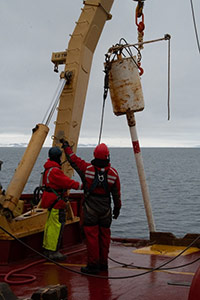
All activities onboard revolve around a choreography of helicopter flights for glaciologists or researchers who need rock, water or ice samples from glaciers; zodiac-based sampling, and instrument deployments directly from the ship. It is a continuous, around-the-clock effort that keeps the science moving as the Amundsen moves from one region to another.
Every research tool deployment is then followed by hours in the onboard laboratories, where samples are processed.
It is remarkably easy to lose track of time aboard a research ship, where day and night blur together under an ever-changing schedule and sleep comes only in naps. The only fixed event in this constantly shifting routine are the mealtimes and daily science meeting held each evening. These are key moments to review preliminary results, plan upcoming operations and adjust to changing conditions. For more senior scientists, it is also an opportunity to discuss collaborative plans and already work on funding applications when time allows.
Speaking of mealtimes, on the Amundsen, Sundays stand apart from every other day of the week. The crew trade their usual light blue shirts for white ones, the scientists spruce up a little, and the galley turns into an even more comfortable zone than usual. From breakfast through dinner, the cooks go all out, and the evening’s three-course feast feels more like dining in a high-end restaurant than being at sea. Sundays are differentiated to help mark the passage of time, but the special meals are also a welcome treat.
Saturday, Sept. 13: A time capsule of Nansen Strait
Our team successfully recovered a 4-metre-long marine sediment core from the floor of Nansen Strait, located inside the Tuvaijuittuq Marine Protected Area, near an ice bridge that formed at the head of the strait opening to the Arctic Ocean. The core’s location was chosen based on sub-bottom profiling of the seafloor, mapped using an acoustic sensor. Even more exciting, the core reached all the way down to the till, which is the dense layer of material that was deposited beneath the Innuitian Ice Sheet that once blanketed this entire region.
This layer was so dense that it sheared the cutter head of the coring device!
This core preserves a crucial slice of the region’s hidden history. Within its layers lies the story of the ice sheet’s retreat and the environmental changes that followed over thousands of years. By studying it, we hope to build the first timeline of these major environmental shifts in this part of the high Arctic.
Sunday, Sept. 14: Visiting the Otto Fiord Glacier
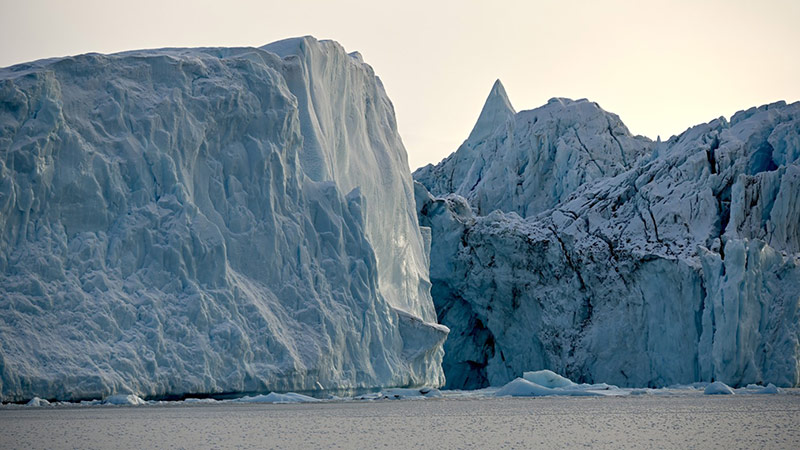
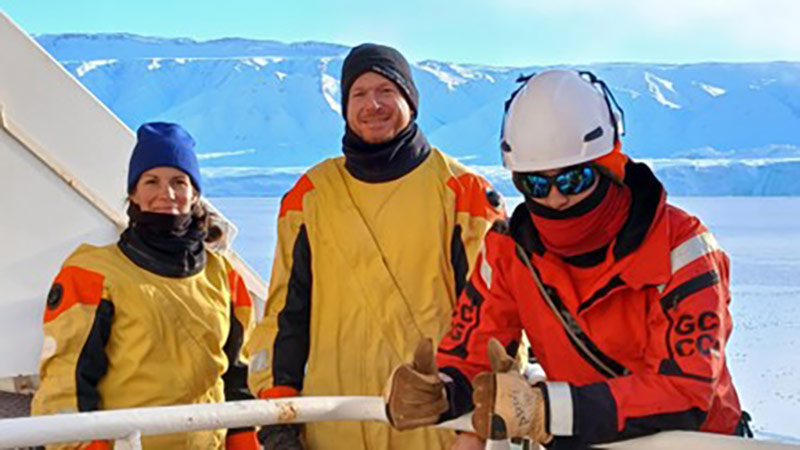
Early in the morning, I, along with my colleague from the Geological Survey of Canada and a Canadian Coast Guard team, donned immersion suits and prepared our gear to set out on a short Zodiac trip. Our destination was the breathtaking front of Otto Fiord’s surge-type, marine-terminating glacier on Ellesmere Island.
Marine-terminating means the glacier extends into the water and surge-type glaciers alternate between long periods of relative calm and sudden bursts of rapid ice movement from an upper reservoir to a lower zone, during which they can expand and surge forward surprisingly quickly.
We were headed to the glacier to collect the first of five surface samples in a line stretching from the glacier front all the way to the mouth of the fjord. As the sun rose, painting the ice and sky in warm colours, the sudden quiet after leaving the big ship behind in our Zodiac, and the privilege of sailing along the glacier front, made the moment fantastic.
We returned to the Amundsen to continue our sampling from the ship, a process that would carry us deep into the early hours of the next morning.
Friday, Sept. 19: Visiting Cañon Fiord
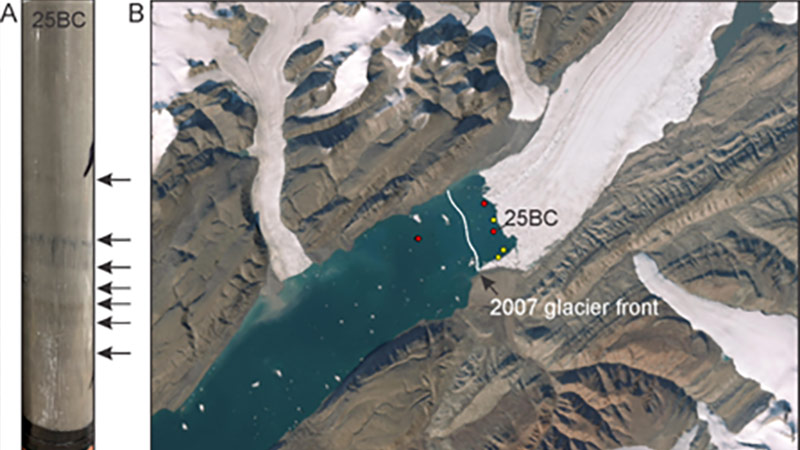
In the beautiful Cañon Fiord, our team managed to collect some of the closest-to-the-ice sediment samples and cores of the expedition. At a few of these sampling sites, the sediment we brought up had been sitting under an ice shelf less than 15 years ago, which is practically yesterday in geological terms.
Sampling so close to the glacier helps us understand how glacial processes influence the ecosystem: these regions are seen as “aquatic critical zones,” where fresh meltwater mixes with salty water and delivers both nutrients and sediment, often supporting high biological activity.
These samples will help us understand how meltwater plumes from different glacial environments—ice shelves, glacier fronts and sandur deltas—shape today’s seafloor. (Sandur deltas, also called outwash plains, are places where large quantities of sediment are deposited by runoff from glaciers.)
From the edge of marine-terminating glaciers, out toward the middle of the fjord, we are tracing how sedimentary processes and the biogenic material—material made by or of life forms—within them change along this significant environmental gradient.
At the very front of the D’Iberville Glacier, the seafloor was so soft and water-rich that our box corer sank like a spoon into pudding. When it surfaced, mud surged out of the top, creating the tell-tale “mushroom” of highly unconsolidated sediment with so little cohesion it behaves almost like a liquid!
This consistency is a sign of extremely high sedimentation rates, and a reminder of how dynamic these glacier-fed fjords really are. There was excitement (and a few groans) on deck: lots of mud everywhere!
After collecting our precious samples, everyone pitched in with shovels and hoses to clean the gear and deck before the next operation.
Saturday, Sept. 20: Pausing to enjoy the beauty of the Cañon Fiord
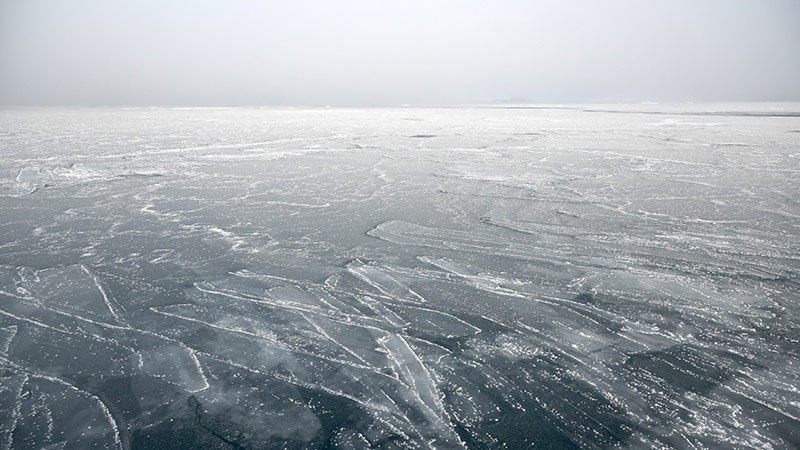
Travelling through the High Arctic in September, as the air becomes colder every day, also means witnessing an ever-changing mosaic of sea ice.
Over the past few days in Cañon Fiord, we have sailed through nilas—the thin, elastic crust of newly formed ice—where the surface was etched into interlocking “finger rafting” patterns. (Finger rafting refers to layers of ice that slide on top of each other in alternating directions, resembling the appearance of interlocking fingers when clasped or holding hands).
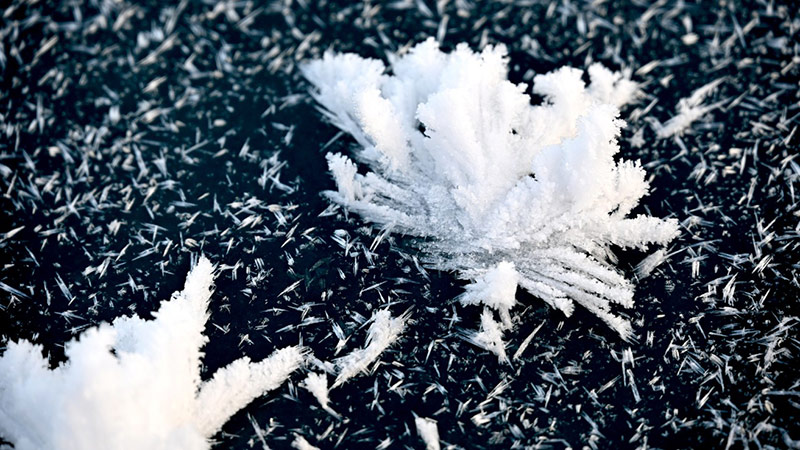
We passed seal breathing holes, vital openings they maintain beneath the ice, and observed striking star-shaped designs dispersed across the frozen surface. But my favourite by far are the frost flowers: delicate, crystalline blossoms that form on young sea ice in calm, sheltered waters like Cañon Fiord, when dry, cold air hovers over (relatively) warmer water.
Monday, Sept. 29: Going with the floe
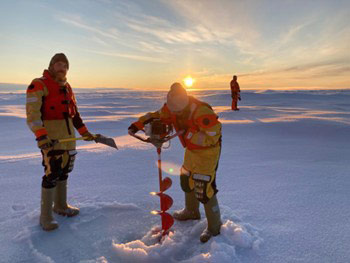
Today, as we headed south via Byam Martin Channel, was a rare day without sediment sampling. Instead, the focus was on an ice floe, which gave me the chance to volunteer with other teams who were collecting their samples. As soon as the sun rose, the team jumped onto the ice to take physical measurements and drill cores.
I joined a team drilling a hole through more than 2.5 meters of ice to profile the water column beneath and investigate its turbulence. It took about two hours to create a hole large enough for the instrument.
Just as we were completing the first profile, lowering the instrument in the water column under the ice, the ship’s horn sounded—a clear signal to follow safety protocols and leave the ice immediately. Crew members had spotted a polar bear approaching our camp from a distance, a stark reminder that constant vigilance, staying together as a group, having multiple bear guards on the ice, and keeping lookout from the bridge are essential in these environments.
After waiting for the bear to move farther away, a few team members returned briefly on the floe to pack up the gear, leaving the ice to its Arctic resident.
Safety always comes ahead of anything else, even science!
Thursday, Oct. 2 – Back to shore, and sharing our science
On our last day before returning south, we had the opportunity to organize thematic activities for the Qarmartalik School in Resolute Bay, Nunavut—the communty’s only K-12 school.
These outreach days are an important part of the science program, as they allow us to connect directly with community members, acknowledge and give back to those who share their land and knowledge with us.
Two groups of curious and enthusiastic children and teenagers moved from table to table, exploring activities and tools related to sea ice, water column properties, food webs, contaminants, science on the Amundsen and marine sediments.
For our demonstration, we had brought three buckets of mud, each with a different colour and texture, to show how different sediments can be. One particularly enthusiastic six-year-old girl began sculpting with the mud. Intrigued by her creativity, we soon realized that she had shaped an entire family of sea urchins!
Late that night, we finally landed back in Quebec City, closing the loop on an unforgettable 28-day expedition.