Where do they go? The missing salmon of the Bay of Fundy
Author: Natalie Dupont
Posted on Sep 25, 2025
Category: Faculty of Forestry and Env Mgt

The Bay of Fundy is a rich and productive marine ecosystem. Known for its massive tides, these same tides mix the water column, bringing up important nutrients and cooling down the upper water layers.
Since time immemorial, Atlantic salmon from rivers in the Inner Bay of Fundy would remain in the Bay to take advantage of this productive habitat. While most salmon would migrate thousands of kilometers out to the Greenland and Labrador seas, Inner Bay of Fundy (iBoF) Atlantic salmon would stay within 500 km of their natal rivers. They would mature within a single year thanks to the rich food sources of the Bay of Fundy and the Gulf of Maine.
Population collapse and conservation
However, in the 1980s the population of iBoF salmon collapsed. In rivers where there used to be 40 000 adult salmon returning to spawn every year, there are now far fewer than 200 across all rivers annually.
In response to this collapse, the iBoF population was designated as endangered under Schedule 1 of Canada’s Species at Risk Act in 2003. To this day, it is still the only population of salmon – Atlantic or Pacific - to be listed under Schedule 1.
Since then, major conservation efforts were undertaken to help their recovery. Commercial salmon fisheries in the Bay of Fundy closed in the 90s, dams in several rivers were removed, and kilometers of river habitat were restored to be favorable for salmon. But, despite these major efforts, iBoF salmon remain on the brink of extinction.
Since 2002, Fisheries and Oceans Canada along with many partner organizations have supplemented the wild population in the rivers with salmon hatched or reared in captivity. This supplementation has sustained the population just enough to prevent their complete extinction. Today, the juvenile iBoF populations in the rivers are sustained through these supplementation programs and survive well thanks to the freshwater restoration efforts in the past few decades.
After spending two to four years in the rivers, the juvenile salmon ‘smoltify’ and migrate out to sea to grow into sexually mature adults. After spending only one winter in the Bay of Fundy and the Gulf of Maine, these salmon are supposed to return to the rivers where they hatched as adults to spawn. But since the population collapse in the 1980s, almost no adult salmon make it back to the rivers of the Inner Bay of Fundy.
This means that practically no wild reproduction occurs, and almost every iBoF salmon either comes from a supplementation program or is the offspring of supplemented salmon. Why aren’t the adult salmon coming back?
Death at sea
Many possible reasons for the high death rate at sea of iBoF salmon have been suggested over the years. Accusations have been made against the fish farming industry, the fishing industry, climate change and predators coming into the Bay.
Due to the challenges of studying a large and open ecosystem like the Bay of Fundy, we still do not know exactly what is causing this high marine mortality. However, with new technological advances, and with renewed interest in this issue, we are now in a good position to address this question.
Acoustic telemetry
Acoustic telemetry is a technology that allows us to track the movements of aquatic organisms using sound. Tracking technologies used on land – such as radio tracking and GPS tracking - do not work in saltwater. As such, marine biologists have turned to sound signals, which even carry better through water than in air!
Scientists tag fish with tags that emit a super-sonic signal. This signal can then be heard by receivers installed in the water. These receivers record the date and time they heard a signal and record the ID number of the tag. By placing multiple receivers throughout an area of research interest, we can reconstruct movement patterns of the tagged fish.
In the spring of 2024, Fisheries and Oceans Canada installed over 250 receivers throughout the Bay of Fundy. These receivers cover the entire Bay, and are also located at sites of particular research interest, such as rivers and salmon farms. There is also a long line of receivers at the mouth of the Bay to detect any fish entering or exiting the area.
Tagging
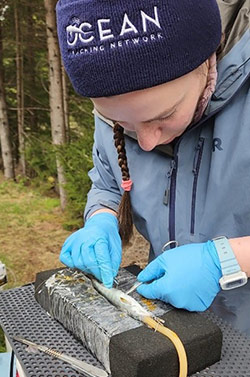
To track the movements of iBoF Atlantic salmon in the Bay of Fundy, smolts are tagged when they are migrating out to sea. This is typically during mid-May. To insert the acoustic tag, the fish are anesthetized and undergo surgery. Once they recover from the operation, the smolts are released back into the river to continue on their way. These tagged smolts can now be detected by the receivers in the Bay of Fundy.
What information do we get?
By November, the batteries in the tags are depleted and the receivers have recorded seven months of tracking data. The receivers can then be recovered, and the tag detections are downloaded off of them.
With this valuable information, the movement path of each fish can be reconstructed. These paths can then be used to answer research questions to better understand the current situation the iBoF salmon are facing in the Bay of Fundy.
All in this together
To date, scientists from Fisheries and Oceans Canada, the University of New Brunswick, Fundy National Park, Fort Folly Habitat Recovery and the Acadia Centre for Estuarine Research have been working together to complete this research.
Salmon smolts from several rivers were tagged in the spring of 2024 and 2025, and the network of receivers in the Bay of Fundy is currently in the water listening for these tagged fish. All that remains is to analyze the data and get answers for these burning questions.
With this information on the marine life stage of iBoF salmon, we can inform more effective marine conservation strategies and hopefully tip the scales in favour of this iconic maritime salmon population.
References
- DFO. 2010. Recovery Strategy for the Atlantic Salmon (Salmo salar), inner Bay of Fundy populations. Species at Risk Act Recovery Strategy Series, Fisheries and Oceans Canada.
- DFO. 2018. Review of the Science Associated with the Inner Bay of Fundy Atlantic Salmon Live Gene Bank and Supplementation Programs. DFO Canadian Science Advisory Secretariat, Science Advisory Report 2018/041.
- DFO. 2019. Action Plan for the Atlantic Salmon (Salmo salar), inner Bay of Fundy population in Canada. Species at Risk Act Action Plan Series, Fisheries and Oceans Canada.
- Lacroix, G. L. 2008. Influence of origin on migration and survival of Atlantic salmon (Salmo salar) in the Bay of Fundy, Canada. Canadian Journal of Fisheries and Aquatic Sciences 65:2063–2079.
- Lacroix, G. L. 2013. Migratory strategies of Atlantic salmon (Salmo salar) postsmolts and implications for marine survival of endangered populations. Canadian Journal of Fisheries and Aquatic Sciences 70:32–48.
- Lacroix, G. L. 2014. Large pelagic predators could jeopardize the recovery of endangered Atlantic salmon. Canadian Journal of Fisheries and Aquatic Sciences 71:343–350.
- Torrissen, O., S. Jones, F. Asche, A. Guttormsen, O. T. Skilbrei, F. Nilsen, T. E. Horsberg, and D. Jackson. 2013. Salmon lice – impact on wild salmonids and salmon aquaculture. Journal of Fish Diseases 36:171–194