McKenna Institute: Human support matters in a digital landscape
Author: Sophie Dallon
Posted on Aug 10, 2026
Category: News
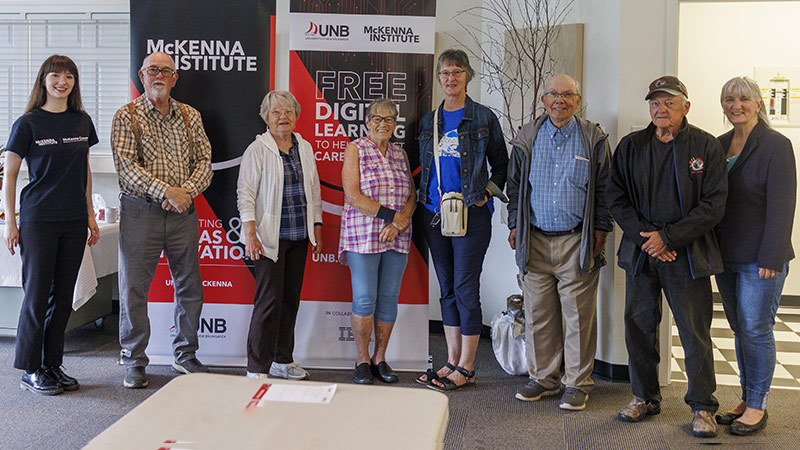
Earlier this summer, a woman walked into the Sussex Regional Library carrying a problem she had been trying to solve for three months.
She had bought a new laptop but could not remember her Google password, leaving her unable to access her email. She had already paid for technical support without success and did not know where else to turn.
An hour later, sitting beside a university student named Matthias Muscroft, she had regained access to her account. More importantly, she practiced the steps until she felt confident she could do them herself.
Her experience captures something we often overlook when we talk about New Brunswick’s digital divide. Access to a device or an internet connection does not necessarily mean someone can confidently use the services that increasingly shape everyday life.
A forgotten password may seem like a minor inconvenience. But when the account provides access to health information, job applications, financial services or communication with family, a small technical problem can quickly become a serious barrier.
This summer, I have watched that reality play out across the province through McKenna Connect. Eleven University of New Brunswick students are working as Student Digital Mentors in rural communities, and have helped over 250 residents and counting through free workshops, community drop-in sessions and direct support to seniors and small businesses.
The questions they receive are rarely about technology alone, rather than about accessing critical information and services.
Someone who cannot log in to MyHealthNB may be unable to see their test results. A job seeker who has never uploaded a resumé may struggle to complete an application. Someone who does not recognize the warning signs of an online scam may avoid digital services altogether because the risk feels greater than the benefit.
As institutions move more services online, we have a responsibility to recognize what that transition asks of people. A service is not truly accessible simply because it exists on a website or in an app. It must also be understandable, navigable and supported by human help when something goes wrong.
What has struck me most this summer is that many people do not need an advanced course or another instruction manual. They need someone patient sitting beside them, answering questions without judgment and allowing them to try again.
That sense of trust matters.
At a digital skills workshop in Three Rivers delivered by Student Digital Mentor Sarah Hale, participants learned how to use email, download apps and recognize potential scams. One attendee explained why she had come: “Everything can be done online now, but I’m always hesitant to try.”
By the end of the session, she was already looking forward to returning.
The same need exists among small businesses and community organizations. In Grand Lake, Student Digital Mentor Ryan Miller has been helping the organizer of a new music festival strengthen its website and social media presence. For a new event operating with limited resources, that support can make it easier to reach potential attendees and build awareness.
These experiences have also changed how our student mentors understand the value of their own skills. They are not solving hypothetical problems in a classroom. They are helping neighbours, local organizations and businesses in the communities they call home.
That exchange is one of the program’s greatest strengths. Residents gain practical skills and confidence, while students see that their education can have an immediate impact close to home.
The work depends on local partners, including libraries, regional service commissions, municipalities and chambers of commerce, that provide trusted spaces and connect mentors with the people who need them. It is supported by the Crabtree Foundation, whose investment has made it possible to place mentors in 11 regions across New Brunswick.
The demand has been revealing. Workshops fill up. Participants book return appointments before they leave. Nearby communities ask when similar support might become available to them.
That demand should make all of us think more carefully about how we define access in a digital society.
Technology can make services faster and more convenient, but only for people who feel able to use it. When systems are designed without enough attention to confidence, clarity and human support, the people who could benefit most may be the ones most likely to be left behind.
The woman in Sussex left the library with a reset password, which also means she left with a little more confidence and a little more independence. If we want technology to strengthen New Brunswick, that is where we have to begin: with people, their needs, and their ability to use it on their own terms.
Sophie Dallon is the program coordinator for McKenna Connect, delivered by the McKenna Institute at the University of New Brunswick. To learn about offerings in your community this Summer, reach out to us at mckennaconnect@unb.ca.