Thomas Hogan, EE Graduate student
Author: UNB Engineering
Posted on Feb 26, 2026
Category: Student Spotlight
When Thomas (BScME'24) walked into the capstone project pitch session in his final year of mechanical engineering in mechatronics at UNB, he already had something specific in mind. He wanted a project that was hands on. Something real. Something that would end with a physical prototype he could actually build.
“My connection to Sys-MoDEL started in my fourth year of mechanical engineering in mechatronics during the Capstone design course,” he explains. “In the lecture where the projects were being pitched, there was one that immediately caught my attention: an innovative quarter car test rig proposed by a research group I hadn’t come across before, Sys-MoDEL. The concept perfectly aligned with what I was hoping to work on, so I knew right away that this was the project for me.”
He was selected for the team, and over the next eight months, his group met weekly with Dr. Kush Bubbar and the rest of the Sys-MoDEL team. What stood out most was not just the technical challenge, but the culture of the group itself.
“They supported us immensely on both the technical and soft skill aspects of the project,” Thomas says. “It was clear that they weren’t just trying to get a finished prototype out of us; they genuinely wanted us to grow as prospective engineers.”
The project was demanding. There were long weeks of problem solving, redesigning, and testing. But it was also deeply rewarding. By the end of the year, their prototype placed second out of fourteen teams in the Mechanical Engineering Design Symposium. More importantly, Thomas had found a research group where he felt challenged and supported.
Conversations about graduate studies began naturally. He had already seen the lab’s passion for meaningful and complex research. So, when Dr. Bubbar introduced the idea of a project in wave energy, the decision came quickly.
“When Dr. Bubbar proposed a project in wave energy, I was immediately sold. And so, it began.”
Thomas officially began his Master of Science in Electrical Engineering in January 2024. His research focuses on the numerical modelling and simulation of wave energy converters. More specifically, he is developing wave-to-wire models that capture the entire energy conversion process, from the incoming wave resource to the electrical power delivered to the grid.
At the centre of his work is an open-source modelling tool in the Modelica language called The Modelica Ocean Engineering Toolbox. The goal is practical. The tool is designed for early-stage design, supporting system optimization, control co-design, and techno-economic feasibility studies before developers move to expensive experimental campaigns.
“Mathematical modelling is the process of creating a mathematical representation of a system, which lets us analyze and gain insights into how a system behaves without, or before, having to actually test it in the real world,” he explains. “In wave energy, physical testing, especially at full scale, is extremely costly and carries significant risk. Developers need to be confident in their designs before ever deploying them in the ocean.”
In other words, modelling gives researchers and developers a safer and more efficient way to test ideas before taking them offshore.
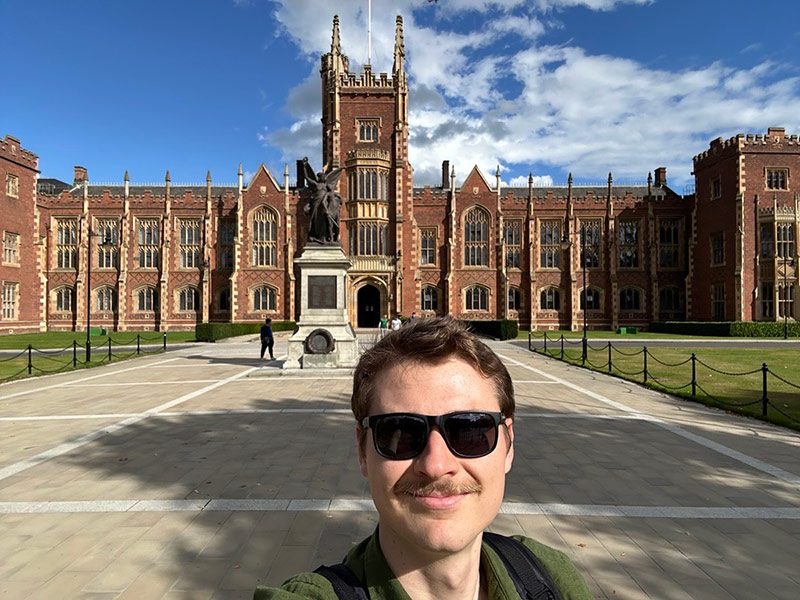
His research has already taken him far beyond Fredericton. In August 2025, Thomas spent five weeks at Queen’s University Belfast through the Fredrik and Catherine Eaton Graduate Fellowship. The collaboration built on connections Dr. Bubbar had previously established with Dr. Carwyn Frost and the Marine Research Group.
“This branched off from my main research at UNB, developing a numerical modelling tool in Modelica for wave energy, by applying similar modelling concepts to tidal stream converters to explore tide-to-wire models,” he says.
His work focused on building a Blade Element Momentum Theory algorithm and integrating it with hydrodynamic modules already established in Modelica. By the end of his visitorship, he was able to run a first round of comparisons against experimental test data.
“I spent five weeks in Belfast in August 2025, and the experience was remarkable on both a professional and personal level,” he says. “On the professional side, I joined a strong and welcoming team of faculty, postdocs, and PhD students.”
Outside the lab, he explored Northern Ireland and immersed himself in the local culture, something he describes as a highlight of the experience.
Thomas also received the MITACS Globalink Research Award, which supported both his time at Queen’s and a second international placement at Maynooth University in Ireland.
At Maynooth, he was hosted by the Centre for Ocean Energy Research under Dr. John Ringwood. His research built directly on his master’s work, focusing on wave-to-wire modelling of converters that use hydraulic transmission systems.
“Being selected to give a comprehensive talk on my research was a highlight; it generated excellent discussions and gave me the chance to engage deeply with researchers across the group,” he says.
He spent four weeks in Maynooth in July 2025. Beyond research, he experienced local sports and events, including a Gaelic football playoff match and the Women’s Irish Open.
In September 2025, Thomas presented two papers at the 16th European Wave and Tidal Energy Conference in Madeira, Portugal.
“Both presentations sparked engaging discussions and opened the door to potential future collaborations,” he says. “It really was an inspiring experience that reinforced my commitment to contributing to marine renewable energy research, especially at the international scale.”
These international experiences have shaped his career goals. “Absolutely, these fellowships have energized me to pursue a career in the field of offshore renewable energy,” he says. “They exposed me to the incredible work being done internationally in the field and inspired me to want to contribute to it myself.”
He credits his time at UNB for preparing him to step confidently into those global spaces.
“My education at UNB has been instrumental in preparing me for this path. It allowed me to engage seamlessly with international researchers and highlighted the high quality of training available here, particularly under the mentorship of Dr. Bubbar.”
From a single capstone pitch session to presenting on an international stage, Thomas’s journey reflects how one project can grow into a global research career.