Budworm days of summer: What climate warming means for one of forestry's smallest foes
Author: Maddie M. Sheppard
Posted on Nov 27, 2025
Category: Faculty of Forestry and Env Mgt
Tiny. Voracious. Cute (depending on who you ask). The eastern spruce budworm is one of Canada’s most prominent foes to the timber industry, and Quebec’s north shore is 19 years into an indeterminate contract.
Taking up residence on some of eastern Canada’s keystone species, such as balsam fir and white spruce, this little critter has inflicted moderate – severe defoliation levels in almost 10 million hectares of Quebec’s forests since 2006. This resolute leaf roller moth can make boreal stands more vulnerable to infestation from other species, forest fire, and with multiple year outbreaks – mortality. With climate change knocking on our door, scientists expect to observe changes in the insect’s life cycle, range, and firing power. But what will this look like?
Understanding outbreaks and budworm life cycles
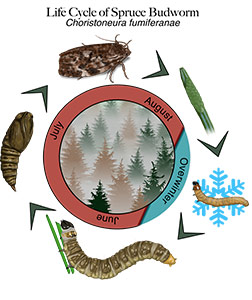
Spruce budworm outbreaks typically occur in 30-40 year cycles and during active outbreaks millions of hectares of boreal forest can be defoliated. In the spring, tiny (smaller than a grain of rice!) 2nd instar larvae emerge from their hibernaculums– a silk sleeping pod that they overwinter in- and begin establishing on their host trees. Throughout the summer, they devour current year foliage until they reach pupation. Adults will emerge from pupae in late summer, mate, then lay their eggs on the host trees. Micro 1st instar larvae will emerge and establish in a cozy place for the winter, triggering the commencement of the cycle all over again.
Canadian forests and their disturbance regimes
Canadian forests are exposed to a variety of forest disturbances like forest fire, wind throw, pathogens, and insect outbreaks. As climate change progresses, researchers have discovered that the frequency and severity of disturbances will increase. This can mean longer fire seasons, brought on by drier conditions. Climate change will also affect spruce budworm outbreaks. This is largely attributed to forecasted changes in the timing of bud burst in its host trees, which in turn will affect budworm appetite or host tree preference, as well as the fitness and survival of the insects themselves. Research surrounding the effect of warming on is ongoing, but much is still unknown about how both the insect and its hosts will respond.
Warming in-situ
To conduct an experiment to understand future warming impacts on spruce budworm dynamics, some degree of warming is required. This can be done in a greenhouse using potted trees- or by planting trees in nature. While planting trees outdoors in the soil seems like a better option to get more realistic results, it can be tricky to control variables of interest like temperature and precipitation.
In our experiment, we used mini greenhouse structures, which PhD candidate and Atlantic Forestry Centre (Natural Resources Canada) biologist, Rob Vaughn, calls “phytotrons”. These phytotrons are fitted with temperature control units and fans to rise the temperature to desired interval above ambient. This way, we were able to test the effects of different temperatures in the field, with seedlings planted directly in the soil, opposed to potted individuals in a commercial greenhouse.
It's getting hot in here…
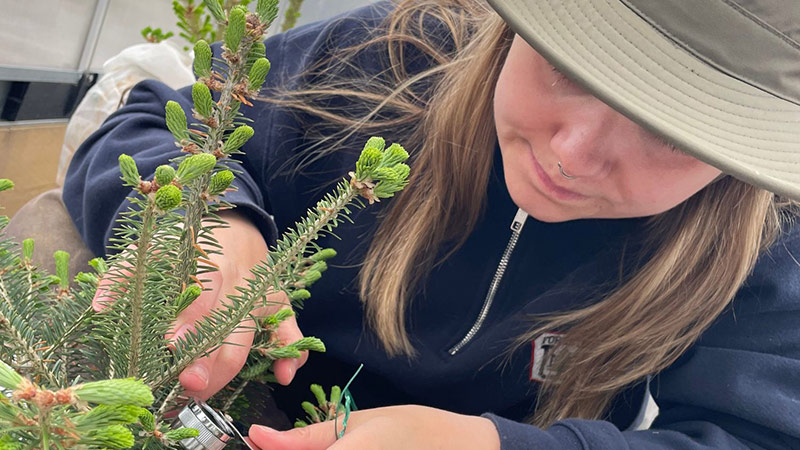
Using our method for warming, throughout the summer we observed the bud development of the trees: from their humble beginnings as a hardened scaly bud, to a fresh and vibrant new shoot. For our little moth friends, we applied eastern spruce budworm larvae on 50% of the trees once the buds started to swell. Over the summer, we tracked their development and collected the individuals that made it to pupation at the end of the experiment. Female pupae, specifically, are a fantastic way to measure insect fitness, as heavier females are indicators of a healthier and stronger population.
By using these measurements, we will be able to determine the effects of warming on various insect and host tree processes, as well as interactions between bug and food. By tracking bud development, we can determine how the warming is affecting the timing and development of the new growth on the trees. While measuring the survival, development, and fitness of the insects helps inform us on how they too are responding to the above optimal temps.
So, what does this mean?
Research has shown that climate warming will affect the synchrony between host and insect life cycles – making some species more practical food sources for spruce budworm – and others… not so much. Research like ours will help other budworm researchers and managers understand how climate warming will impact this precarious relationship between bud and bug.
Furthering our understanding of these interactions is important, as it can inform management strategies for spruce budworm as their range and host tree preference will shift. This is important to multiple provinces and northeastern Maine, as spruce-fir forests account for a big chunk of our forest types.
Managing for spruce budworm is also pertinent to managing for forest fire, as areas that are subjected to multiple years of heavy defoliation can be transformed into timber boxes, as consistent, harsh SBW infestation can result in a landscape of dead standing trees – a.k.a. forest fire fuel!
Don’t sweat it, our top experts are on it!
With climate change on the rise, such research topics revolving around climate impacts insect-host interactions are important aspects in the field of forest entomology and ecology. Dr. Patrick James, at the University of Toronto, is researching how spruce budworm defoliation will impact forest fire regimes using modelling techniques and cool gadgets, such as LiDAR. Dr. Rob Johns and Dr. Deepa Pureswaran, at the Atlantic Forestry Centre (Canadian Forest Service – Natural Resources Canada), co-lead the Healthy Forest Partnership, which does research for the federal governments Early Intervention Strategy (EIS). EIS investigates new ways to manage for spruce budworm, particularly by implementing management in the early, low-density stages of an outbreak.
Climate change will have impacts on all walks of life, from the mightiest redwood to a tiny spruce budworm egg. It is important to conduct research in a way that will help inform our way of managing, and to mitigate and adapt to the effects of climate warming on insect outbreaks in Canadian forests and across the globe.