
IBME at 60: From early wheelchair hacks to AI-driven care
Author: Tim Jaques
Posted on Oct 6, 2025
Category: UNB Fredericton
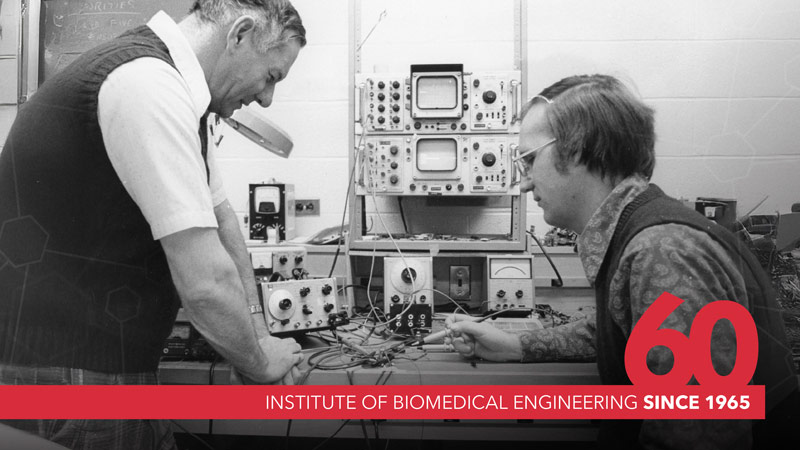
As part of Research Celebration Week, the Institute of Biomedical Engineering will celebrate its 60th anniversary by showcasing research that combines engineering, healthcare and artificial intelligence at an open house on Oct. 7 from 10 a.m. to noon, at RN Scott Hall, 25 Dineen Drive in Fredericton.
When a Fredericton rehabilitation centre turned to UNB for help, nobody imagined the request would spark decades of breakthroughs in prosthetic technology and rehabilitation science.
The Institute of Biomedical Engineering is now marking its 60th anniversary, celebrating its past and ongoing achievements with an open house in honour of the milestone.
“We will show the active research and clinical activities we are doing,” said Dr. Jon Sensinger, the institute’s director and a professor of electrical and computer engineering.
“We will also showcase our key identification technology, which allows us to identify you simply by the way you walk across the floor. We will showcase our upper limb pattern recognition work and some of our clinical technologies, including the multi-jet fusion printer that we use to create custom devices. Visitors will be able to see the CARE facility, which has a zero-gravity apparatus and a CAREN virtual reality platform.”
From makeshift fixes to a mandate
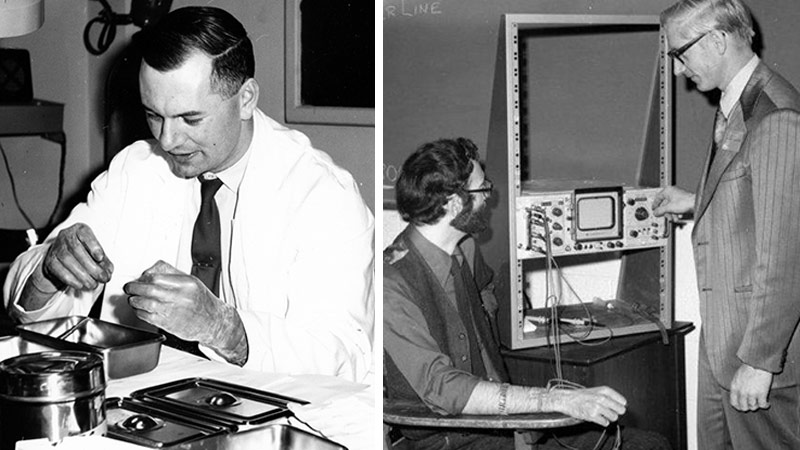
The institute’s history actually began in 1961 when the Forest Hill Rehabilitation Centre sought assistance in providing quadriplegic patients with more agency and autonomy. A UNB electrical engineering professor, the late Dr. Robert N. Scott (BScEng’55), answered the call.
“We moved the control panel from the arm of the chair to a place where it could be operated by the patient’s mouth. It was done in a few hours with no budget,” Scott recalled in an early 1990s interview.
This led to the creation of the Technical Assistance and Research Group for Physical Rehabilitation. In 1965, the UNB Senate formalized the effort as the Bioengineering Institute (later given its current name) with a mission of teaching, research and community service.
From cables to code
In the early days, prosthesis users relied on body-powered devices.
“These devices are still in use today, as they are the most suitable option in certain situations for some individuals. They are lighter and waterproof, and you don’t have to charge them,” Sensinger explained.
Myoelectric systems, which read tiny electrical signals from muscles, improve possibilities.
“Every time you move your muscles, you generate electricity as a byproduct,” Sensinger said. “It is like when a car engine produces force: you can hear an audible rumble as a byproduct of the process.”
Pattern recognition refined control in the 1980s and ‘90s, thanks to researchers at the institute such as Dr. Bernie Hudgins (BScEng’78, MScEng’80, PhD’91) and Dr. Kevin Englehart (BScEng’89, MScEng’92, PhD’99), who focused on above-elbow amputees.
Old roots, new horizons
“Artificial intelligence is very popular at the moment, and a lot of people think it was invented in the last five years or so,” Sensinger said.
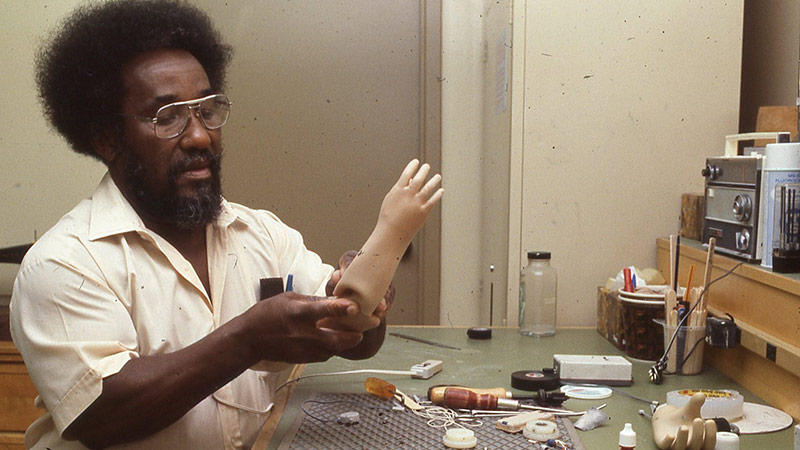
“Its roots go back to the 1920s, and a lot of the work is from the ‘50s and ‘60s. Within the realm of prostheses, it goes back to the ‘60s and some of the work we did, particularly Dr. Philip Parker (BScEng’64, PhD’75), who was the first PhD student of the institute’s founder, Robert Scott.”
Today, the institute’s researchers are exploring adaptive and curiosity-driven AI. These systems can learn on the fly and even seek out new information. While curiosity-driven AI hasn’t yet been applied to prosthetic limbs, the institute is using it in spinal cord rehabilitation and health policy planning.
“We’re pretty excited about the potential for spinal cord rehabilitation,” Sensinger said. “We think this provides a good way to take all the knowledge that we have across the country but still provide individualized plans for people.”
The institute is also in talks to join a European consortium on pandemic response and health resource allocation.
A lab that doubles as a clinic
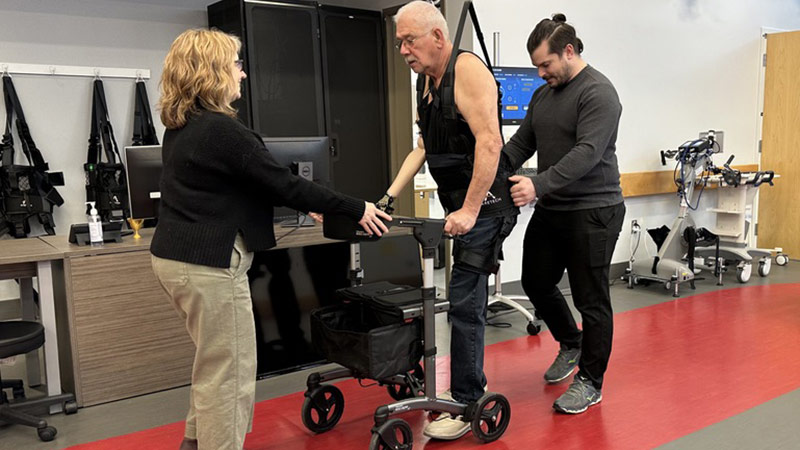
The institute’s Centre for Adaptive Rehabilitation Engineering (also called the Pickett Wing after a donor, or CARE) combines research and care. It features motion capture, a virtual reality platform and an instrumented treadmill that can simulate slips to study balance. The Activities of Daily Living Lab helps assess how rehabilitation helps in daily environments.
Patients from the Stan Cassidy Centre for Rehabilitation visit the CARE labs for clinical care and to participate in research aimed at improving rehabilitation methods and outcomes. Research at CARE also includes the study of fall risk, balance and aging across populations, with dedicated work on slowing the progression of Parkinson’s disease.
The Atlantic Clinic for Upper Limb Prosthetics, founded in 1981, treats patients from infants to seniors, pairs commercial devices with custom interfaces, and is conducting a War Amps-funded study to improve silicone liners for enhanced comfort. A new 3D printer now produces lighter, stronger and more personalized prosthetic parts.
Teaching the world
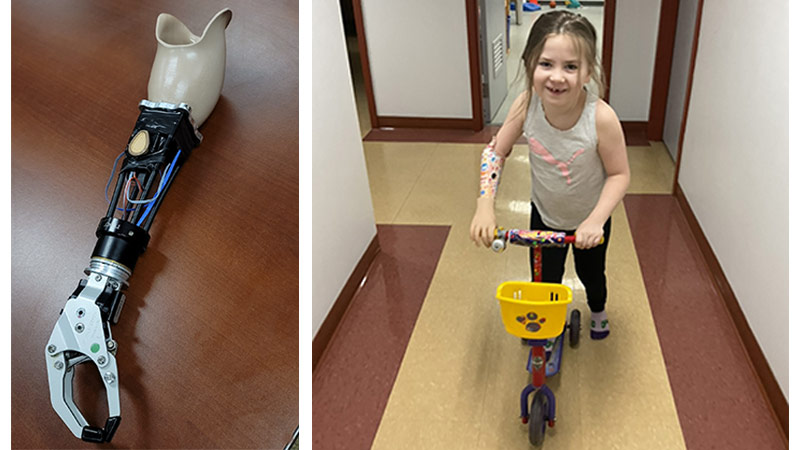
“In the early 1970s, UNB started myoelectric control courses,” said Kristel Desjardins, the institute’s finance and administration manager.
“People would travel here to learn about myoelectric control systems and how to implement these systems into prosthetics. This became the basis of the MEC Symposium. It evolved in the 1990s to become a research symposium, which also has an educational aspect to it.”
This reputation endures.
“If you look at us now, our work is referenced three times more than any other group in the world in terms of myoelectric control,” Sensinger said. “We are the go-to place for that.”
Training remains central
“The first point of our mission statement is actually to train highly qualified personnel,” Sensinger said. “One-third of our graduate students go on to become professors, and that is an amazing statistic that speaks to the impact we make in our people.”
Katie Campbell (BScE’15, MScE’18) is a third-year doctoral candidate in electrical and computer engineering.
Growing up in Fredericton with a love for math and science, she was drawn to biomedical engineering by its purpose-driven nature.
“I was drawn to biomedical engineering because I am driven by helping people, and it gives my work a sense of purpose,” she said.
She researches curiosity-driven AI for spinal cord injury rehabilitation, combining clinical insight with data modelling. Interdisciplinary mentorship has shaped her mixed-methods approach. She values the institute’s mix of clinical and research spaces, while mentorship from diverse experts guided her toward graduate studies and real-world engineering applications.
“The IBME offers an exceptionally supportive environment that truly sets it apart from other research institutes,” she said.
Dee Carr (BScE’24) is in her second year of a master’s degree in electrical engineering with a focus in biomedical engineering. The institute has instilled in her a user-centred mindset, preparing her to apply research to practical solutions.
“I’ve been working on a project with the National Research Council’s Aging in Place Challenge program that began by partnering with older adults and caregivers to understand their mobility needs and concerns,” she said.
“Guided by their input, I am co-designing accessible, technology-enabled mobility assessments, and our team is developing a deployment model to enable confident use in community settings. The work is underway, with the potential to help people get assessed sooner, manage balance more effectively and stay independent longer.”
Carr described the culture at the institute as “collaborative and curious,” with everyone genuinely interested in each other’s work.
Desjardins sees the impact of the institute on students.
“We take great pride in our graduate students and the dedication they bring to their studies. Many keep in touch with us after graduation, and it is rewarding to see them thrive in both their careers and personal lives.”
What’s next?
The institute is working to make prostheses easier to use, more reliable and less dependent on training. Parkinson’s disease research is another priority, aligning with the institute’s tools and expertise.
As for the future of prosthetic control, Sensinger envisions systems that learn through experimentation.
“The curiosity-driven AI might actually say, ‘I’m going to do something a little bit different from what I think you want me to do, and I’m going to see how you react to it, and I’m going to learn about you through reacting to it. Ultimately, that’s going to help me help you better.’”
Historical references
- Foord, D. J. A. & Kyberd, P. (2015). From Design to Research: Upper Limb Prosthetic Research and Development in Canada, 1960-2000. Scientia Canadensis, 38(1), 50–71.
- Montague, Susan. A Pictorial History of the University of New Brunswick. Fredericton: University of New Brunswick, 1992, 168-169.